Earthly Branches (Dìzhī) in BaZi: A Structured Guide to the Twelve Branches
Learn how Earthly Branches (Dìzhī) shape your BaZi chart through hidden stems, combinations, and clashes. A calm, structured guide to the twelve terrestrial signs.
Earthly Branches (Dìzhī 地支) form half of the BaZi reading framework, alongside Heavenly Stems. In Chinese cultural reference, the twelve Branches represent the terrestrial qi, seasonal cycles, and the deep-rooted energies that express themselves in a person’s life patterns. This wiki explains what the Earthly Branches are, their hidden stems, how they interact through combinations and clashes, and how you can begin to read them in a BaZi chart.
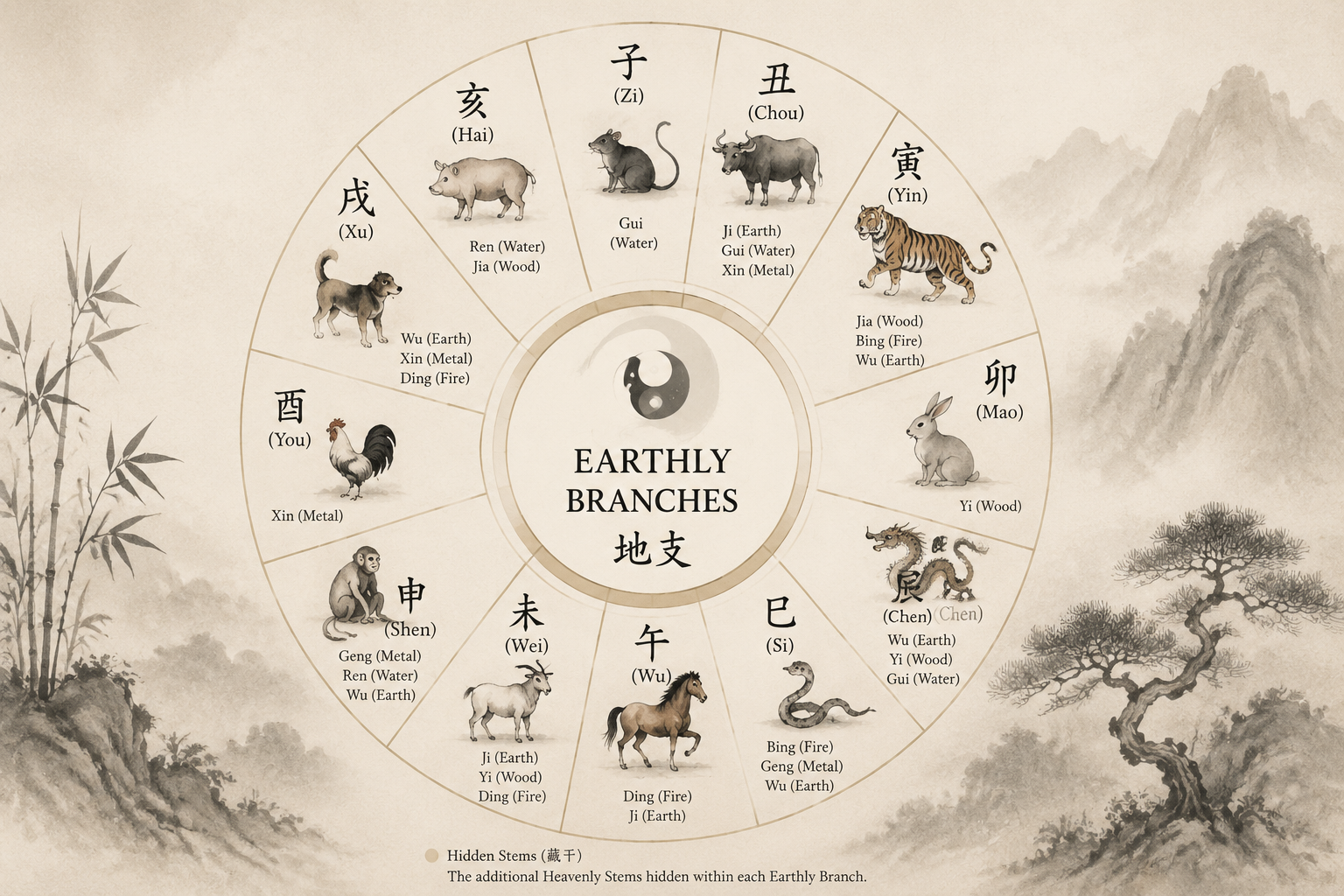
What Are the Earthly Branches?
The Earthly Branches are a set of twelve terrestrial signs: 子 (Zi), 丑 (Chou), 寅 (Yin), 卯 (Mao), 辰 (Chen), 巳 (Si), 午 (Wu), 未 (Wei), 申 (Shen), 酉 (You), 戌 (Xu), and 亥 (Hai). In a BaZi chart, each of the four pillars (year, month, day, hour) contains both a Heavenly Stem (top) and an Earthly Branch (bottom). While the Stem represents the celestial or more overt quality, the Branch acts as the root—it holds the substance and, through its hidden Heavenly Stems, determines the Ten Gods that shape a reading.
The Branches correspond to the Chinese zodiac animals, lunar months, and the twelve double-hours of the day. In interpretation, however, their primary importance lies not in personality-caricatures but in the elemental relationships they form with the Day Master and with one another.
The Twelve Branches and Their Hidden Stems
Each Earthly Branch contains one, two, or three hidden Heavenly Stems. The first (main qi) generally reflects the dominant energy, while the others represent incidental or latent potentials. When evaluating a chart, we look at how these stems interact with the Day Master’s element to define the Ten Gods.
- Zi 子 (Rat) – 癸 (Gui) Yin Water
- Chou 丑 (Ox) – 己 (Ji) Yin Earth (main), 癸 (Gui) Yin Water, 辛 (Xin) Yin Metal
- Yin 寅 (Tiger) – 甲 (Jia) Yang Wood (main), 丙 (Bing) Yang Fire, 戊 (Wu) Yang Earth
- Mao 卯 (Rabbit) – 乙 (Yi) Yin Wood
- Chen 辰 (Dragon) – 戊 (Wu) Yang Earth (main), 乙 (Yi) Yin Wood, 癸 (Gui) Yin Water
- Si 巳 (Snake) – 丙 (Bing) Yang Fire (main), 庚 (Geng) Yang Metal, 戊 (Wu) Yang Earth
- Wu 午 (Horse) – 丁 (Ding) Yin Fire (main), 己 (Ji) Yin Earth
- Wei 未 (Goat) – 己 (Ji) Yin Earth (main), 丁 (Ding) Yin Fire, 乙 (Yi) Yin Wood
- Shen 申 (Monkey) – 庚 (Geng) Yang Metal (main), 壬 (Ren) Yang Water, 戊 (Wu) Yang Earth
- You 酉 (Rooster) – 辛 (Xin) Yin Metal
- Xu 戌 (Dog) – 戊 (Wu) Yang Earth (main), 辛 (Xin) Yin Metal, 丁 (Ding) Yin Fire
- Hai 亥 (Pig) – 壬 (Ren) Yang Water (main), 甲 (Jia) Yang Wood
Because these hidden stems give rise to the Ten Gods, the Branch in which a Stem appears often tells you whether that God’s theme—career, resource, output—has deep root or is merely a passing influence.
Reading the Branches in a BaZi Chart
When you open a chart using the free BaZi tool, the Branches sit beneath each pillar. A structured reading path might look like this:
- Identify the Day Master’s element. The Day Stem tells you whether the person is a Wood, Fire, Earth, Metal, or Water Day Master.
- Extract the main stem from each Branch. Look at the dominant hidden Stem and classify its Ten God relationship to the Day Master.
- Check for combinations and clashes. Branches can form special temporal alignments (Liu He, San He, San Hui) or direct oppositions (Liu Chong) that alter how elemental energies manifest.
- Weigh the overall balance. See whether the Branches strengthen or weaken the Day Master, and which of the Five Elements are over- or under-represented.
- **Overlay the current Luck Pillar.** When an arriving Luck Pillar Branch interacts with natal Branches, it can temporarily emphasise certain themes.
This step-by-step approach keeps the reading transparent—it is a method of pattern recognition, not a promise about fate.
Combinations and Clashes Between Branches
The interaction framework for Earthly Branches includes harmonious combinations and challenging clashes, each interpreted through the lens of the whole chart.
Six Combinations (Liu He)
Pairs that merge into a new element when conditions allow:
- Zi + Chou → Earth
- Yin + Hai → Wood
- Mao + Xu → Fire
- Chen + You → Metal
- Si + Shen → Water
- Wu + Wei → Earth
These combinations often point to cooperative themes in relationships or situations, but they do not guarantee an event; they simply show that two Branches are capable of mutual transformation.
Three Harmony (San He) & Seasonal Meeting (San Hui)
- San He: Shen‑Zi‑Chen (Water), Yin‑Wu‑Xu (Fire), Si‑You‑Chou (Metal), Hai‑Mao‑Wei (Wood)
- San Hui: Yin‑Mao‑Chen (Wood), Si‑Wu‑Wei (Fire), Shen‑You‑Xu (Metal), Hai‑Zi‑Chou (Water)
When three Branches of the same seasonal or elemental flow appear, they can form a strong current—think of them as a concentration of a particular quality rather than a decisive verdict.
Six Clashes (Liu Chong)
Direct Branch oppositions that often suggest tension or movement:
- Zi ↔ Wu, Chou ↔ Wei, Yin ↔ Shen, Mao ↔ You, Chen ↔ Xu, Si ↔ Hai
A clash does not inherently mean misfortune; it may indicate a push for change, a healthy disruption, or the need to address a long‑standing imbalance. The outcome depends on the roles the clashing Branches play in the chart and the elemental weights present.
Practical Interpretation Notes
Earthly Branches are a language of elemental relationships, not a deterministic script. A few reminders for a balanced reading:
- Context is everything. A Branch combination is only as meaningful as the surrounding Stems, the Day Master’s strength, and the relevant Ten Gods.
- Hidden stems matter in layers. Look at the main stem first for core themes, then consider secondary stems for subtle nuances.
- Branches change with time. Luck Pillars introduce new Branches, and annual cycles (year Pillar shifts) can temporarily activate dormant patterns.
- Use the Branches as a self‑exploration tool, not as a prediction. They offer a map, not a command.
If you would like to see which Earthly Branches appear in your own BaZi chart, try our free BaZi calculator.
FAQ
What is the difference between Earthly Branches and Heavenly Stems?
Heavenly Stems represent the outward, celestial qualities—pure element types and more overt personality expressions. Earthly Branches are the terrestrial, rooted counterpart. They contain hidden Stems and describe the environmental and subconscious undercurrents; they also govern long‑term cycles through the Luck Pillars.
How do Earthly Branches influence the Day Master?
The Day Master’s element is a Heavenly Stem, but the Branches influence it through the Ten Gods that the hidden Stems produce. For example, if the Day Master is Jia Wood and a Branch contains Xin Metal, that Metal becomes the Direct Officer—often linked to career or discipline. The strength and position of that Branch indicate how prominent that theme may be.
Can Earthly Branches predict specific events?
No. In the Free BaZi approach, the Branches describe patterns and tendencies—like a weather report, not a scripted play. They can suggest periods when certain qualities (e.g., creativity, introspection, social challenge) may be more active, but they never prescribe a fixed outcome. Personal choices, environment, and free will always shape the actual experience.
What is a Branch combination or clash?
A combination occurs when two or three Branches merge to form a new element, tempering each other’s effects. A clash is a direct opposition that creates tension and movement. Both are traditional ways of reading how time‑periods and relationships might blend or compete. They are best understood as potential dynamics that the interpreter tests against the full chart.