Annual Pillar (Liúnián) and Your BaZi – How the Current Year Interacts
Learn how the Liúnián (Annual Pillar) interacts with your BaZi natal chart. A clear, step-by-step guide to reading the current year's influence using stems, branches, and Ten Gods.
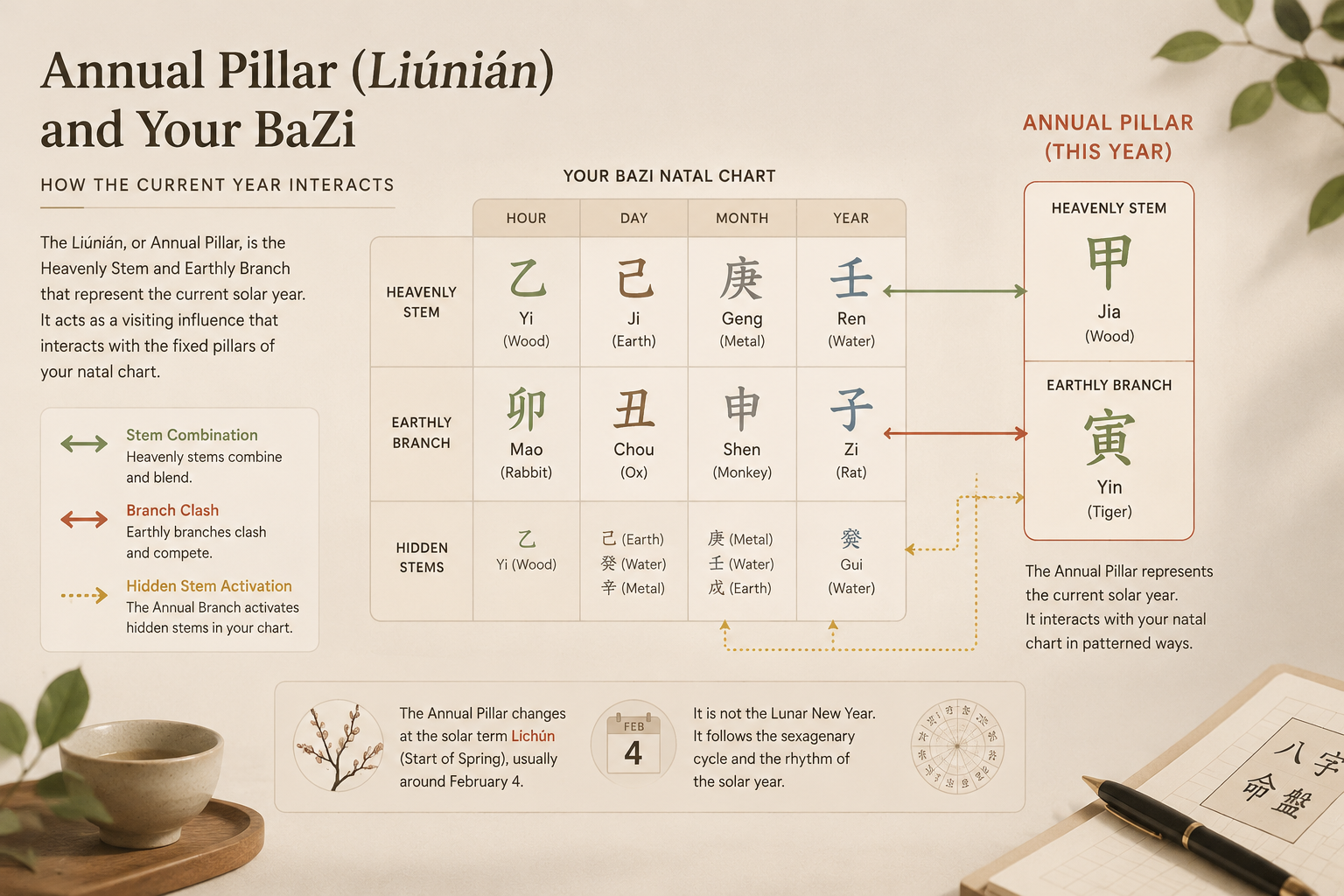
The Liúnián, or Annual Pillar, is the Heavenly Stem and Earthly Branch that represent the current solar year. In BaZi reading, it acts as a visiting influence that interacts with the fixed pillars of your natal chart. Every year brings a different pair—such as a Wood Tiger year or a Metal Rat year—and those symbols meet your personal Stem‑Branch combinations in patterned ways. This guide explains what the Liúnián is, how it interacts with your chart, and a step‑by‑step method for reading it without overpromising.
What Is the Annual Pillar?
The Annual Pillar changes at the solar term Lìchūn (Start of Spring), usually around February 4. It is not the lunar New Year; it follows the sexagenary cycle of 60 Stem‑Branch pairs. To find the current Liúnián, you can use a reliable calendar source such as the Huangli calendar on this site, which gives the exact Stem and Branch for any year.
The pillar consists of a Heavenly Stem (one of the ten characters \(甲,乙,丙,丁,戊,己,庚,辛,壬,癸\)) and an Earthly Branch (one of the twelve animal signs \(子,丑,寅,卯,辰,巳,午,未,申,酉,戌,亥\)). For example, 2025 is the \(乙巳\) year: Yin Wood Stem sitting on a Snake (Fire) Branch. This Stem‑Branch pair carries its own Five Elements qualities and hidden contents that will touch every chart differently.
How the Annual Pillar Interacts with Your Natal Chart
The Liúnián does not replace your chart; it overlays it. Interactions occur between the annual Stem and each natal Stem, and between the annual Branch and each natal Branch. Those interactions are interpreted through the lens of your Day Master (the Heavenly Stem of your Day Pillar), which defines the Ten Gods for all other Stems.
For instance, if you were born on a \(甲午\) (Jia Wu) day and the year is \(庚子\) (Geng Zi), the annual Stem \(庚\) relates to your Day Master \(甲\) as the Seven Killings star—often associated with challenge, pressure, or authority. The annual Branch \(子\) (Rat) clashes with your Day Branch \(午\) (Horse), creating a dynamic push‑pull effect. These signals are not verdicts; they suggest themes that may surface, shaped by your Luck Pillars and personal context.
The annual Stem interacts with all four natal Stems. A Resource star may indicate learning or support, an Output star expression or creativity. The Branch interacts with the four Branches in more complex ways: combinations, clashes, harms, and destruction relationships. A clash can point to change, a combination to merging of energies. The hidden Stems inside the annual Branch can activate hidden elements in your chart, adding subtle nuance.
To make reading practical, always start from the Day Master as the reference point and weigh the strength of the elements in your chart. A favorable element appearing in the Liúnián is generally encouraging; an unfavorable one may highlight a period requiring more effort. However, no BaZi reading removes your own agency.
Reading the Annual Pillar Step by Step
A methodical approach keeps the reading grounded in the chart’s structure, not in vague feelings. Follow these steps with your own Free BaZi chart tool open.
- Identify the current Liúnián Stem and Branch. Use the Huangli calendar or the annual indicator on the chart page. Write down the Stem‑Branch pair.
- Confirm your Day Master and its strength. Is it strong or weak in the chart? Which elements help support or balance it? This sets the lens for interpreting any incoming Stem.
- Assign Ten Gods to the annual Stem. Look up what Ten God the annual Stem represents relative to your Day Master. For example, if your Day Master is \(丙\) (Yang Fire) and the year is \(庚子\), \(庚\) is Indirect Wealth. The Ten God flavor colors the year’s overall pressure or opportunity.
- Check Branch interactions for each pillar. Examine the annual Branch against your Year, Month, Day, and Hour Branches. Note clashes, combinations, and hidden‑stem overlaps. A clash with the Year Branch might involve external environment; a clash with the Day Branch may touch personal life or partnerships.
- **Layer the Luck Pillar context.** The active Luck Pillar defines a longer arc. The annual pillar acts within that arc, either reinforcing or temporarily disrupting the Theme. If the Luck Pillar brings a Wood Tiger period and the year is a Wood Rabbit, the Wood energy is reinforced; if the year is a Metal Monkey, a clash with the pillar’s Tiger introduces friction.
- Form a balanced reading. Avoid alarm. Instead, phrase what might receive attention: “This year resources may be available, but there is some rivalry.” The Liúnián is a reference, not a directive.
Limitations and Practical Use
BaZi is a cultural reference system, not a predictive tool. The Liúnián shows possible thematic currents; it does not guarantee specific events. Many factors—location, profession, health, family, choices—matter more than the Stem‑Branch of a single year. Use the annual reading as one lens among many: a chance to reflect on timing and to prepare mentally, never to make fear‑based decisions.
The reading method above is built on transparency. The interactions are described through the Five Elements and Ten Gods, which are well‑documented frameworks. If you encounter an unclear pattern, return to the basics: element strength, Day Master, and Luck Pillar.
FAQ
How do I find the current Annual Pillar?
You can check the Huangli calendar on this site, which shows the Liúnián Stem and Branch for any year. Alternatively, when you view your chart with the Free BaZi chart tool, the current year’s pillar is often displayed alongside your four pillars.
Can the Annual Pillar override my Luck Pillar?
No. The Luck Pillar sets the backdrop for a 10‑year period; the Liúnián is a yearly layer. The two interact, but the Luck Pillar’s direction usually carries more weight. A strong annual clash might create a temporary spike within the longer trend, but it does not erase the pillar’s influence.
What if the Annual Pillar clashes with my Day Master or year pillar?
Clashes are not inherently harmful. A branch clash often brings movement, decision points, or a change in focus. The quality of the experience depends on the Ten Gods and elements involved. If both branches have supportive elements for your Day Master, the clash may just stir up energy in a useful way.
Is the Annual Pillar the same for everyone?
The Liúnián Stem‑Branch pair is the same for everyone in a given year—2025 is \(乙巳\) for all. However, how it interacts with each person’s own chart is unique. Your natal Stem‑Branch structure determines which Ten Gods appear and which branches are activated.