Four Pillars — Year, Month, Day & Hour Pillars in BaZi
Understand the Four Pillars in BaZi: Year, Month, Day, and Hour pillars explained. Learn how each pillar shapes a BaZi chart reading.
A BaZi chart is built from your birth time, structured as four columns—the Year, Month, Day, and Hour pillars. Each pillar combines a Heavenly Stem and an Earthly Branch, creating a snapshot of temporal influences that form the basis for a structured reading. Rather than a fixed destiny, the Four Pillars offer a framework for understanding patterns, tendencies, and the dynamic interplay of the Five Elements in your life.
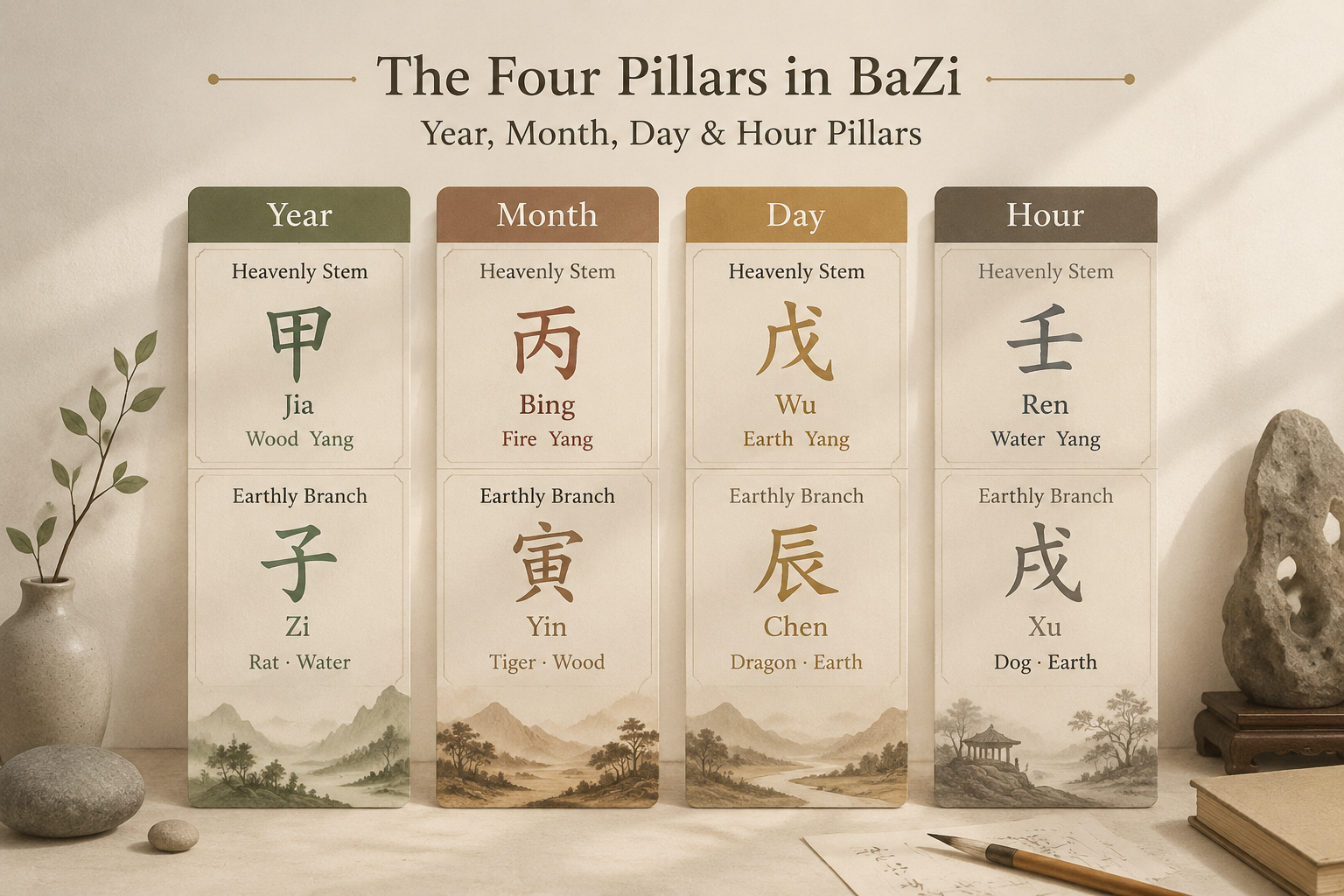
Understanding the Four Pillars in BaZi
The term "BaZi" itself means "Eight Characters"—the two characters (Stem and Branch) for each of the four pillars. The system is rooted in the sexagenary cycle: 10 Heavenly Stems and 12 Earthly Branches combine to form 60 unique pillar pairs. Every year, month, day, and two-hour period carries one of these pairs. Your natal chart freezes the specific four pairs active at the moment of your birth.
These pillars are not random; they reflect observable cycles of nature and time. The Year pillar relates to broader generational shifts, the Month pillar to the season of your birth, the Day pillar to your core self, and the Hour pillar to your inner world and later life. Together they create a layered map that practitioners read by examining the relationships among the Stems and Branches, the strength of the Day Master, and the Ten Gods that emerge.
This guide walks you through each pillar, what it represents, and how to approach reading them in a calm, methodical way.
The Year Pillar: Generational and External Influences
The Year pillar is often associated with the environment you were born into—your ancestors, early childhood, and the larger societal backdrop. It can point to the values and trends that shaped your formative years. For example, if your Year pillar is Yang Wood Rat (甲子), the combination of outward growth (Wood) and initial Yang Water (the Rat’s hidden stem) might suggest a social environment focused on new beginnings or collective renewal. However, this is only one thread; the full meaning emerges only when examined alongside the other pillars.
In readings, the Year pillar is rarely taken alone. It interacts with the Day and Month pillars to show how external influences color your core nature. It also plays a role when looking at family dynamics or the first luck pillar, which covers childhood. Because the Year stem and branch can form combinations or clashes with the Day Master’s stem, they may indicate either harmony or tension between personal goals and family expectations.
Understanding your Year pillar can help you recognize the broader patterns you were born into, but remember that it reflects context, not constraint.
The Month Pillar: Seasonal Energy and Life Phase
The Month pillar governs the season of your birth and thereby the temperature and elemental strength in your chart. In BaZi, the season is a critical factor for determining the strength of your Day Master. A Wood Day Master born in a Tiger month (early Spring) will be inherently stronger than one born in an autumn Metal month, because Spring supports Wood’s growth. This pillar often represents your parents, your work life, and your productive years.
The earthly branch of the Month pillar is particularly important: it holds the dominant Qi of the season. For instance, a Water Rabbit month (癸卯) brings the gentleness of Yin Water and the burgeoning Wood of early Spring. If your Day Master is Fire, the Water may act as a controlling element, while the Wood can serve as a resource. A chart reader will start here to gauge how the elements flow into the Day Master.
Because the Month pillar is so closely tied to the season, it also influences how you approach your career and public life. It sets the energetic stage on which your Day Master performs.
The Day Pillar: The Self and Core Personality
The Day pillar is the heart of your BaZi chart. Its Heavenly Stem is your Day Master—the character that represents you, your fundamental nature, and how you engage with the world. The Earthly Branch of this pillar is often called the “spouse palace” and relates to your partner or closest relationships.
Your Day Master’s element (Wood, Fire, Earth, Metal, or Water) and polarity (Yang or Yin) form a starting point for describing personality tendencies. A Yang Fire Day Master, for example, might outwardly express warmth, enthusiasm, and a direct manner. But no stem acts in isolation: the strength and condition of the Day Master depend on the seasonal support from the Month pillar, the resource stars from other stems, and the influences of the Ten Gods arrayed around it.
When you read your Day pillar, pay attention to both the Stem and Branch. Sometimes the Branch contains hidden stems that color your inner self or relationship patterns. This pillar doesn’t dictate who you are; it offers a lens to reflect on your characteristic responses and innate preferences.
The Hour Pillar: Inner World and Later Life
The Hour pillar represents the part of life that often stays private—your thoughts, dreams, and the legacy you build. It’s also linked to your children and your later years. While the Day pillar shows how you present yourself, the Hour pillar reveals how you process experiences internally.
For instance, if your Hour branch is the Rooster (酉), a pure Yin Metal, you may have an inner world that values precision, order, and subtle refinement. If your Day Master is Water, this Metal can serve as a resource that feeds your thinking. Clashes between the Hour branch and other branches might indicate an inner restlessness that others don’t see.
Because the Hour pillar adds depth, a full reading always integrates it. It often explains why two people with similar Day pillars can behave so differently—their private Hour influences steer motivation and fulfillment in unique directions.
Reading the Pillars Together: A Structured Approach
A BaZi chart is not four isolated columns; it’s a dynamic system of interactions. Stems combine and clash with each other, branches do the same, and hidden stems add subtle layers. In a structured reading, you typically begin by identifying the Day Master, then assess its strength based on the Month (season), and then examine the Ten Gods formed by the other stems relative to the Day Master. Finally, you look at the interplay among all branches and how the Luck Pillars overlay the natal chart over time.
At Free BaZi, our chart tool lets you generate your Four Pillars instantly from your birth date and time. The clean, interactive layout highlights your Day Master, element distribution, and pillar relationships without overwhelming you. Use it as a reference to explore each pillar at your own pace.
No single pillar holds all the answers. The real value comes from seeing how the Year’s external background, the Month’s seasonal energy, the Day’s core self, and the Hour’s inner world weave together. This method is a cultural framework for self-reflection—a way to notice patterns, ask questions, and cultivate awareness.
FAQ
What is the most important pillar in a BaZi chart?
The Day pillar is considered central because it defines the Day Master, which represents you. However, every pillar contributes essential information. The Month pillar sets the seasonal strength, the Year pillar frames your environment, and the Hour pillar reveals your inner inclinations. A complete reading considers all four together.
Can the Four Pillars predict my future?
No. BaZi is a cultural reference and structured reading method, not a system of guaranteed prediction. It helps you recognize tendencies, cycles, and elemental balances, but it does not determine specific events or outcomes. Decisions and actions remain yours.
How do I find my Four Pillars?
You can use the Free BaZi chart tool on our website. Enter your birth date and exact time (if known), and the tool will generate your Year, Month, Day, and Hour pillars with a clear interpretation starting point.
Why are there 60 combinations for each pillar?
Because the sexagenary cycle pairs 10 Heavenly Stems with 12 Earthly Branches. The least common multiple of 10 and 12 is 60, so the cycle repeats every 60 years. That’s why the same Year pillar reappears after six decades, but with different Month, Day, and Hour pillars, no chart is exactly repeated in a lifetime.