Luck Pillars (Dàyùn) — The 10-Year Cycles in BaZi
Understand what Luck Pillars (Dàyùn) are, how they are calculated, and how to read a 10-year cycle using the BaZi chart method. A clear, method-driven reference for BaZi students.
A BaZi chart is often described as a snapshot of the heavens at the moment of birth. It reveals a person’s constitution, natural tendencies, and the interplay of the Five Elements and Ten Gods. But while the natal chart is fixed, its expression unfolds over time. The mechanism that maps that unfolding is the system of Luck Pillars—known in Chinese as Dàyùn (大運). These are 10‑year cycles that begin somewhere in childhood and serve as the primary dynamic layer in a BaZi reading.
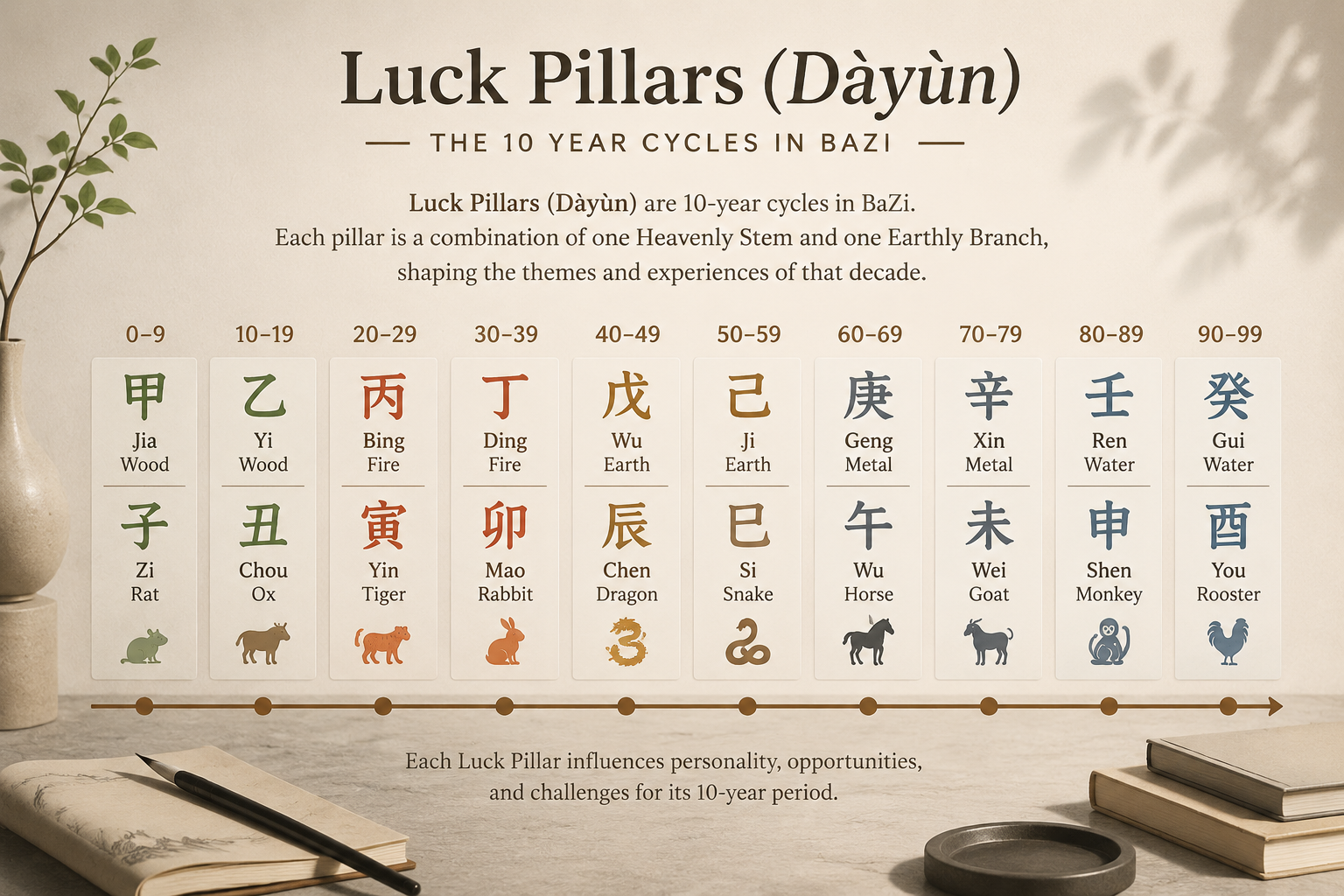
What Are Luck Pillars (Dàyùn)?
A Luck Pillar is a pair of one Heavenly Stem and one Earthly Branch that governs a period of approximately ten years. The pillar is not chosen randomly; it is derived mathematically from the natal chart’s Month Pillar and the person’s gender. Once the first Luck Pillar begins, the Stems and Branches cycle forward or backward in a strict sequence, creating a chain that can span a lifetime.
The term “luck” here can be misleading. It does not imply that everything will be positive or negative. In BaZi, Luck Pillars describe the shifting elemental climate that a person moves through. They show which of the Ten Gods are activated, whether the Day Master gains or loses strength, and which life themes come to the foreground. A pillar can bring a period of relative ease or challenge, but the actual experience is always filtered through the natal chart and the person’s own choices.
How Are Luck Pillars Calculated?
The calculation of Luck Pillars follows a precise set of rules rooted in the sexagenary cycle of Heavenly Stems and Earthly Branches. Four pieces of information are needed:
- The natal chart’s Day Master (not directly used in calculation, but essential for reading)
- The Month Pillar (the Stem and Branch of the birth month)
- The gender of the person
- The Heavenly Stem of the birth year (yin or yang polarity)
Counting Direction
The Gender‑Year‑Stem combination determines whether you count forward or backward from the Month Pillar. If the Year Stem is Yang and the gender is male, or the Year Stem is Yin and the gender is female, the count goes forward. If the Year Stem is Yang and the gender is female, or the Year Stem is Yin and the gender is male, the count goes backward.
Once the direction is set, you simply move to the next or previous Stem‑Branch combination in the 60‑term cycle. That becomes the first Luck Pillar. The second Luck Pillar is the next (or previous) pair in the sequence, and so on.
Determining the Start Age
The age at which the first Luck Pillar begins is also calculated, not arbitrary. It depends on how far the birth moment is from the nearest seasonal node (Jiéqì). The interval is converted into years using the formula: 3 days = 1 year, 1 day = 4 months, 1 hour = 5 days. While modern tools handle this arithmetic instantly, understanding it helps grasp that Luck Pillars are anchored to the rhythms of the solar year, not a rounded number like age 10.
Manual calculation has its own value, but you can also see your own Luck Pillars in a few seconds by generating your chart on Free BaZi — the tool displays the full Luck Pillar sequence with start ages automatically.
Reading a Luck Pillar
Reading a Luck Pillar means examining the Stem and Branch of the pillar not in isolation, but in dialogue with the natal chart. The same element can behave very differently depending on the Day Master and the structure of the chart. An approach rooted in method, not mystique, follows three basic steps.
1. Identify the Ten Gods
Look at the Heavenly Stem of the Luck Pillar first. Compare it to the Day Master’s element and polarity. That gives you the main Ten God for the decade—for example, if the Day Master is Yang Wood (Jia) and the Luck Pillar’s Stem is Yin Wood (Yi), the relationship is Friend (also called Parallel). The Earthly Branch can then be read either through its hidden Stems (the main Qi) or, in advanced readings, through the full sub‑gods.
Familiarity with the Ten Gods spectrum is essential. A decade governed by the Direct Officer carries an entirely different set of themes than one governed by the Eating God, even if both appear with the same Element.
2. Assess Elemental Balance
The Luck Pillar’s elements are added to the natal chart, temporarily shifting the strength of each of the Five Elements. If the Day Master is already weak and the pillar floods the chart with its opposing element, the decade may feel exhausting. Conversely, a pillar that feeds a weak Day Master can bring a period of recovery and consolidation. This is not “good” or “bad” in an absolute sense—it is a reading of the changing climate.
3. Watch for Interactions
A Luck Pillar does not simply sit on top of the chart. It combines, clashes, harms, or punishes natal Stems and Branches. Combinations can create new elements; clashes can shake up static areas of life. A pillar that combines with a natal Branch might seal away a resource or a relationship, while a clash might bring movement into a stagnant area. These interactions are where the reading becomes vivid, and they need to be checked against the fundamental structure of the chart.
Interpreting the Ten Gods in Each Pillar
Because the Luck Pillar’s Stem is often read as the “head” energy and the Branch as the “tail,” practitioners often assign the Stem to the first five years and the Branch to the second five. However, a more nuanced view sees the Stem as the overt theme and the Branch as the underlying setting. Both influence the entire decade.
The Day Master receives the Luck Pillar’s Stem and Branch as a pair of Ten Gods. A quick reference table for all ten is beyond this article’s scope, but the principle is straightforward: each pillar activates certain gods, and those gods highlight areas of life such as career, creativity, wealth, power, relationships, or personal growth. The same Direct Wealth appears very differently in a robust, earth‑heavy chart than in a fragile, fire‑dominant chart.
When reading, avoid fixed interpretations. BaZi is a structured reading, not a fortune. The Direct Officer may bring pressure in one context and recognition in another. The Eating God may represent artistic output or, under certain structures, a drain that must be managed. Context is everything.
Limitations and Practical Use
It is important to state clearly what Luck Pillars are not. They are not prophecies. They do not dictate exact events. They do not override personal agency. The BaZi framework, including Luck Pillars, is a cultural reference that offers a lens for reflection—nothing more.
Within that boundary, Luck Pillars are useful as a rhythm tool. They help a person understand why certain years feel heavy and others light, why some decades invite expansion and others consolidation. When approached with restraint, they can support self‑awareness and planning without falling into determinism.
For those who want to engage with BaZi as a living practice, the best approach is to look at the current or upcoming Luck Pillar, read it alongside the natal chart, and consider what themes might be awakening. Then watch how those themes actually play out in real life. Over time, this cultivates a grounded literacy in the method, far from sensational claims.
FAQ
How do I find my own Luck Pillars?
You can generate a full chart with Luck Pillars for free on the Free BaZi homepage. Enter your birth date, time, and gender, and the system will display the Dayun sequence, including start ages and the Stem‑Branch pairs for each 10‑year cycle.
Are Luck Pillars the same for everyone born in the same year?
No. The Year Pillar is only one factor in determining the counting direction, and the Month Pillar varies dramatically across the year. Two people born in the same year but in different months will have entirely different Luck Pillar sequences. Even within the same month, different birth times and genders produce different start ages and sometimes different directions.
Can a Luck Pillar change my Day Master’s strength?
Not permanently. A Luck Pillar adds temporary elemental influence, but it does not rewrite the natal chart. When the pillar passes, the chart returns to its original configuration. However, a pillar that closely matches the natal chart’s needs can make the Day Master function more easily for a decade, while a clashing pillar can feel like walking against the wind.
What happens when a Luck Pillar changes?
When the Dàyùn switches, the elemental climate shifts. Some people experience the transition as a distinct change in priorities, energy levels, or the kind of challenges they face. Others notice it only in retrospect. The shift is not instant—it often blends across the overlapping years of the Annual Pillar (Liúnián), which provides the yearly layer atop the decade.
Should I wait for a “good” Luck Pillar to make decisions?
BaZi is not designed as a waiting system. A Luck Pillar sets a broad backdrop, but annual and even monthly influences, as well as individual action, shape daily life. Use the reading as one perspective among many, never as a substitute for judgment or effort.
Start your own reading. Open the Free BaZi chart, generate your Dayun sequence, and begin exploring your Luck Pillars with a clear, method‑first approach.