Yong Shen vs Favorable Element: Understanding the Distinction in BaZi
Learn the key differences between Yong Shen (Useful God) and Favorable Elements in BaZi. A method-driven guide that clarifies their roles without fortune-telling promises.
In BaZi (Four Pillars of Destiny) analysis, two terms frequently appear: Yong Shen (Useful God) and Favorable Element. They are related but not identical, and using them interchangeably can lead to an oversimplified reading. This article draws a clear line between the two concepts — not to promise outcomes, but to help you apply them with greater clarity and reason.
Both terms describe elements that bring benefit to a chart, but they differ in scope, priority, and method of determination. Understanding that difference is essential for anyone who wants to move past surface-level BaZi and toward a more structured reading path.
What Is the Yong Shen (Useful God)?
Yong Shen is the single most important element for a given natal chart. In the classical framework, it’s the element that most effectively corrects the core imbalance of the Day Master and the overall configuration. When a BaZi chart is overly strong or excessively weak, the Yong Shen acts as the remedy, restoring a more harmonious state.
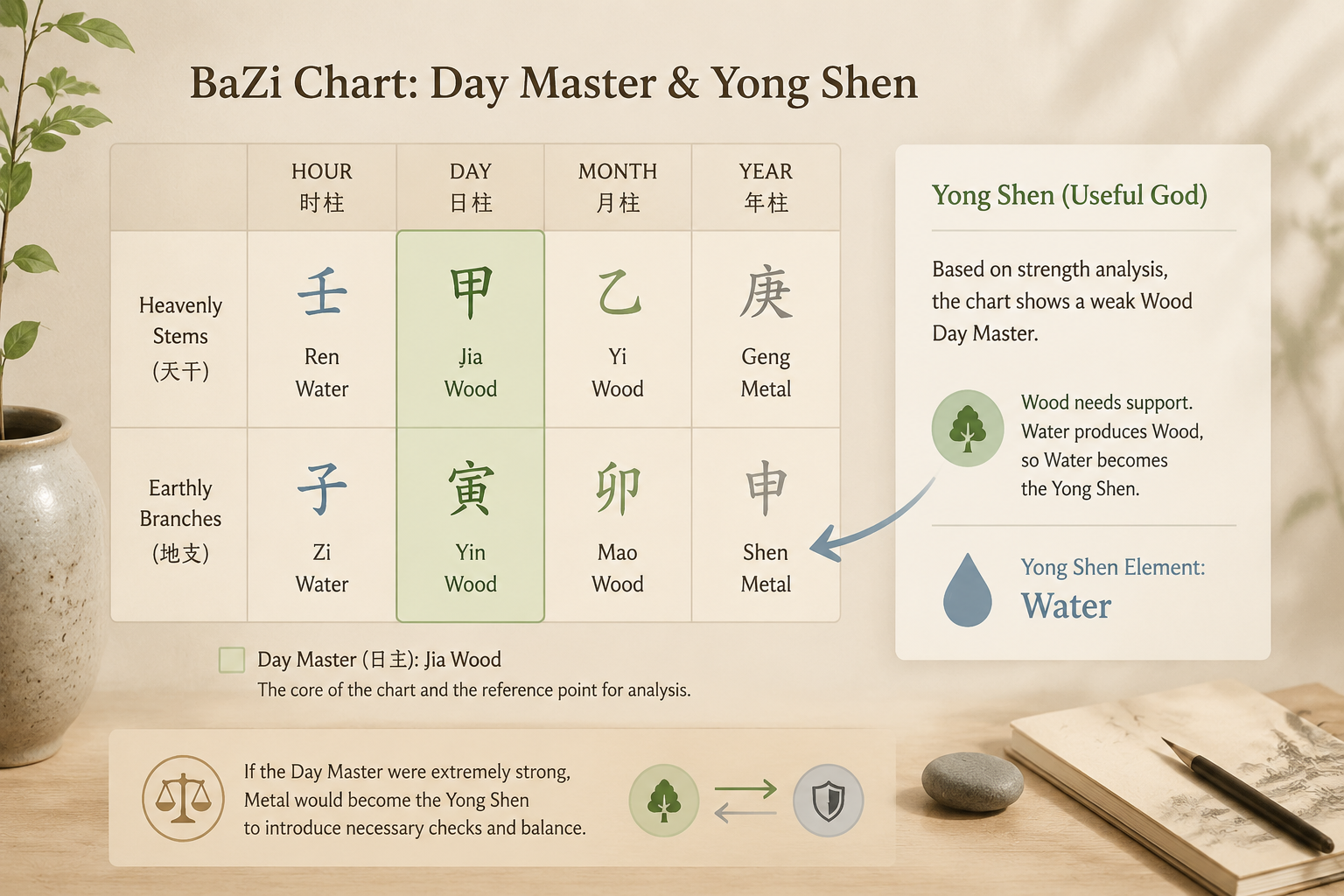
For example, imagine a chart with a weak Wood Day Master. Because it needs support, the element that produces Wood — Water — may serve as the Yong Shen. Alternatively, if the chart is extremely strong Wood, the controlling element (Metal) might become the Yong Shen to introduce necessary checks. The choice always follows from a careful assessment of the Day Master’s strength and the interrelationships among all eight characters.
Because the Yong Shen is the primary remedy, it becomes a reference point for many life areas: the industries where a person might find the most alignment, the relationships that offer genuine support, and the wellbeing strategies that match their constitutional tendencies.
What Is a Favorable Element?
While Yong Shen is singular in its corrective priority, a Favorable Element is any element that generally supports the chart’s balance. A chart can have several favorable elements — they don’t all carry the same weight, but they work together to produce beneficial outcomes.
Favorable elements are closely tied to the Ten Gods system. When favorable elements appear, they tend to produce Ten Gods that one would interpret as helpful — for instance, the Direct Resource or Proper Wealth when the Day Master is weak. Conversely, unfavorable elements give rise to gods that are classically associated with pressure, loss, or competition.
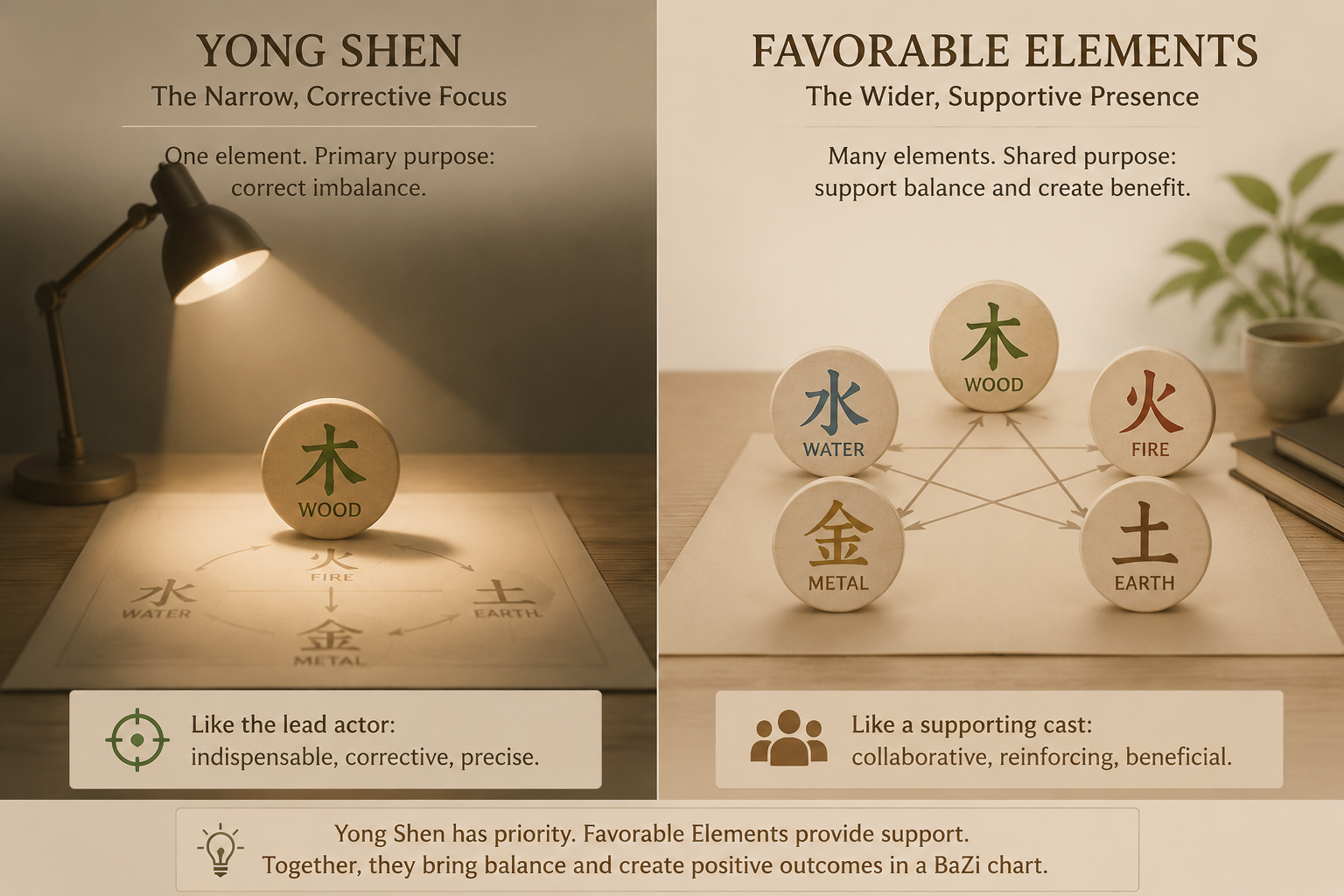
Think of Yong Shen as the lead actor in a performance, while favorable elements are the supporting cast. The show can still go on without some of the supporting roles, but without the lead, the whole effort would falter.
Key Differences Between Yong Shen and Favorable Element
| Aspect | Yong Shen (Useful God) | Favorable Element |
|---|---|---|
| Scope | One primary element; sometimes a closely linked secondary co-useful god is acknowledged but the emphasis remains on one corrective force. | Can include multiple elements that harmonize with the chart. |
| Function | Addresses the deepest imbalance; acts as the primary remedy. | Supports overall balance and generates positive god connotations; may assist the Yong Shen or simply not disturb it. |
| Determination | Requires a thorough strength analysis of the Day Master and the whole chart. | Identified through a broader balance check of the five elements and the Ten Gods structure. |
| Life application | Often guides core career direction, health considerations, and pivotal life choices. | Indicates helpful periods, supportive people, and general areas of comfort or opportunity. |
| Stability | Remains constant throughout life, because it is derived from the fixed natal chart. | The set of elements considered favorable can shift in the context of different Luck Pillars, even though a base set may be stable. |
To make this concrete, revisit the weak Wood Day Master: its Yong Shen might be Water (to nourish) or sometimes Wood itself (to strengthen). Favorable elements could include Water and Wood simultaneously, with the addition of Earth if it doesn’t severely drain Wood. This nuance is why many readers mistakenly assume Yong Shen and Favorable Element are interchangeable — in some charts they overlap heavily, but the analytical reasoning behind them remains distinct.
How to Identify Your Yong Shen vs Favorable Elements
Identifying these elements is a structured process, not a guess. Here is a step-by-step path:
- Determine Day Master strength. Assess whether the Heavenly Stem representing you is strong or weak based on the season of birth, supportive stems and branches, and the presence of the same element. (See our Day Master Strength guide for a detailed approach.)
- Evaluate the overall balance. Even if the Day Master is weak, check whether the chart shows excessive cold, heat, or an overpowering element that needs tempering.
- Select the Yong Shen. Ask: which one element would most effectively bring the chart back toward balance? It is usually the element that supports a weak Day Master or controls an overly strong one, but sometimes it’s the element that moderates extreme climatic conditions.
- Identify favorable elements. With the Yong Shen in place, note all other elements that work in harmony with it, produce it, or at minimum do not disrupt the newly introduced balance. These become the favorable companions.
- Check against Luck Pillars. While Yong Shen remains the anchor, observe how favorability of elements may adjust as pillars change. An element that is neutral in the natal chart can become particularly favorable in a decade pillar that activates it positively.
The Free BaZi chart tool (see call-to-action at the end) automates the strength analysis and suggests the Yong Shen and favorable elements based on traditional calculation, giving you a transparent starting point for your own reading.
Common Misconceptions
Misconception 1: Yong Shen is always the same as the Day Master’s element.
If the Day Master is strong, the Yong Shen often becomes the element that controls it, not its own kind. The goal is balance, not reinforcement.
Misconception 2: Every favorable element is equally powerful.
Favorable elements vary in impact. Some merely avoid harm; others actively assist the Yong Shen. The Yong Shen remains the top priority when making decisions based on the chart.
Misconception 3: Yong Shen changes as you age.
The Yong Shen is anchored in the natal chart and does not shift. What can change is the favorability of certain elements during specific Luck Pillars, because a pillar may bring an element that temporarily supports the Yong Shen even more.
Misconception 4: You must avoid all unfavourable elements at all costs.
A chart needs all five elements to exist in some measure. An unfavourable element isn’t “poison”; it simply doesn’t contribute positively to the current configuration. The method teaches awareness, not fear.
Practical Application in Reading
When you use the Free BaZi chart tool, the reading explicitly separates the Yong Shen from the favorable elements. This separation allows you to build interpretations in layers:
- Start with the Yong Shen to understand your most fundamental corrective need. For instance, if Metal is your Yong Shen, environments that emphasize structure, precision, and discipline may feel most aligned.
- Then explore the favorable elements to see which supportive influences show up in relationships, career cycles, and annual luck.
A sample reading excerpt might state: “The Yong Shen is Earth, suggesting that stability, patience, and trustworthiness are central to your path. Water and Metal appear as favorable, pointing to financial insight and determination as natural allies.” No prediction is absolute; the description remains a cultural reference for self-reflection.
FAQ
Can my Yong Shen be two elements?
In orthodox analysis, the Yong Shen is a single element. Some schools acknowledge a “co-useful god” when a chart is complex and requires a second balancing force, but a primary Yong Shen is always identified first.
Is a Favorable Element the same as a Lucky Element?
Not exactly. “Lucky Element” can refer to favorable elements that appear only in certain Luck Pillars or annual cycles, while a Favorable Element is more stable in the natal chart’s overall assessment.
How does Yong Shen affect my career?
The Yong Shen points toward occupations that share the quality of that element. For example, a Wood Yong Shen aligns with growth, education, planning, or the natural environment. This isn’t a prescription but a directional suggestion based on elemental correspondence.
What if my chart has no clear Yong Shen?
Some charts are relatively balanced. In those cases, the Yong Shen is determined by a more nuanced analysis of temperature and structural flow. The Free BaZi tool still provides a reading based on traditional rules.
Does Free BaZi show me my Yong Shen?
Yes. The chart output includes a clearly labeled Yong Shen and lists the primary favorable elements, along with a short explanation of why they were chosen.
Ready to see how Yong Shen and Favorable Elements appear in your own chart? Generate your free BaZi reading now and explore a structured, culturally grounded perspective.