Favorable Element (Xǐyòng Shén) — Your BaZi's Most Helpful Energy
Learn how the Favorable Element (Xǐyòng Shén) balances your BaZi chart, supports your Day Master, and guides cultural self-understanding without fortune-telling promises.
In a BaZi chart, not every element supports you equally. Some energies harmonize naturally with your structure, easing inner tension and helping you move through life with less friction. This special ally is called the Favorable Element, or Xǐyòng Shén. Understanding your Favorable Element is a cornerstone of the BaZi reading method—it’s the element that, when present, tends to bring a sense of balance and cultural alignment, without making overreaching promises.
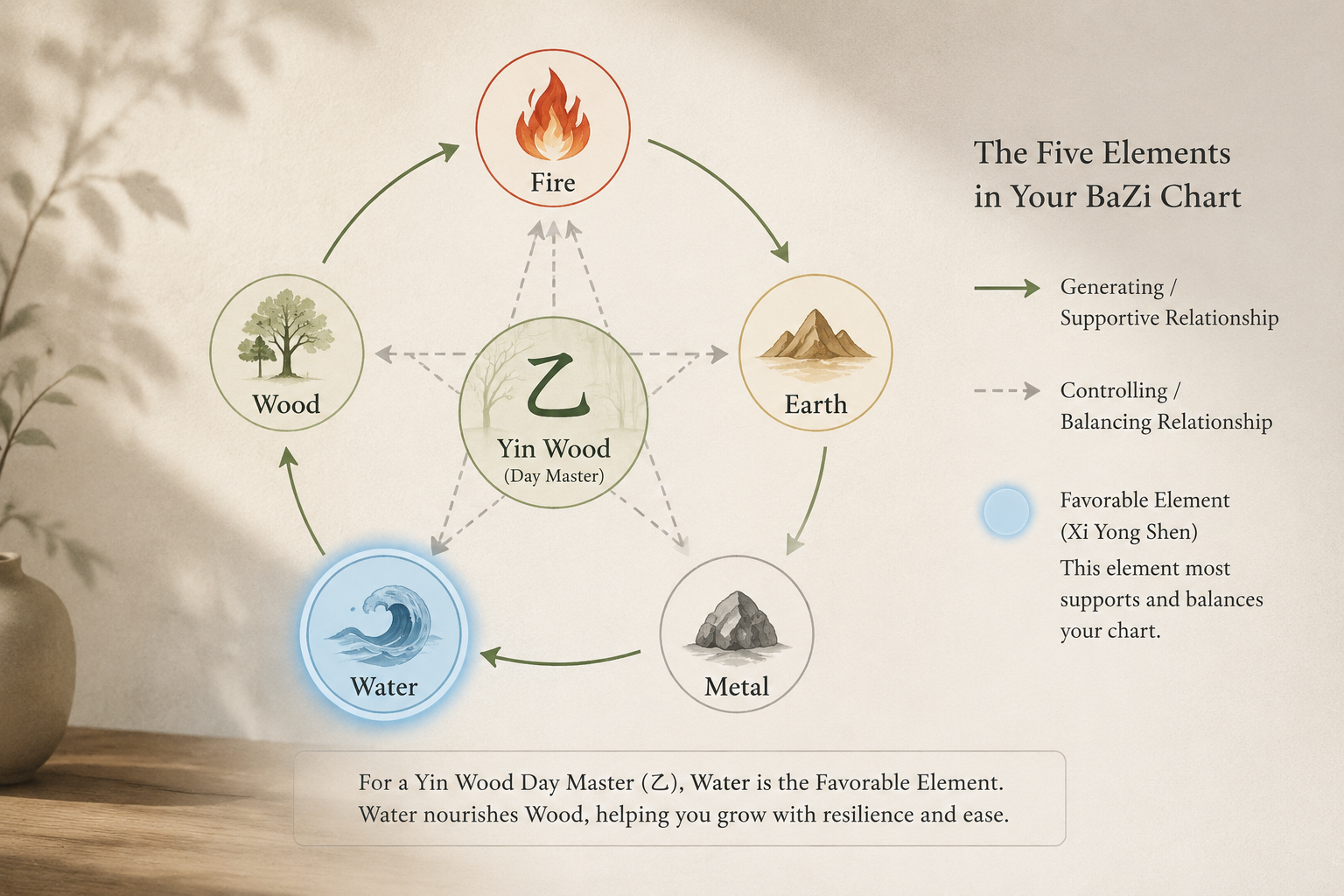
What Is the Favorable Element?
The Favorable Element is the single Five Element—among Wood, Fire, Earth, Metal, or Water—that most effectively supports and balances your individual BaZi chart. In traditional Zi Ping thinking, its role is both therapeutic and structural: it corrects imbalances and strengthens the core nature represented by your Day Master.
This concept emerges from an analysis of the Five Elements dynamic at work in your birth time. If your chart is too cold, the Favorable Element might be Fire; if too weak, a nourishing element like Wood or Water might be indicated. If a particular element is overpowering, the Favorable Element could be the one that precisely controls it, much like Metal controls Wood. The selection always respects the whole chart, not just the Day Master in isolation.
Xǐyòng Shén sits within a broader family of “useful gods.” There is also the Yong Shen (the main working element) and, in some systems, a Xi Shen (cheering element). For practical reading, many practitioners collapse these into the single idea of the Favorable Element—the one you benefit from seeing more of, in a balanced way, throughout your life.
Why the Favorable Element Matters
When the Favorable Element appears in a person’s Ten Gods configuration, Luck Pillars, or even external environment, BaZi interpretation suggests the person may experience periods of smoother energy. This is not about luck in the predictive sense; rather, it reflects the cultural concept that aligning with your natural elemental support can make effort feel less obstructed.
Imagine a chart dominated by Metal—rigid, principled, but at times overly critical. If Wood is the Favorable Element, it introduces flexibility, growth, and kindness, softening the Metal’s sharp edges. The person might then navigate relationships and work with more ease when Wood energies are present, like during Yan Wood hours or in professions linked to growth (education, ecology, design).
Furthermore, knowing your Favorable Element helps you interpret your chart without falling into simplistic “good element/bad element” thinking. Every element has a role, but the Favorable one is the one your chart most gracefully invites. This creates a useful lens for understanding your natural disposition and possible paths of cultural coherence, not a fixed destiny.
How to Identify Your Favorable Element
Identifying the Favorable Element requires a structured reading flow. It’s not a guess based on your birth year’s zodiac animal, nor a preference for a certain element. A full method includes these steps:
- Determine the Day Master strength. Your Day Master’s strength comes from the balance of elements in the entire chart. You need to examine its supporting elements, the season it was born in, and the presence of controlling or draining influences. A weak Day Master may need a supporting element (like the element that gives birth to it in the Sheng cycle) as its Favorable Element.
- Assess global element distribution. Count how many of each element appear and note if one dominates excessively. The Favorable Element is often the one that can tame the excess without harming the Day Master.
- Check for cold/warm imbalance. Some charts are too cold (dominated by Water and Metal, born in winter) or too hot (too much Fire and Earth, born in summer). The Favorable Element then becomes the one that moderates temperature: Fire for cold charts, Water for hot charts.
- Consider the useful god hierarchy. In advanced reading, you look at the interplay between the Day Master and the Ten Gods, selecting an element that strengthens positive stars (such as Direct Resource or Direct Officer) or neutralizes negative influences like the Seven Killings.
Because this process is multi-layered, using a free BaZi chart tool can reduce the manual calculation. Our tool computes Day Master strength, displays element weights, and suggests a Favorable Element based on classical Zi Ping rules. While no automated tool can replace a nuanced human reading, it provides a reliable starting point for learning.
Practical Use of the Favorable Element
BaZi does not direct your life; it offers a cultural mirror. Once you know your Favorable Element, you might choose to bring more of that quality into your daily rhythm—as a way of exploring balance, not as a formula for guaranteed outcomes.
- Directions and surroundings. Some traditional practitioners suggest orienting your desk toward a direction governed by the Favorable Element (e.g., East for Wood). You might also introduce that element’s color or material into your workspace in subtle, aesthetic ways.
- Occupations and hobbies. Occupations can be loosely associated with elements: Water with communication and travel, Earth with real estate and mediation, Metal with finance and precision. If your Favorable Element is Fire, you may feel a natural resonance with roles involving visibility, transformation, or social dynamics—but this is a suggestion, not a career mandate.
- Seasonal awareness. Knowing that your Favorable Element thrives in a certain season can help you plan important endeavors during that time, without expecting supernatural results. It’s about working with rhythm.
- Personal growth language. Instead of saying “I need more Water,” you can reflect on what Water represents in your chart: clarity, adaptability, introspection. The Favorable Element becomes a vocabulary for self-understanding, not a craving for an external fix.
Always remember that BaZi readings are probabilistic and cultural. The aim is to appreciate the system’s coherence, not to treat the Favorable Element as a magic key. If your chart lacks the Favorable Element in the stems and branches, that doesn’t mean you are stuck; it means the invitation is to consciously cultivate that quality in your life.
Limitations and Responsible Use
BaZi interpretation works best when seen through the lens of cultural tradition rather than fortune-telling. The Favorable Element does not guarantee wealth, health, or specific events. Many complex variables—your environment, personal choices, the luck pillar period, and interactions with other people—override any simple element preference.
For readers new to BaZi, it’s common to fixate on the Favorable Element and reject everything else. A chart is an ecosystem. Every element plays a functional role. Even an element that appears “unfavorable” in one context may protect you in another. Developing a well-rounded understanding of Day Master dynamics and Ten Gods helps prevent this simplistic trap.
FAQ
Is my Favorable Element the same for my whole life?
No. While your natal chart’s Favorable Element remains a foundational reference, the influence of Luck Pillars and Annual Stars can temporarily shift which element brings the most harmony. A BaZi reading during a particular decade or year may suggest a secondary favorable element to consider, but the main Xǐyòng Shén is derived from your birth chart and usually stays consistent.
Can I just wear the color of my Favorable Element?
Color association is a folk practice rather than a core Zi Ping method. If you want to experiment, wearing or surrounding yourself with a color linked to your Favorable Element can serve as a subtle mindfulness reminder. However, it should not replace deeper understanding of your chart’s structure or be treated as a surefire way to change your circumstances.
What if my chart shows two elements that could be favorable?
Sometimes a chart requires more than one element to achieve balance—for example, a weak Day Master may benefit both from the element that directly supports it and the element that weakens an overbearing force in the chart. In such cases, practitioners distinguish between the primary Yong Shen and the secondary Xi Shen, but for practical self-reflection you may focus on the element that most clearly balances the most urgent excess or deficiency.
How does the Favorable Element relate to the Ten Gods?
The Favorable Element itself is a Five Element, but it appears in your chart through the lens of the Ten Gods. For instance, if your Favorable Element is Wood and Wood in your chart manifests as the Indirect Resource star, then you might notice themes of learning, nurturing, and support being especially helpful. The Ten Gods layer adds narrative texture to the element’s influence.
Understanding your Favorable Element opens a door to a more nuanced view of your BaZi chart. Use it as a gentle framework for self-reflection, not a prediction. To see your own chart and discover which element brings the most balance, visit our Free BaZi Chart tool and begin exploring the patterns in your birth time.