Hidden Stems (Cánggān) — What's Inside Each Earthly Branch
Learn what the hidden stems (Cánggān) in each Earthly Branch represent in BaZi. A method-driven overview of all twelve branches, how hidden stems interact with the Day Master and Ten Gods, and a practical reading path to interpret their influence.
In BaZi (Eight Characters) chart reading, each Earthly Branch is not just a single elemental energy; it acts as a container for one, two, or three Heavenly Stems. These are called hidden stems (Cánggān). Understanding what lies inside each branch is essential for moving beyond the surface of a chart—it lets you see the underlying currents that shape a person’s inner world, hidden motivations, and unexpressed potential.
When you look at a BaZi chart generated by the Free BaZi chart tool, the hidden stems appear within each of the four pillars (year, month, day, hour) beneath the Earthly Branch. They are marked with their Heavenly Stem identity, often ordered by strength from primary to secondary and tertiary. This article explains the hidden stem compositions of all twelve branches and introduces a reading path that connects them to the Day Master and Ten Gods, always within the cultural reference framework of BaZi.
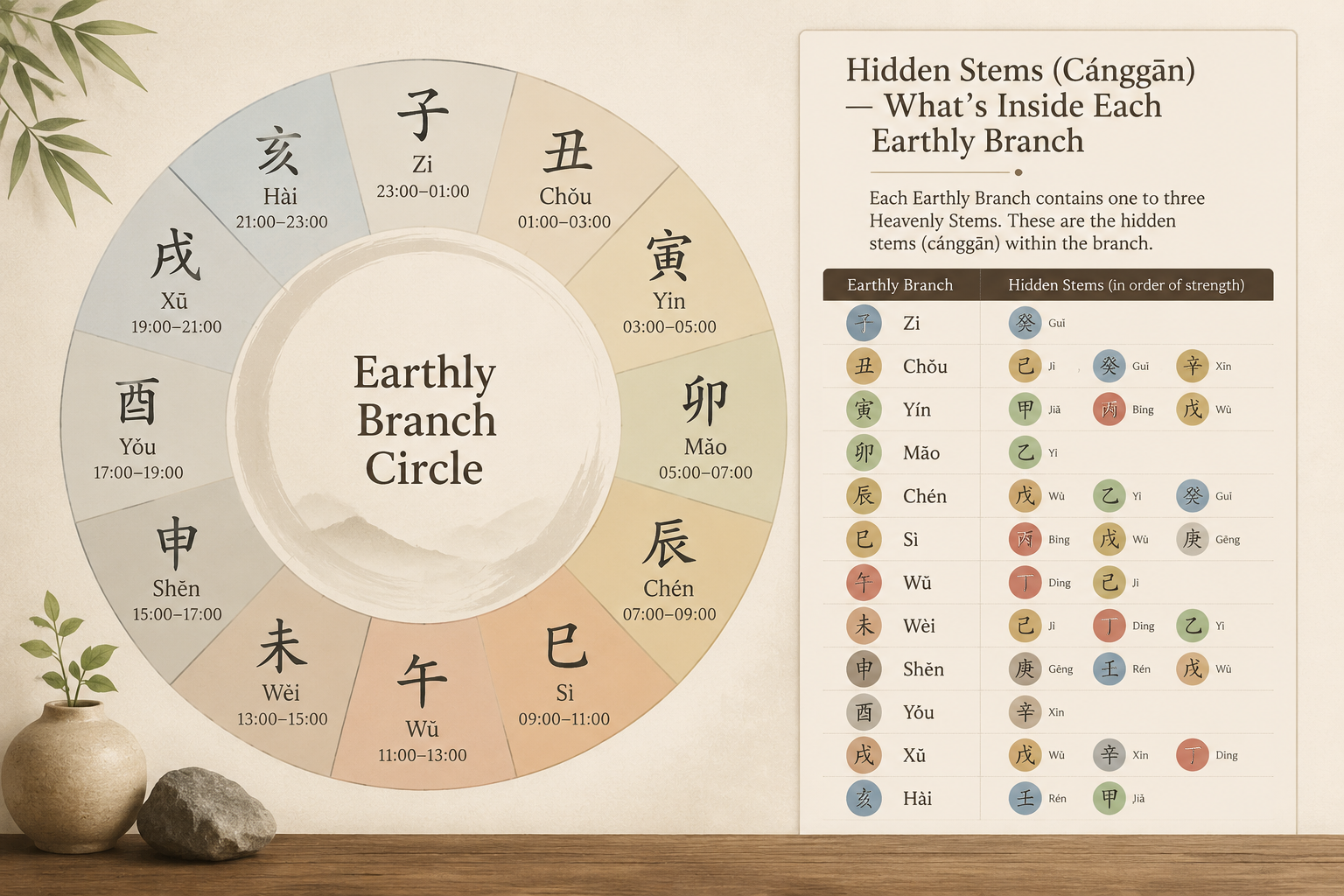
The Twelve Earthly Branches and Their Hidden Stems
Each Earthly Branch corresponds to a fixed combination of stems. These stems are categorized as dominant (the core qi), secondary, and sometimes tertiary—reflecting residual energies from the season or directional cycle. Here is the complete reference:
- Zi (子) — Gui (+water)
- Chou (丑) — Ji (-earth), Gui (+water), Xin (-metal)
- Yin (寅) — Jia (+wood), Bing (+fire), Wu (+earth)
- Mao (卯) — Yi (-wood)
- Chen (辰) — Wu (+earth), Yi (-wood), Gui (+water)
- Si (巳) — Bing (+fire), Wu (+earth), Geng (+metal)
- Wu (午) — Ding (-fire), Ji (-earth)
- Wei (未) — Ji (-earth), Ding (-fire), Yi (-wood)
- Shen (申) — Geng (+metal), Ren (+water), Wu (+earth)
- You (酉) — Xin (-metal)
- Xu (戌) — Wu (+earth), Xin (-metal), Ding (-fire)
- Hai (亥) — Ren (+water), Jia (+wood)
The notation uses the Heavenly Stem name followed by polarity (+ yang, – yin) and the elemental association. A single-branch branch like Zi or Mao is all yang or all yin water/wood, while a triple-branch like Yin carries the season’s sprouting wood, the rising warmth of fire, and the earth that stabilizes. This layering is what gives hidden stems their complexity.
How Hidden Stems Influence a BaZi Chart
Hidden stems act as sub-personas or latent resources. They are not directly visible in the eight explicit characters, but they interact with the Day Master and the rest of the chart through combinations, clashes, and elemental cycles. A typical reading considers them in three ways:
- Inner personality: The stem that aligns with the Day Master’s element can reveal suppressed talents. For example, if the Day Master is Yang Wood (Jia) and a hidden stem in the hour pillar is also Jia, the person might have a quiet, self-renewing creativity that surfaces only under specific circumstances.
- Relationship dynamics: Hidden stems in the spouse palace (day branch) often represent the partner’s qualities or the native’s hidden expectations. If the day branch is Chou, the secondary Gui water could indicate unspoken emotional depths even when the surface shows a stable Ji earth demeanor.
- Luck Pillar triggers: When a new Luck Pillar brings a Heavenly Stem or Earthly Branch that interacts with a hidden stem, previously dormant drives may become active. This is observed in the Luck Pillars timing system, where a branch clash can “release” the hidden stem’s energy, making the native more aware of that quality.
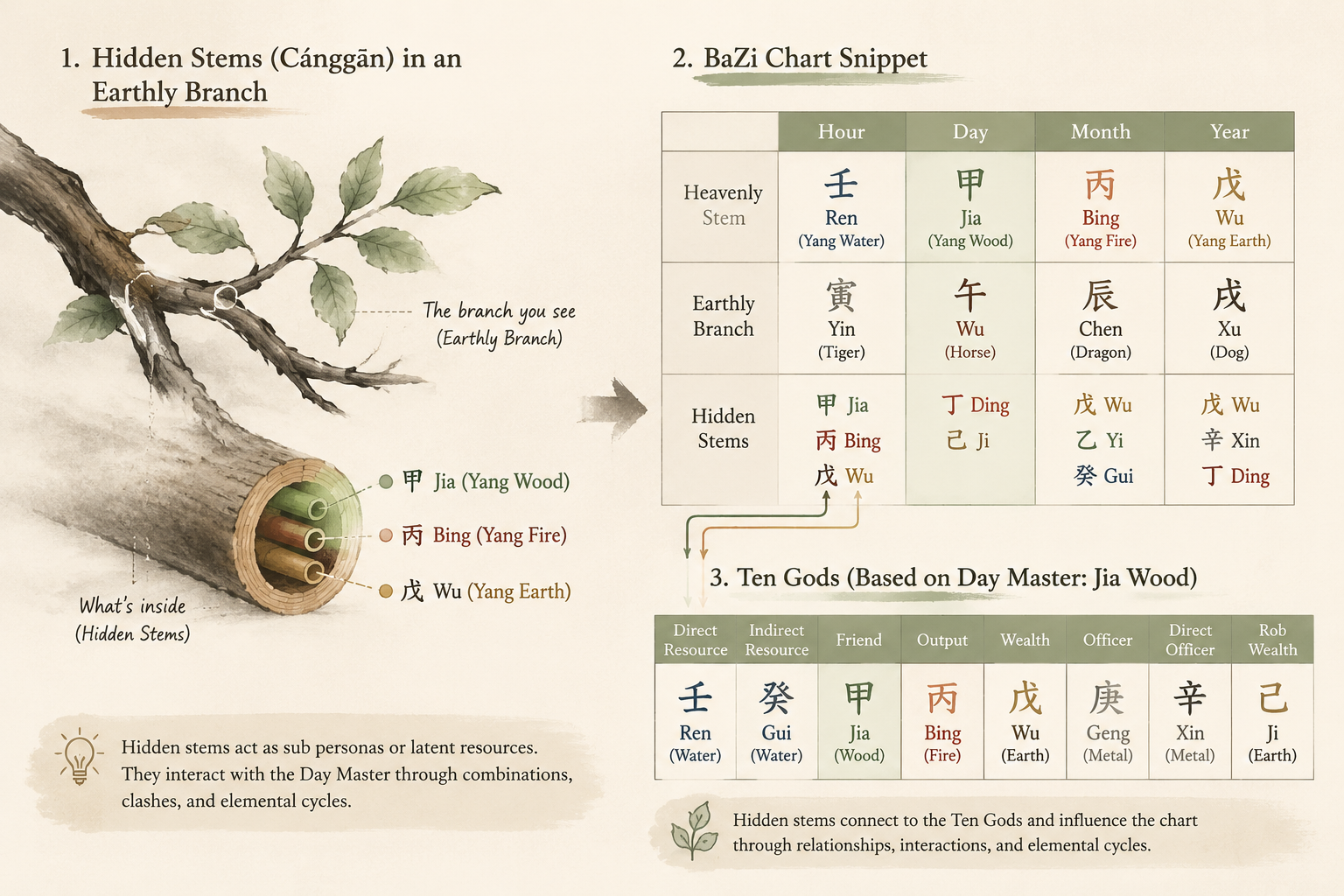
Reading Path: Interpreting Hidden Stem Relationships
A structured approach prevents over-interpretation. Follow this sequence:
- Identify the Day Master and its polarity. The Day Master is the anchor for all Ten Gods. If you haven’t yet, read about finding your Day Master first.
- For each pillar, note the revealed Heavenly Stem and Earthly Branch. Then look into the branch’s hidden stems.
- Convert each hidden stem into its Ten God designation relative to the Day Master. For instance, if the Day Master is Ding (-fire), a hidden Geng (+metal) would be Indirect Wealth. The Ten Gods framework provides the vocabulary—each stem relates to the Day Master through one of ten roles.
- Check for stem-to-branch combinations (e.g., a Heavenly Stem that merges with a hidden stem in the same pillar) or branch clashes where the hidden stems might offset or combine with stems from another pillar.
- Assess the element balance. The element count now includes contributions from hidden stems. This may shift the perceived strength of the Day Master, which matters for chart structure analysis. See Five Elements for how elements cycle.
- Read situational influence, not destiny. A hidden Seven Killings stem does not “cause” aggression; it indicates that under certain conditions, the person may access a disciplined, authoritative edge. Context is always provided by the whole chart, not a single hidden stem.
This path keeps the reading grounded and transparent. It’s a method for observation, not prediction.
Limitations and Cultural Reference
Hidden stems are part of a traditional framework that has evolved over centuries. Like the Earthly Branches themselves, they originate in lunisolar calendar systems and were adapted for human character reading. Their meanings are not literal—they are symbolic references that gain richness through long cultural use, not through empirical proof. No single hidden stem can determine an outcome. A chart reading always requires considering the interplay of all pillars, the Ten Gods, element strength, and the person’s own life context.
In the Free BaZi tool, hidden stems are displayed automatically as a reference layer. Use them to add subtlety to your reading, not to search for dramatic revelations. The method works best when you stay curious and refrain from fear-based interpretations.
FAQ
Why do some Earthly Branches have three hidden stems and others only one or two?
This reflects the seasonal nature of the branches. Branches associated with the middle of a season, like Mao (spring) and You (autumn), contain only one stem because the seasonal qi is pure and undiluted. Branches that mark transitions between seasons, such as Yin (beginning of spring) or Shen (beginning of autumn), can hold residual energies from the previous season, resulting in up to three stems. The number tells you how mixed the environment is at that point in the cycle.
Which hidden stem is the most important in a reading?
The dominant stem (the first listed) generally represents the branch’s main character and is the most influential. However, the secondary and tertiary stems can become significant when they are activated by a Heavenly Stem in the main chart, a Luck Pillar arrival, or when they form part of a combination. For example, in a day branch Chou, the dominant Ji earth often describes the outward spousal relationship, but the hidden Gui water could become prominent during a water-strong Luck Pillar.
Can I use hidden stems to choose a career or make life decisions?
Hidden stems offer a layer of insight into latent talents and inner needs, but they are not prescriptive. Any decision should integrate your full chart, personal judgment, and real-world considerations. A hidden stem that corresponds to a Ten God like Eating God may suggest creative tendencies, but it does not dictate a career path. Use it as a prompt for self-reflection, not a deterministic guide.
Ready to see the hidden stems in your own chart? Open the Free BaZi chart generator, enter your birth details, and explore the branch layer in each pillar. For deeper reading, combine this information with articles on the Day Master, Ten Gods, and Five Elements.