Heavenly Stems (Tiāngān) — The Ten Stems in BaZi
Explore the ten Heavenly Stems (Tiāngān) in BaZi: their Yin-Yang and Five Element qualities, how they appear in a BaZi chart, and how to read them in practice. A restrained, method-driven reference.
The Heavenly Stems, or Tiāngān (天干), are one of the two fundamental cyclical systems in BaZi (Four Pillars of Destiny). Along with the Earthly Branches, they form the sixty sexagenary combinations that structure a BaZi chart. This reference explains the ten stems, their Yin-Yang and Five Element assignments, and how they appear in a chart reading.
What Are the Heavenly Stems?
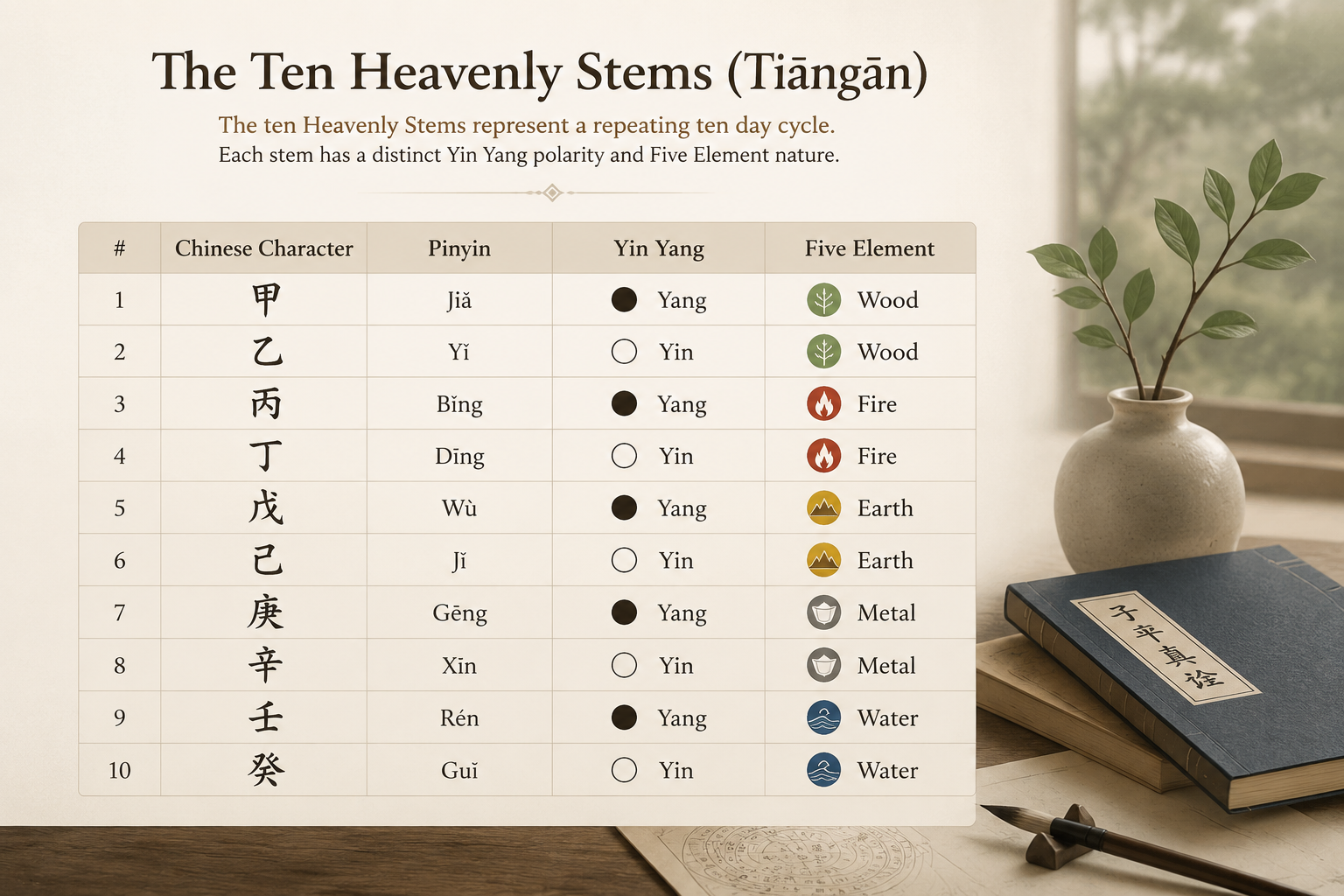
The ten Heavenly Stems are ten symbols that represent a repeating ten-day cycle. In BaZi, each stem carries a distinct Qi quality defined by its Yin-Yang polarity and its Five Element nature. The stems are often described as the “sky” influence, expressing visible, directional energy in a pillar, while the Earthly Branches provide the “earth” context and internal dynamics.
A table of the ten stems quickly orients a reader:
The stems are not read in isolation. They interact with the Earthly Branches beneath them, with the stems and branches of other pillars, and with the Luck Pillars that unfold over time. This web of relationships is what makes the system a structured reading method rather than a set of fixed labels.
The Ten Stems and Their Yin-Yang & Element Attributes
Each stem has a fixed polarity and element. Understanding these properties is the first step in interpreting a chart.
- Jia (甲) — Yang Wood: Tall, expansive, growing upward. Associated with leadership, initiative, and a strong external presence.
- Yi (乙) — Yin Wood: Flexible, winding, grass-like. Connected with adaptability, gentleness, and persistence through subtle channels.
- Bing (丙) — Yang Fire: Bright, warm, the sun. Represents enthusiasm, openness, and warmth that radiates outward.
- Ding (丁) — Yin Fire: A candle flame, focused and lingering. Points to insight, refined passion, and a more introverted intensity.
- Wu (戊) — Yang Earth: A mountain, solid and stable. Denotes reliability, stubbornness, and a grounding force.
- Ji (己) — Yin Earth: Soil that nurtures, receptive and fertile. Carries qualities of care, practicality, and quiet support.
- Geng (庚) — Yang Metal: Raw ore, axe, cutting and reshaping. Implies decisiveness, competitiveness, and the drive to transform.
- Xin (辛) — Yin Metal: Jewelry, refined metal, precise and delicate. Associated with detail, elegance, and controlled expression.
- Ren (壬) — Yang Water: A mighty river, flowing freely. Represents adaptability, communication, and strong movement.
- Gui (癸) — Yin Water: Mist, rain, or morning dew, subtle and pervasive. Linked to intuition, deep thinking, and quiet influence.
These attributes are not personality predictions. They are the starting assumptions that a reader uses to see how the Day Master — the stem of the day pillar — relates to everything else in the chart. For a deeper dive into the element cycle, see our reference on the Five Elements.
How Heavenly Stems Appear in a BaZi Chart
A BaZi chart is built from a person’s birth year, month, day, and hour. Each pillar carries a Heavenly Stem on top and an Earthly Branch below. The stem is the visible, expressed quality of that pillar, while the branch holds the hidden context and the underlying Qi reservoir.
The most important stem is the one on the day pillar, known as the Day Master. It represents the subject of the reading — the person asking the question. All other stems and branches are then related to the Day Master through the Ten Gods system, which categorises interactions like Resource, Output, Wealth, Influence, and Friends. (For the full set of relationships, see the Ten Gods guide.)
Heavenly Stems interact with each other through:
- Combinations: e.g., Jia (Yang Wood) and Ji (Yin Earth) combine to produce Earth. These combinations can indicate a blending or transformation of energies, and their meaning depends on whether the result supports the Day Master.
- Clashes: e.g., Jia (Yang Wood) and Geng (Yang Metal) clash, reflecting tension or conflict between two direct forces.
- Countering flows: The five-element production and control cycles (Wood feeds Fire, Metal cuts Wood, etc.) apply to stems according to their assigned elements.
A Jia Day Master born in spring (Wood season) will be naturally strong, while the same stem in autumn (Metal season) may be restrained. The surrounding stems either support the Day Master (comrades, resource) or challenge it (output, wealth, influence), creating a dynamic balance that the reader explores.
Reading Stems in Practice: A Simple Example
Consider a chart with a Jia (Yang Wood) Day Master. Assume the birth month is February (early spring), so the seasonal energy supports Wood. The month stem might be Bing (Yang Fire), which represents Output — a flowing channel for the Wood’s creative energy. The year stem is Ji (Yin Earth), which forms a Heavenly Stem combination with Jia, potentially binding the Day Master’s focus toward stability and resource accumulation.
A structured reading does not label this chart “good” or “bad”. Instead, it notes that the strong Wood Day Master has a constructive outlet for its energy through Fire (talent, expression) and a combination that pulls awareness toward Earth matters (practical concerns, security). The interpretation then examines the Earthly Branches, any hidden stems, and the current Luck Pillar to assess whether the circumstances are favourable for this configuration.
This method-driven approach is what Free BaZi models in its online charts. You can generate your own chart to see your stem placements with the Free BaZi Chart Tool. The tool organizes the stems and branches clearly, letting you explore the foundational structure before diving into advanced concepts.
FAQ
What is the significance of the Day Master stem?
The Day Master is the Heavenly Stem of the day pillar. In BaZi reading, it represents the self — the person whose chart is being analyzed. All other stems, branches, and elemental interactions are evaluated in relation to the Day Master. It provides the base element and polarity (e.g., Jia Wood, Yang) that everything else reacts to. Understanding the Day Master is essential before exploring the Ten Gods or Luck Pillars.
Why are Heavenly Stems paired with Earthly Branches?
The pairing mirrors the traditional Chinese view of heaven and earth working together. The stem expresses the active, visible quality of a pillar, while the branch carries the hidden potential, seasonal depth, and sometimes secondary stems inside its hidden storehouse. A stem alone would give an incomplete picture; the branch rounds out the context, much like seeing both action and circumstance.
How do Heavenly Stem combinations work?
Heavenly Stem combinations occur when two specific stems appear in nearby pillars (often the year and month pillars, or the month and day pillars). For example, Jia (Yang Wood) and Ji (Yin Earth) can combine to produce Earth. The combination can change the fundamental element focus of the chart, but whether it is beneficial depends on the Day Master’s needs. If the Day Master “likes” the resulting element, the combination may be supportive; if it weakens a needed element, it may suggest a period of adjustment.
Can the Heavenly Stems predict compatibility between people?
Heavenly Stems play a role in elemental compatibility analysis, where the Day Master stems of two people are compared for elemental support, control, or clash relationships. For instance, a Jia (Wood) Day Master and a Ren (Water) Day Master show a Resource relationship (Water feeds Wood), which can indicate a nourishing dynamic. However, compatibility is a nuanced cultural reading, not a deterministic prediction. Many other factors — Earthly Branches, hidden stems, and individual life circumstances — also shape any relationship. BaZi offers a way to reflect on potential patterns, not to hand down fixed verdicts.
Ready to see how the Heavenly Stems appear in your own chart? Open the Free BaZi Chart Tool and explore the stems and branches that form your four pillars.