Ten Gods (Shíshén) — The Core Relationship System in BaZi
A structured guide to understanding the Ten Gods in BaZi, how they are derived from the Day Master, and their role as a cultural reading framework.
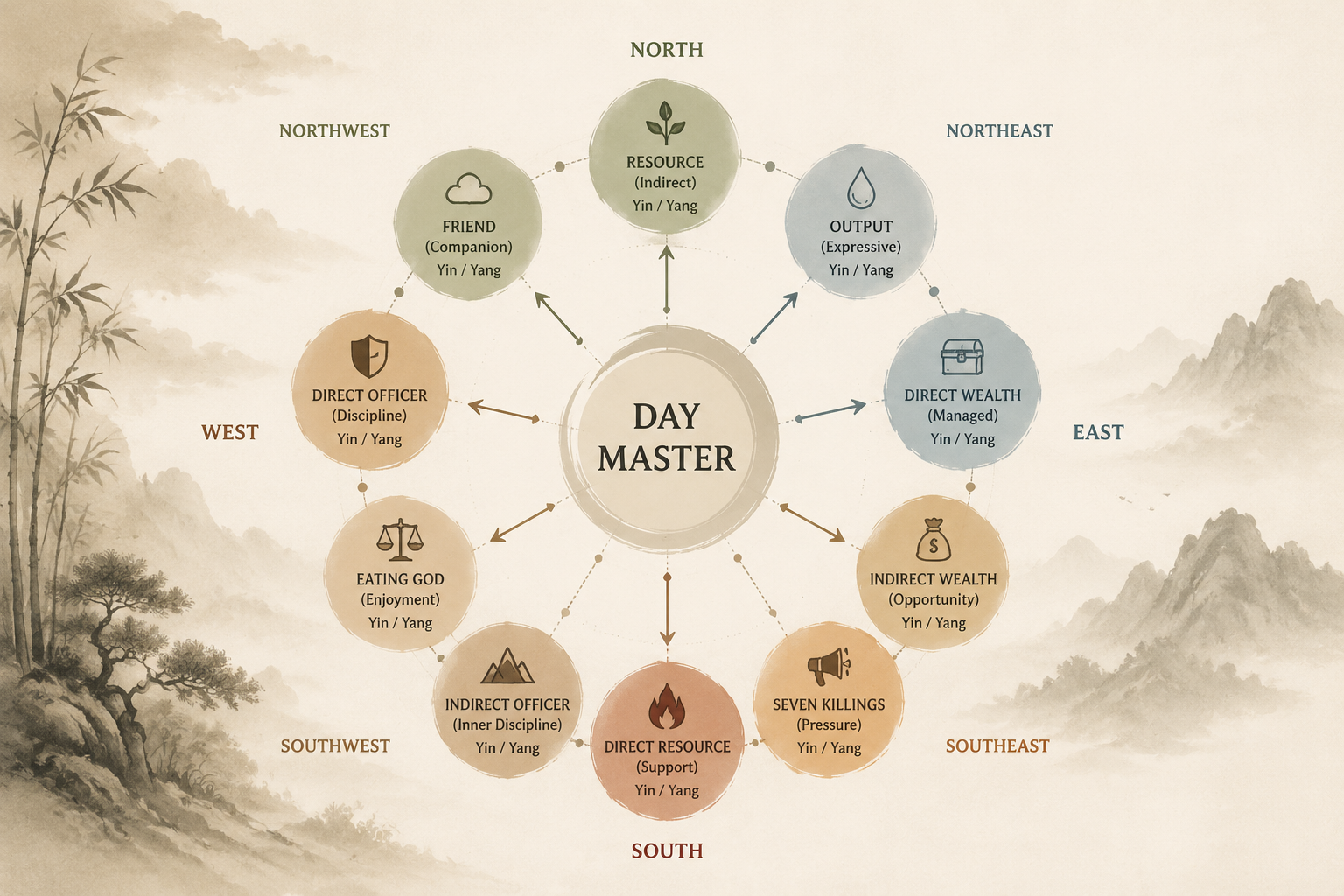
Every BaZi chart is built on relationships. At its centre sits the Day Master, representing the person whose chart is being read. Around it, the other seven stems and the earthly branches unfold a network of interactions that are traditionally organised into ten distinct archetypes known as the Ten Gods (Shíshén). This system is not a collection of mystical entities; it is a structured method for categorising how the element of the Day Master interacts with every other element present in the chart.
In this guide, we walk through what the Ten Gods are, how they are determined, the ten core relationships, and how to approach them as part of a restrained, transparent BaZi reading. No predictions, just method.
What Are the Ten Gods?
The Ten Gods (十神, Shíshén) are ten standardised labels that describe the relationship between the Day Master’s elemental stem and each of the other Heavenly Stems that appear in the chart. Because every stem belongs to one of the Five Elements and carries a yin or yang polarity, the interaction between two stems always falls into one of five broad categories—Resource, Parallel, Output, Wealth, or Power—each split into a yin and a yang variant, giving ten in total.
These relationship categories provide vocabulary for discussing the chart. Instead of saying “you have a lot of the element that produces your Day Master,” we say “you have strong Direct Resource” or “Indirect Resource.” This abstraction makes it possible to talk about thematic patterns without reducing everything to raw elemental counts.
The Ten Gods are widely used because they offer a consistent, shareable language for exploring a BaZi configuration. They do not, by themselves, make predictions. Their value lies in structuring what the chart already shows.
How the Ten Gods Are Determined
To determine which Ten God a given Heavenly Stem represents for a specific chart, you need to look at two things: the element of the Day Master and the element of the other stem, and their yin-yang polarity. The method follows the generating and controlling cycles of the Five Elements.
The Base Rules
- Identify the Day Master’s element and polarity. For example, if the Day Master is Yang Wood (甲, Jia), its element is Wood and its polarity is yang.
- Take the stem you want to classify. Suppose it is Yin Water (癸, Gui). Water produces Wood in the Five Elements cycle, so the relationship is Resource or Nourishment. Because the Day Master is yang and the other stem is yin (different polarities), it becomes Direct Resource (正印, Zhèng Yìn). If the other stem were Yang Water (壬, Ren), same element but same polarity, it would be Indirect Resource (偏印, Piān Yìn).
This same logic applies across all interactions:
- Generating cycle (element produces Day Master) → Resource
- Same element → Parallel (Friend / Rob Wealth)
- Day Master produces other element → Output (Hurting Officer / Eating God)
- Day Master controls other element → Wealth (Direct / Indirect Wealth)
- Other element controls Day Master → Power (Direct Officer / Seven Killings)
Polarity decides whether the relationship is the direct (yin-yang opposite) or indirect (yin-yang same) variant. This simple framework turns the chart into a network of clearly labelled connections.
If you are new to the Five Elements or the Day Master concept, you can explore them in our detailed Day Master and Five Elements guides.
The Ten Relationships at a Glance
Below is a systematic overview of the ten gods, grouped by function. The names used here are the most common English translations, but the concepts are rooted in the generating and controlling cycles, not in fortune.
Resource Stars (印星)
Direct Resource (正印)
When a different-polarity element produces the Day Master. Traditionally associated with support, learning, and protection. It suggests a chart that draws on stable, external sources of knowledge or care.
Indirect Resource (偏印)
When a same-polarity element produces the Day Master. Often linked to unconventional intelligence, intuition, and sudden insights. It can indicate a mind that works outside formal structures.
Parallel Stars (比劫)
Friend (比肩)
Same element and same polarity as the Day Master. Represents peers, equals, or the personal sense of self. It underlines independence and straightforward self-expression.
Rob Wealth (劫财)
Same element but opposite polarity. Points to social competitors, siblings, or the dynamics of sharing and rivalry. It highlights how the person navigates cooperation and competition.
Output Stars (食伤)
Eating God (食神)
When the Day Master produces an element of the same polarity. Connected to talent, creativity, and gentle expression. It often describes the ability to produce something of value in a calm, steady way.
Hurting Officer (伤官)
When the Day Master produces an element of the opposite polarity. A more intense output star, related to unconventional talent, sharp critique, and breaking established norms. It can signal a rebellious streak.
Wealth Stars (财星)
Direct Wealth (正财)
When the Day Master controls an element of the opposite polarity. Reflects earned income, material assets, and step-by-step gain. It emphasises discipline and sustained effort.
Indirect Wealth (偏财)
When the Day Master controls an element of the same polarity. Associated with windfalls, business acumen, and risk-taking. It can point to an entrepreneurial or speculative edge.
Power Stars (官杀)
Direct Officer (正官)
When a different-polarity element controls the Day Master. Stands for authority, discipline, rules, and structure. It often relates to career, reputation, and the ability to work within systems.
Seven Killings (七杀)
When a same-polarity element controls the Day Master. A challenging power star that brings pressure, competition, and the need for resilience. It can also denote leadership through overcoming obstacles.
Every chart will contain a mixture of these relationships, and the distribution across the four pillars provides a starting point for reading thematic emphases. Use the [Free BaZi Chart](/ ) tool to see how your own stem relationships translate into Ten Gods.
Reading the Ten Gods in a BaZi Chart
Once you have identified the Ten Gods in each pillar, the reading moves from labelling to pattern observation. Here are three core steps that keep the process grounded and transparent.
1. Locate the Dominant Themes
Look at which Ten Gods appear most frequently and in which pillar. A chart heavy in Resource stars may emphasise learning and support; one overweight in Wealth stars may point to a life path centred on resource management. Dominance is not destiny—it is simply a starting point for understanding which themes are more pronounced.
2. Observe Interactions
The Ten Gods do not operate in isolation. They interact through the same Five Element cycles that created them. A Direct Officer (Metal controlling Wood) may find its expression softened if there is also a strong Direct Resource (Water producing Wood) to buffer the pressure. These internal dynamics are where the chart’s story becomes more nuanced.
3. Place the Chart in Time
The Ten Gods appear not only in the natal chart but also in the Luck Pillars and annual cycles. Observing how the mix of Ten Gods shifts over time can highlight periods where certain themes become more prominent. Again, this is pattern recognition, not prediction. For a deeper look at timing, our Luck Pillars guide explains the framework.
Throughout any reading, it is important to remember that BaZi is a cultural reference. The Ten Gods offer language, not a verdict. The same Direct Wealth star can describe a careful saver in one context and a detail-oriented project manager in another. Context, life experience, and the broader chart configuration always matter.
Limitations and Cultural Context
The Ten Gods system is a product of Chinese metaphysical tradition. It is a structured, relational model—not an empirical science. It does not guarantee outcomes, nor does it replace personal agency. When we discuss Direct Officer as “authority” or Indirect Wealth as “windfall,” we are using shared cultural symbols, not issuing financial advice.
Free BaZi presents the Ten Gods as part of a transparent toolset. We encourage readers to approach them with curiosity and critical thinking. If a configuration seems to suggest a challenging theme, remember that any single Ten God is only one thread in a much larger fabric. The interplay of elements, the strength of the Day Master, and real-life decisions all shape how themes actually manifest.
When using our BaZi Chart tool, you will see your Ten Gods displayed clearly alongside the chart, with no hidden interpretations. This clarity allows you to learn the system at your own pace, building understanding step by step.
Frequently Asked Questions
Are the Ten Gods real deities or spirits?
No. Despite the name, they are not gods, spirits, or supernatural beings. The term “god” is a translation of the Chinese character 神, which in this context means a functional archetype or category. They are labels for relationships between stems.
How do I find out my Ten Gods?
You can obtain your Ten Gods instantly by generating a chart on the Free BaZi homepage. Once you enter your birth details, the tool calculates the Day Master and maps every Heavenly Stem to its corresponding Ten God, displaying them directly on the chart.
Can the Ten Gods predict my future?
No. The Ten Gods describe thematic patterns based on the Five Elements and yin-yang interactions. They provide a vocabulary for discussing character, tendencies, and life themes, but they do not predict specific events. Any responsible reading treats them as a cultural lens, not as a deterministic forecast.
What is the difference between Direct Officer and Seven Killings?
Both are Power stars—elements that control the Day Master. Direct Officer appears when the controlling element has opposite polarity (yang vs yin), and it is often likened to orderly authority and discipline. Seven Killings occurs when the polarity matches, and it typically indicates more intense, competitive pressure. In practice, the chart’s overall balance and the Day Master’s strength strongly influence how either is expressed.
Do I need to study all Ten Gods to read my chart?
You don’t need to memorise all ten at once. Starting with the broad five categories—Resource, Parallel, Output, Wealth, Power—often gives enough structure for a first reading. As you become more familiar, the yin and yang distinctions add further nuance. Our Five Elements guide is a helpful companion while learning.