BaZi Chart — How a Four Pillars Chart Is Structured
A structured guide to understanding the components and organization of a BaZi (Four Pillars) chart, including the Eight Characters, Day Master, Five Elements, and Ten Gods. Learn how the chart is built and read as a cultural reference tool.
A BaZi chart, often called the Four Pillars of Destiny, is a structured representation of the Chinese sexagenary cycle applied to a person’s birth date and time. The term “BaZi” (八字) means “Eight Characters,” because the chart compresses a moment in time into four vertical pillars, each carrying two characters: one Heavenly Stem and one Earthly Branch. This arrangement produces a clear, repeatable framework that is used as a cultural reference for understanding personality inclinations, relationship dynamics, and life phases—always within the context of a structured reading method, never as a fixed or guaranteed prediction.
Before diving into interpretation, it’s essential to understand how the chart is physically organized. The backbone of any BaZi reading starts with the chart itself—its layout, its components, and the logic behind each placement. This guide walks through that structure step by step.
The Eight Characters (BaZi) at a Glance
A completed BaZi chart consists of four columns, or pillars, read from right to left (or top to bottom in some layouts):
- Year Pillar – corresponds to the year of birth in the Chinese calendar.
- Month Pillar – derived from the birth month.
- Day Pillar – the center of the chart, representing the day the person was born.
- Hour Pillar – based on the two-hour time slot of birth.
Each pillar contains two rows:
- The Heavenly Stem (top row) – one of the 10 celestial stems.
- The Earthly Branch (bottom row) – one of the 12 terrestrial branches.
Because there are four pillars and each gives two characters, the total number of characters in the chart is eight—hence the name BaZi. The chart can be displayed vertically or horizontally, but the relationships between stems and branches remain the same. Below is an example layout of what a basic BaZi chart looks like when generated by a tool like Free BaZi:
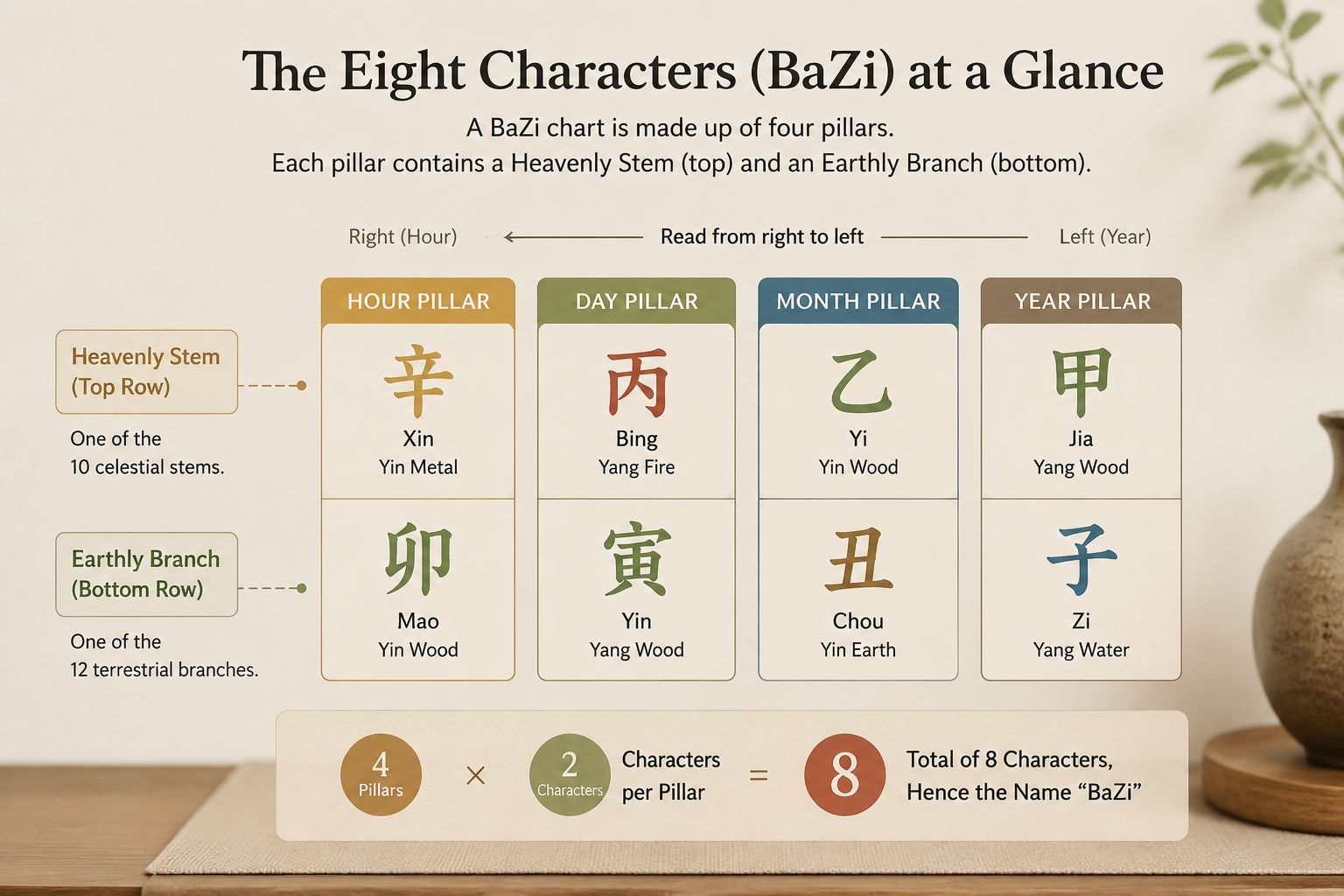
Every stem and branch is assigned an elemental quality (Wood, Fire, Earth, Metal, or Water) and either yin or yang polarity. This elemental mapping is the first step toward any reading, as it sets the stage for understanding interactions and cycles.
How a Pillar Is Formed: Stems, Branches, and Hidden Stems
A pillar is more than a simple stem-branch pair. The Earthly Branch always contains one or more hidden stems—these are the stored energies or sub-elements within each branch. For example, the Earthly Branch “Yin” (寅) is primarily Wood but also contains hidden stems of Earth and Fire. These hidden components enrich the chart’s depth and influence how the branch interacts with the stem above it and with other pillars.
The pairing of a stem and branch follows the 60-combination cycle (the sexagenary cycle). In BaZi chart construction, the year pillar is often found in the Chinese almanac (Huangli), and the month, day, and hour are then computed using systematic rules based on the solar calendar. The Five Elements and their producing and controlling cycles provide the underlying logic for these calculations. A detailed understanding of each pillar’s composition helps the reader move from raw data to meaningful relationships, especially when mapping the Ten Gods.
The Role of Hidden Stems
Hidden stems act as a second layer of information within the Earthly Branches. They explain nuances that the main stem-branch pair alone might not reveal. When interpreting a chart, a practitioner will consider not only the surface stem and branch but also the hidden stems, because they can form connections with other stems or branches in the chart. This layered view is what makes a Ten Gods analysis possible—each hidden stem, like any visible stem, can produce one of the ten god relationships relative to the Day Master.
Reading the Chart: Day Master, Elements, and Ten Gods
The centerpiece of any BaZi reading is the Day Master, which is the Heavenly Stem of the Day Pillar. This stem represents the person at the core of the chart, and its element (Wood, Fire, Earth, Metal, or Water) defines the default lens through which all other characters are evaluated. For instance, if your Day Master is Yang Wood (Jia), the entire chart is interpreted from the perspective of a Wood-type anchor.
Every other stem and branch in the chart—including those in the Month, Year, and Hour Pillars, plus any luck pillars and annual cycles—is classified in relation to the Day Master using the Ten Gods system. The Ten Gods are not deities but categories of relationship that arise from the interplay of elements (through the creation and controlling cycles) and yin-yang polarity. The categories include, among others, the Friend, the Indirect Wealth, the Direct Officer, and the Eating God. Each category describes an archetypal influence that can be read in context.
To orient yourself in a chart, the typical reading path follows this sequence:
- Identify the Day Master’s element from the Day Pillar’s Heavenly Stem.
- Scan the month stem and branch to understand the season and the strongest elemental influence.
- Map the Ten Gods for the remaining stems and branches, including hidden stems.
- Observe the structure and balance of elements across the four pillars.
Even without diving into advanced interpretation, this basic walk-through shows how the chart is more than a static set of eight symbols—it reflects a dynamic network of interactions. The Day Master page on Free BaZi offers a deeper look at each stem type and its signature traits.
Luck Pillars and the Time Axis
A BaZi chart is not meant to be read only as a fixed natal snapshot. The traditional system adds a temporal dimension through luck pillars (also called Da Yun, or large cycles). These are 10-year periods that overlay the natal chart and shift the elemental balance at different stages of life. The start point and direction of the luck pillars are calculated from the gender, birth year, and month pillar timing, following well-documented rules.
In practice, a reading often considers:
- The static natal chart (the four pillars at birth).
- The current luck pillar (the 10-year cycle).
- The annual pillar (the current year’s stem and branch).
The interplay among these layers shows why two people with the same birth chart may experience different patterns at a given time—the luck pillar sequence is unique to the individual’s gender and precise birth moment. Understanding how luck pillars are derived completes the picture of how a BaZi chart functions as a structured, time-aware reference rather than a one-time label. For more details, see the Luck Pillars guide.
FAQ
What are the Four Pillars in a BaZi chart?
The Four Pillars are the Year, Month, Day, and Hour of birth, each represented by a Heavenly Stem and an Earthly Branch. Together they form the eight characters (BaZi) that serve as the foundation for the entire reading.
How is the Day Master determined?
The Day Master is the Heavenly Stem found on the Day Pillar. Its element and polarity set the baseline for interpreting all other stems and branches in the chart through the Ten Gods classification.
Why are there hidden stems in the Earthly Branches?
Hidden stems add nuance to a chart by revealing the stored elemental energies within each branch. They allow for a finer reading of relationships and show potential influences that the surface characters alone cannot express.
What is the difference between a BaZi chart and a luck pillar?
A BaZi chart is the natal blueprint—the static arrangement of the Eight Characters at birth. Luck pillars are 10-year cycles that modify the chart over time, reflecting shifting elemental emphases and life themes.
Can I generate my own BaZi chart for free?
Yes. You can create your personal chart instantly using the Free BaZi tool and immediately see your Day Master, Five Elements distribution, and Ten Gods. The tool does the calculations based on your birth date and time, giving you a clear, structured chart to begin exploring.