Seasonal Element Strength in BaZi
Learn how the seasons influence the strength of the Five Elements in BaZi and how to assess a Day Master’s seasonal power in chart reading.
In BaZi—the Four Pillars of Destiny—the season of birth is not just a backdrop. It is one of the first and most decisive factors in understanding the balance of the Five Elements within a chart. This article explains how seasonal influence works, how to read it, and what it can (and cannot) tell you about a chart’s structure. The focus is method and clarity, not prediction.
Seasonal strength answers a simple question: does the element of the Day Master receive natural support from the time of year, or is it born into a season that works against it? The answer shapes the entire reading, but always as one layer among many.
The Five Elements and the Seasons
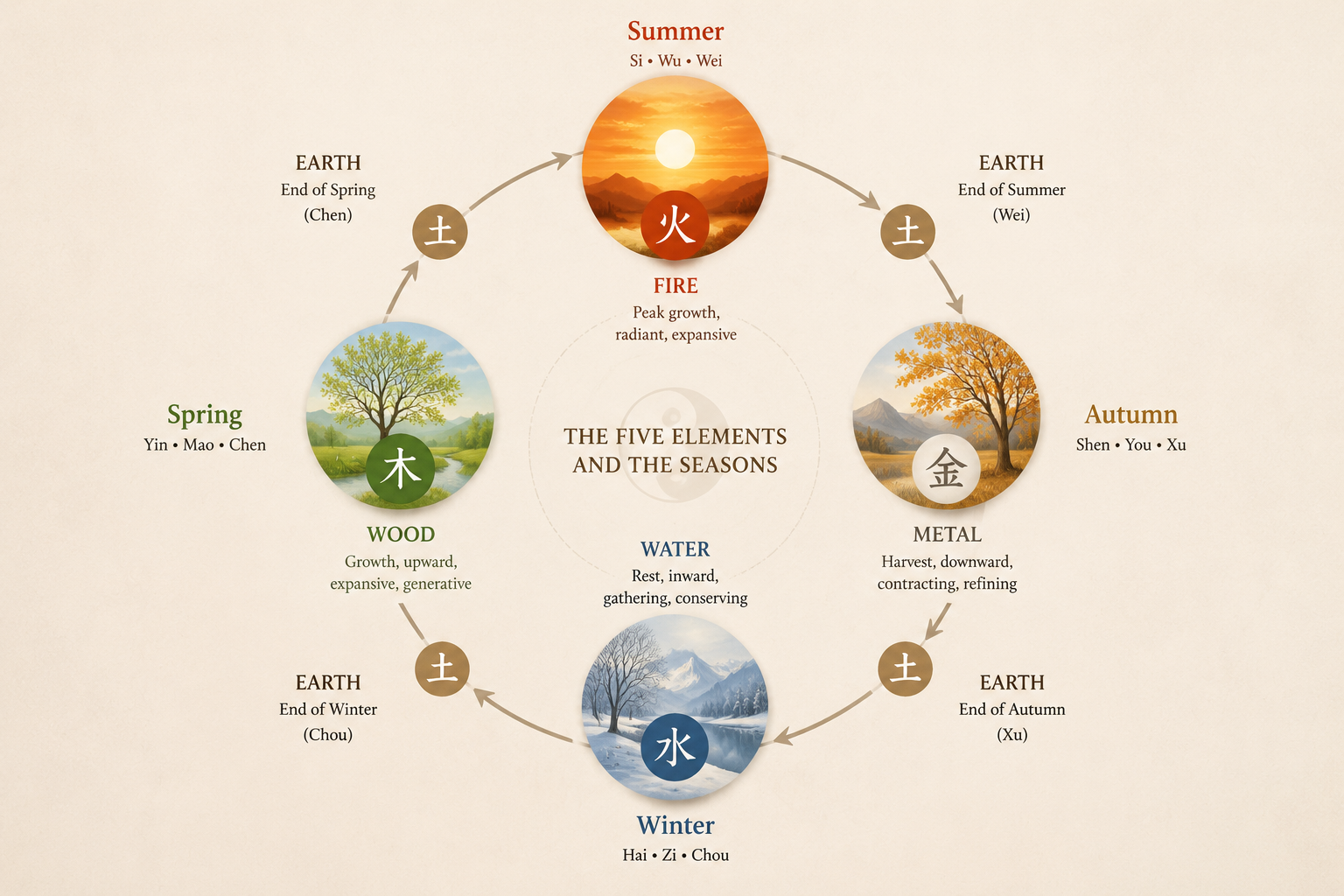
The Five Elements—Wood, Fire, Earth, Metal, and Water—each have a natural relationship with a particular season. This relationship comes from observation: Wood pushes upward in spring, Fire blazes in summer, Metal cuts and contracts in autumn, Water gathers inward in winter. Earth is transitional, appearing most tangibly in the intervals between seasons.
In a BaZi chart, the month pillar is the most direct expression of the season. The earthly branch of the month pillar tells you which element holds the strongest seasonal qi at the time of birth. For example:
- Spring (Yin, Mao, Chen months): Wood is the dominant element. The energy is expansive, upward, and generative.
- Summer (Si, Wu, Wei months): Fire dominates. Energy is hot, outward, and radiant.
- Autumn (Shen, You, Xu months): Metal is strongest. Energy contracts and sharpens.
- Winter (Hai, Zi, Chou months): Water peaks. Energy sinks, stores, and stills.
Earth holds a special place. It is not assigned a single season but is strengthened during the last month of each season—Chen (end of spring), Wei (end of summer), Xu (end of autumn), Chou (end of winter)—and whenever the earthly branch carries a strong Earth component.
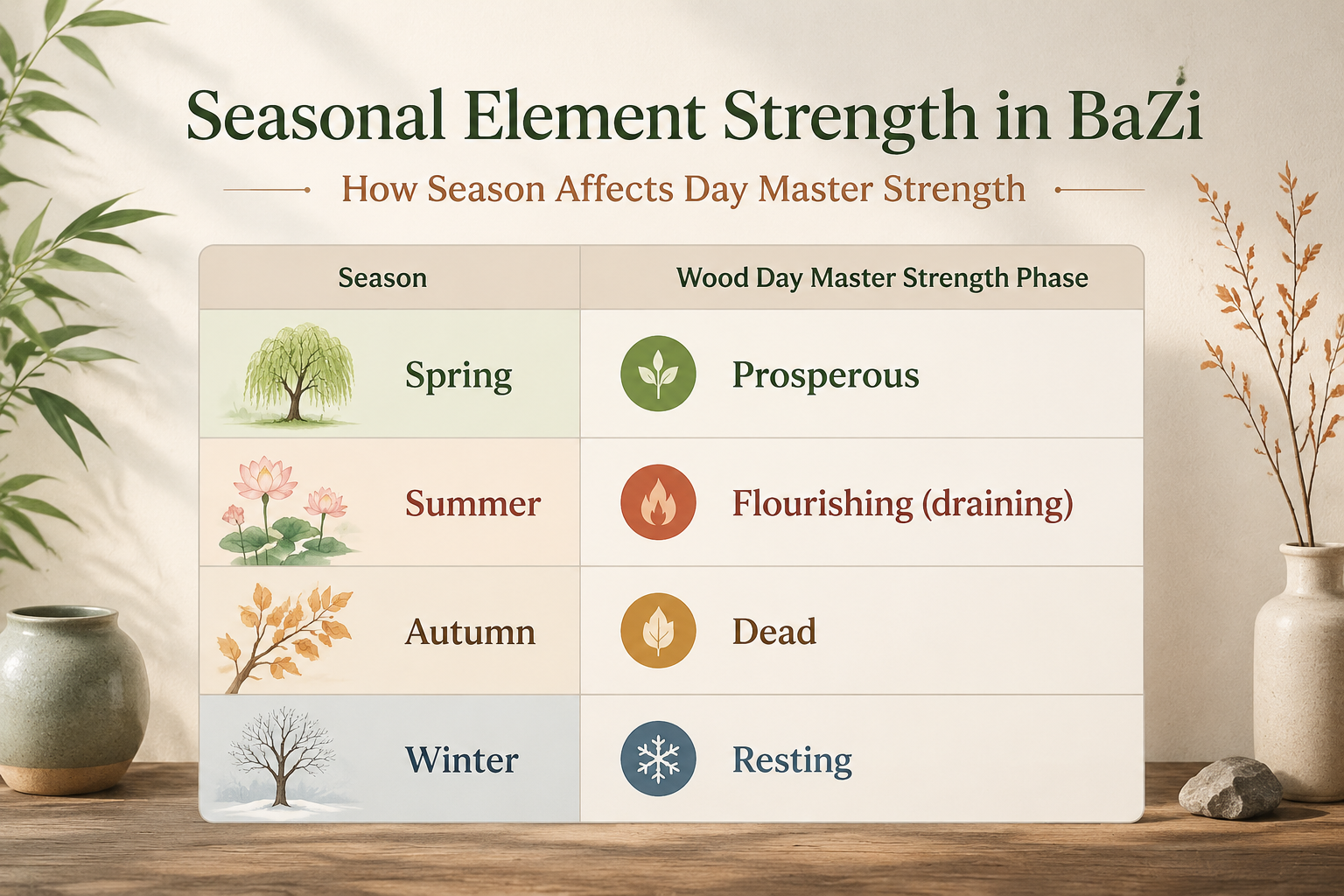
How Season Affects Day Master Strength
The Day Master is the heavenly stem of the day pillar. It represents the self in a BaZi reading. Its strength—whether it is robust, moderate, or fragile—is first assessed by comparing it with the month of birth.
Every element moves through five strength phases as the seasons change. These phases are often described as:
- Prosperous (旺) – the element is the same as the seasonal dominant element (e.g., Wood in spring).
- Flourishing (相) – the element is produced by the season (e.g., Fire in spring, because Wood produces Fire).
- Resting (休) – the element that produces the season becomes less active (e.g., Water in spring: Water produced Wood, so its energy has been used).
- Trapped (囚) – the element that the season controls is weakened (e.g., Metal in spring: Wood controls Earth, but Metal controls Wood—here Metal’s effort to control the strong Wood leaves it depleted).
- Dead (死) – the element that is controlled by the season is at its weakest (e.g., Earth in spring: Wood controls Earth, and Earth has no foothold).
While these five terms are traditional, in practice you can simplify the assessment:
- If the Day Master’s element matches or is produced by the month branch’s main element, it is seasonally strong or supported.
- If the Day Master’s element controls the season’s element or is controlled by it, it is seasonally weaker.
For example, a Wood Day Master born in the Yin month (February) is in its most prosperous state. The same Wood Day Master born in the You month (September) faces the sharp Metal of autumn and will be naturally weaker—unless other chart factors compensate.
Reading Path: Assessing Elemental Strength Step by Step
You don’t need to memorize every phase table to start reading seasonal strength. Follow a consistent method:
- Identify the Day Master element. Look at the day stem in your BaZi chart. Use the Day Master reference to confirm its element.
- Locate the month pillar and its main element. The earthly branch of the month pillar defines the season. For instance, branch Yin = Wood season, branch Wu = Fire season. Even without a chart, knowing your birth month’s branch gives you the seasonal Qi.
- Check the relationship. Is the Day Master element the same as the month branch’s dominant element? That’s immediate seasonal support. Is it the element that the month branch produces? That’s a secondary support—available but less direct. If it’s neither, the Day Master is seasonally unsupported.
- Consider Earth separately. If your Day Master is Earth and the month branch is Chen, Wei, Xu, or Chou, Earth is still seasonally supported, even though the branch may also carry Wood, Fire, Metal, or Water. Earth draws strength from the transitional nature of these months.
- Combine with other pillars. A Day Master that is weak by season can still be strong overall if the remaining pillars contain many supporting elements (same element or the element that produces it). This is why a full reading always looks beyond the month pillar alone.
- Observe the Luck Pillars. The Luck Pillars introduce new seasonal contexts over time. A weak Day Master may enter a Luck Pillar that brings seasonal support, shifting the balance.
This step-by-step approach keeps the reading grounded. Seasonal strength is a starting point, never the final word.
Limitations and a Balanced Perspective
Seasonal strength tells you about elemental resources, not about a person’s worth, success, or destiny.
- Strong does not mean good. A Day Master that is too strong may exhibit excess—stubbornness for Wood, dominance for Metal, restlessness for Fire. Balance is the goal, and BaZi readings often focus on whether a chart needs to weaken an overly strong element or support a seasonally weak one.
- Weak does not mean bad. A seasonally weak Day Master can still be balanced by the supporting elements in the remaining pillars. Many charts with a fragile Day Master are simply more responsive to external factors, such as the presence of producing or parallel elements in the stems and branches or in the Luck Cycles.
- This is a cultural reference, not a guaranteed outcome. BaZi offers a structured way to reflect on personal tendencies and timing. It does not determine a fixed fate, and the seasonal factor is just one part of that reflection.
Use seasonal strength as a lens, not a label. It can help you understand why certain years or Luck Pillars feel different, but it does not replace personal agency.
FAQ
Does a strong Day Master due to season mean I will be successful?
No. Seasonal strength indicates an abundance of a certain elemental quality. Success in any area depends on how that strength interacts with other chart factors, your environment, and your choices. Too much strength without proper outlet can create imbalance.
What if my Day Master’s element is weak in my birth season?
You may start from a point of lower internal momentum, but other elements in the chart—like the stems and branches appearing in the year, day, and hour pillars—can provide support. Additionally, Luck Pillars can bring seasonal boosts later in life.
How does the Earth element work with seasons if it has no dedicated season?
Earth is considered strong during the inter-seasonal months (Chen, Wei, Xu, Chou) and receives support whenever the chart contains multiple Earth branches or stems. While it may appear less tied to a single season, it can still be robust under those conditions.
Can I use seasonal strength to choose a career?
Seasonal strength may hint at inclinations—for example, a strong Wood Day Master might naturally gravitate toward growth-oriented tasks—but career decisions should be based on a broader chart reading that includes the Ten Gods, interactions, and personal context.
How accurate is a seasonal assessment without the rest of the chart?
It provides a partial view. Seasonal strength gives you one dimension of the Day Master’s standing. A full reading incorporates relationships with the other seven characters of the chart, elemental interactions, and the Luck Pillars to reach a balanced picture.
Ready to see how the seasons influence your own BaZi chart? Generate your free chart now and explore the seasonal position of your Day Master right inside the reading interface.