BaZi Patterns (Gé Jú) – Understanding Chart Configuration
Learn how BaZi patterns (Gé Jú) give a structured reading of your chart’s configuration. Understand how Stem-Branch relationships, Day Master strength, and classical categories form the blueprint of a BaZi reading.
A BaZi (Four Pillars of Destiny) chart is not just a collection of eight characters. When the stems and branches arrange themselves into a coherent structure, they form a Gé Jú – a pattern that reveals the chart’s dominant energetic blueprint. This wiki entry explains what patterns are, how they emerge from the Stem‑Branch framework, and how to read them as part of a restrained, method‑driven BaZi analysis.
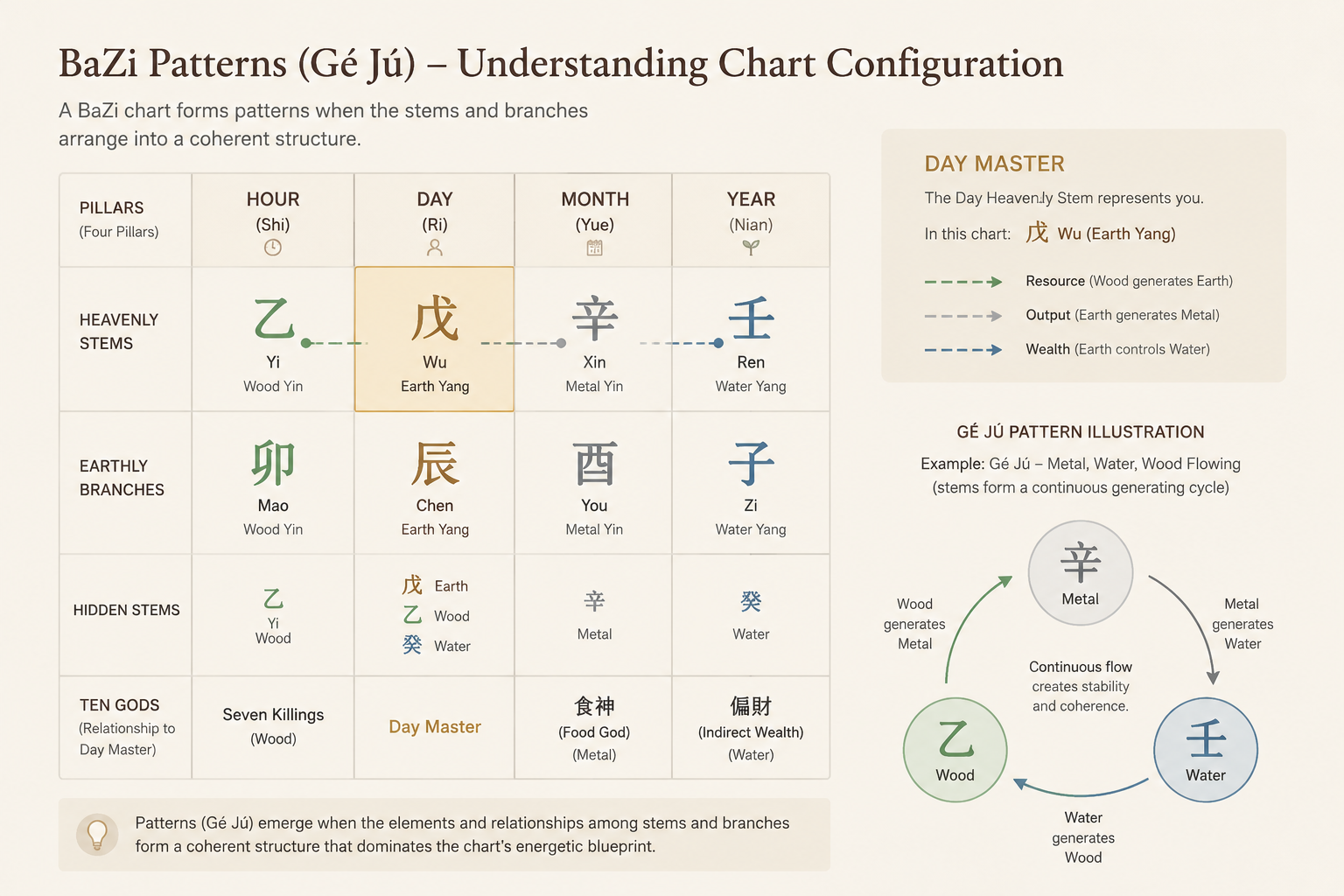
What Are BaZi Patterns (Gé Jú)?
In BaZi, Gé Jú (格局) translates roughly to “structure” or “configuration.” It is a macro‑level reading method that looks beyond individual stems and branches to see how the chart’s elements work together as a whole. While the Ten Gods describe relationships one by one – Officer, Resource, Wealth, and so on – a pattern binds those relationships into a single thematic signature. The pattern answers a basic structural question: What is this chart’s overall mode of operation?
Patterns are rooted in the Five Elements cycles of generation and control. The Day Master’s element interacts with the season of the Month Pillar, and the other pillars either support or challenge that seasonal quality. When enough stems and branches coalesce around a particular element or functional theme, a recognisable pattern appears. Classical texts named dozens of patterns – such as Direct Officer Pattern, Hurting Officer Pattern, or Follow the Wealth Pattern – but modern practice often simplifies them into strength‑based archetypes (Strong Day Master, Weak Day Master) that still respect the underlying Stem‑Branch logic.
Crucially, a pattern is a structural description, not a destiny verdict. It tells you how the chart distributes its energetic resources; it does not predict specific events or promise outcomes. The reading always keeps the boundary that BaZi is a cultural reference tool for self‑awareness, not a fortune‑telling guarantee.
How Patterns Form: The Stem‑Branch Framework
The Month Pillar is the anchor of pattern formation. It carries the strongest qi because it governs the season. The Day Master’s element is checked against the Month Branch to determine whether the self is strong or weak in that environment. From there, every other Heavenly Stem and Earthly Branch is evaluated as a network of support or control.
- Supportive forces come from the same element as the Day Master (parallel energy) or the element that produces it (Resource).
- Controlling forces come from the element the Day Master controls (Wealth), the element that controls the Day Master (Officer), or the element the Day Master generates (Output).
When one of these forces dominates the chart – for example, if the stems and branches are packed with Resource elements and the Day Master is strong – a pattern of Strong Day Master with Resource dominance emerges. If the chart is instead filled with Wealth or Officer elements and the Day Master is weak, the pattern may lean toward a Following configuration, where the native’s energy aligns with the external power rather than resisting it.
Patterns are not static. The Luck Pillars, which unfold over time, can strengthen, weaken, or even temporarily shift a chart’s pattern. A weak Day Master that follows a strong Wealth element may perform well only during luck cycles that support that wealthy influence; if a conflicting Resource cycle arrives, the pattern’s harmony can be disrupted. This is why pattern analysis always works in tandem with the full life‑cycle reading of Luck Pillars.
Reading Common Pattern Categories
Instead of memorising dozens of classical pattern names, it is more useful to understand the structural families to which most charts belong. These families are described by the relationship between the Day Master’s strength and the dominant functional star (expressed through the Ten Gods).
- Strong Day Master with Output dominance – The chart abounds in the element the Day Master generates (Output: Eating God or Hurting Officer). The native’s resourcefulness tends to flow outward into expression, creativity, or communication. The pattern works well when the Day Master is genuinely strong and there is some Wealth element to ground the output.
- Strong Day Master with Resource dominance – Resource elements (Direct or Indirect Resource) heavily nourish the self. This creates internal steadiness but also a risk of inertia. For the pattern to be productive, an Output or Wealth element is needed to channel the stored energy.
- Weak Day Master following a powerful influence – When the Day Master is markedly weak and one external force (such as Wealth or Officer) overwhelmingly fills the chart, the configuration often functions as a “following” pattern. Instead of resisting, the native’s energy merges with that dominant force, making the external structure the primary operating principle.
- Balanced chart – No single functional star dominates. The chart’s qi is evenly distributed, and the native’s experience shifts with each Luck Pillar rather than following one unified theme. These charts are sometimes called “special” or “irregular” patterns in classical texts, but their very flexibility is their defining characteristic.
None of these descriptions are personality labels or fate pronouncements; they are structural lenses that help you see which part of the chart is the loudest and how the Day Master is positioned in relation to it. Always ground the reading in the whole chart and the individual’s context.
Pattern Strength and the Day Master Context
A pattern’s usefulness depends on the Day Master’s ability to handle it – a concept often referred to as the Useful God (Yong Shen). The Useful God is the element that resolves the chart’s innate tension and makes the pattern work coherently.
For instance, a Hurting Officer pattern with a strong Day Master can be dynamic and effective, but it may need a Fire element (if the chart calls for it) to temper the output and maintain focus. Without that Useful God, the same pattern might manifest as scattered energy or impulsiveness. Conversely, a pattern that appears “difficult” – such as a heavy Officer structure – becomes workable when the right Useful God (for example, Resource to transform the Officer pressure into nourishment) appears.
To explore your own Day Master strength and pattern clues, use the Free BaZi chart tool to generate a chart. The tool’s interface provides the Stem‑Branch breakdown and highlights the primary relationships, giving you a solid foundation for pattern work.
Using Patterns in a Full Chart Reading
A pattern is a map, not the journey. Once you have a read on the Gé Jú, you still need to examine:
- The exact placement of Ten Gods in each pillar
- Special relationships such as Clashes, Combinations, and Harms that modify elemental flow
- Luck Pillar timing, which shows when specific themes are activated or deactivated
- The ongoing dialogue between the pattern and the native’s lived reality
For example, a Follow the Wealth pattern may describe a person who naturally operates within financial or tangible frameworks, but that does not mean perpetual abundance. The chart might show a wealth‑friendly Luck Pillar at age 30, but a severe clash at 40 that disturbs the configuration. Reading the pattern gives you the baseline; reading the rest of the chart tells you how that baseline plays out over time.
Understanding patterns is an invitation to engage with the chart as a structured system of meaning, not as a collection of separate predictions. The language of Gé Jú helps you ask better questions about the self and its environment, always anchored in the cultural reference that BaZi provides.
FAQ
Is a strong pattern always favourable?
Not in itself. A pattern describes a configuration, not an absolute quality. A strong Officer pattern might indicate order and discipline, but if the Day Master is too weak to carry that Officer energy, the result can feel oppressive or restrictive. Patterns are only one part of the reading; their practical expression depends on balance, the Useful God, and the timing of Luck Pillars.
Can my chart contain more than one pattern?
Yes, many charts display overlapping or mixed patterns. The analysis weighs which theme carries the most weight – often the influence coming from the Month Pillar. When a chart contains two equally strong themes (for example, both Output and Resource), the pattern becomes a dialogue between those forces, and the reading must account for the dynamic tension between them.
What if I don’t find a classical pattern in my chart?
Not every chart fits neatly into a named Gé Jú. Balanced charts, or those where qi moves in a complex, inter‑relational way, may not follow a single dominant theme. In those cases, it is more fruitful to focus on the practical arrangement of elements and the interactions between stems and branches, rather than forcing a pattern label. A reading that prioritises clarity over classification often yields the most useful insights.
Pattern analysis is one of the most rewarding aspects of BaZi study because it gives you a way to see the whole chart at once. Start with your own chart using the Free BaZi tool, note the Day Master’s strength, and observe which functional star appears most frequently – that is often the first clue to your present configuration.