Clashes & Combinations — How BaZi Pillars Interact
Explore the six clashes and six combinations in BaZi. Learn how Earthly Branch interactions shape the dynamics of a chart—with clear examples and reading guidance.
In BaZi (Eight Characters) analysis, the interaction between the four pillars—Year, Month, Day, and Hour—shapes the narrative of a chart. While Heavenly Stems express the visible qualities, the Earthly Branches carry the deeper, hidden dynamics. The two most fundamental patterns among branches are the Six Clashes and the Six Combinations. These relationships describe how the energy of two branches connect, create tension, or merge. In this guide, we’ll break down each clash and combination, explain their practical significance, and show you how to identify them in your own chart using the Free BaZi chart.
The Building Blocks: Stems, Branches, and the Five Elements
A BaZi pillar consists of a Heavenly Stem and an Earthly Branch. The 12 Earthly Branches (子 Zi, 丑 Chou, 寅 Yin, 卯 Mao, 辰 Chen, 巳 Si, 午 Wu, 未 Wei, 申 Shen, 酉 You, 戌 Xu, 亥 Hai) each carry animal signs, hidden elemental qualities, and a primary element. Interactions between branches are governed by the Five Elements (Wood, Fire, Earth, Metal, Water) and their cycles of creation and destruction. A clash represents a mutually destructive scenario—two opposite branches strike each other’s element—while a combination is a merging or attraction that often generates a new element.
Understanding these interactions starts with the basics of the elements. For a deeper dive into elemental relationships, see our Five Elements wiki.
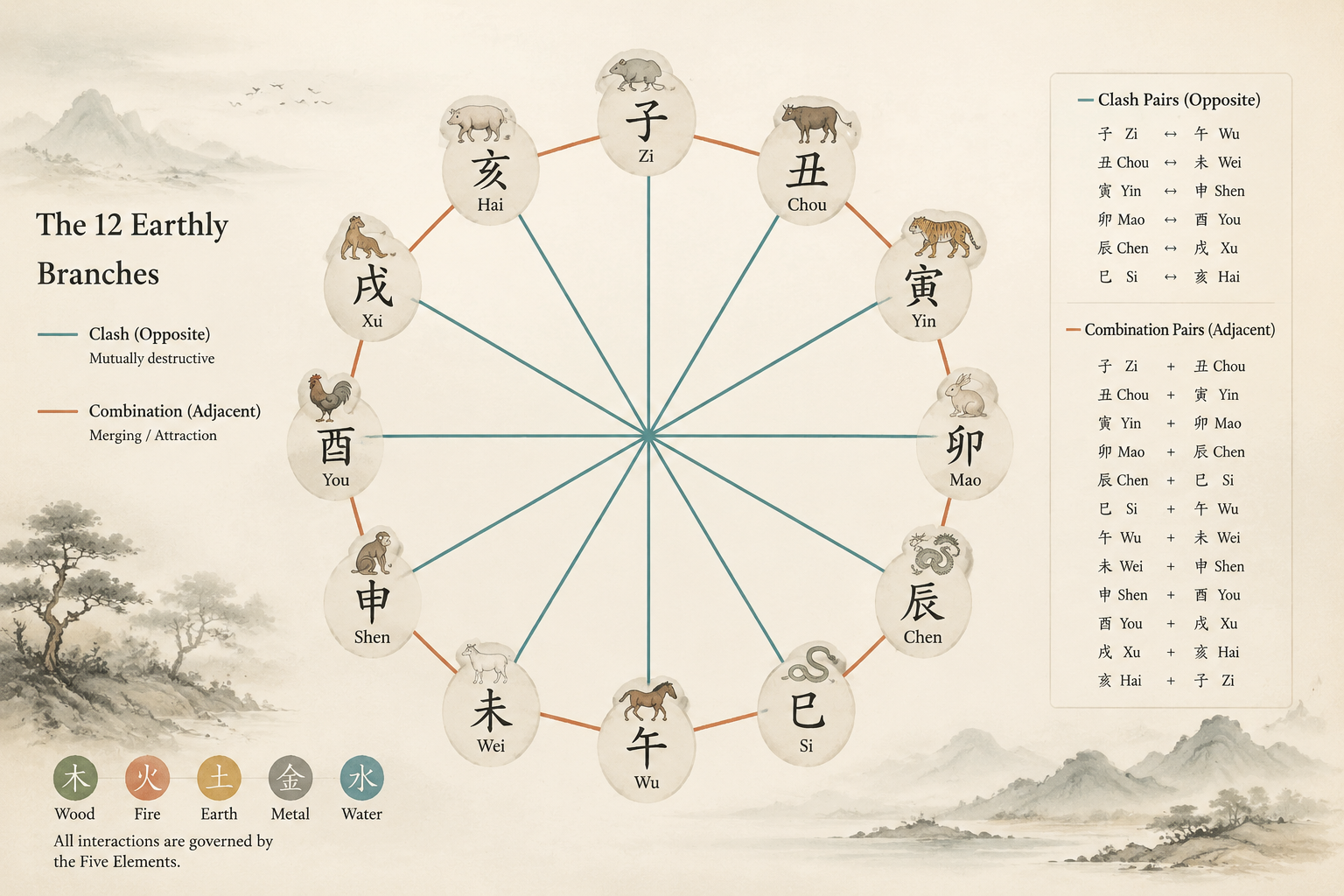
The Six Clashes: Tension and Awakening
Clashes occur between opposite branches on the traditional compass circle. They are:
- Zi (子) – Wu (午): Water clashes with Fire
- Chou (丑) – Wei (未): Earth clashes with Earth (wet vs. dry)
- Yin (寅) – Shen (申): Wood clashes with Metal
- Mao (卯) – You (酉): Wood clashes with Metal
- Chen (辰) – Xu (戌): Earth clashes with Earth (spring reservoir vs. autumn storage)
- Si (巳) – Hai (亥): Fire clashes with Water
In a reading, a clash signals friction, sudden change, or conflicting interests. It doesn’t always mean misfortune—clashes can break stagnation and force necessary recalibration. When a clash appears between the Day Branch (self) and a Luck Pillar or annual pillar, it often marks a period of dynamism that invites self-awareness and adjustment. If the clash involves your Day Master, pay attention to the elemental confrontation: for example, a Water Day Master facing a Fire clash may experience heightened emotional intensity or creative pressure that, with mindful handling, can fuel growth.
The Six Combinations: Harmony and Fusion
Combinations involve pairs of branches that feel a natural affinity, often neighbouring on the branch circle, and they tend to produce a new element:
- Zi (子) – Chou (丑): merges to Earth
- Yin (寅) – Hai (亥): merges to Wood
- Mao (卯) – Xu (戌): merges to Fire
- Chen (辰) – You (酉): merges to Metal
- Si (巳) – Shen (申): merges to Water
- Wu (午) – Wei (未): merges to Fire
These patterns indicate attraction, cooperation, and blending of energies. In a birth chart, a combination between the Day Branch and another pillar’s branch may describe a natural alliance, be it with family, career, or inner qualities. For instance, a Mao-Xu combination brings a catalytic Fire that can add warmth and expressiveness, though it may also blur personal boundaries. Because combinations can alter the Ten Gods affinities within a chart, a deeper look at Ten Gods helps you interpret how these shifts influence personality and life themes.
Combinations are also central to relationship dynamics. When two people’s Day Branches form one of the six combinations, it often indicates a sense of ease and mutual understanding—a key factor in Compatibility readings.
Reading Clashes & Combinations in Your Own Chart
Interpreting these interactions is a structured process. You can follow this method whenever you examine a chart:
- Plot your chart – Use the Free BaZi chart. It automatically highlights clashes and combinations, saving you manual lookup.
- Identify the branches – Note the four Earthly Branches in the Year, Month, Day, and Hour pillars, plus the branch of your current Luck Pillar and the current year.
- Spot clashes – Look for opposite pairs from the clash list. If your Day Branch is 寅 (Yin) and the Year Branch is 申 (Shen), a clash exists—suggesting a tension between personal direction and external circumstances or family background.
- Spot combinations – Check for adjacent pairs that make a standard combination. A combination between Month and Hour branches, for example, can blend social role with personal projects.
- Interpret contextually – Which pillars are involved? A clash touching the Day Branch will affect the self more directly than one between Year and Month. The elements involved tell you what life domain may feel the friction: Water-to-Fire combines emotions with action; Wood-to-Metal can reflect ambition meeting structure.
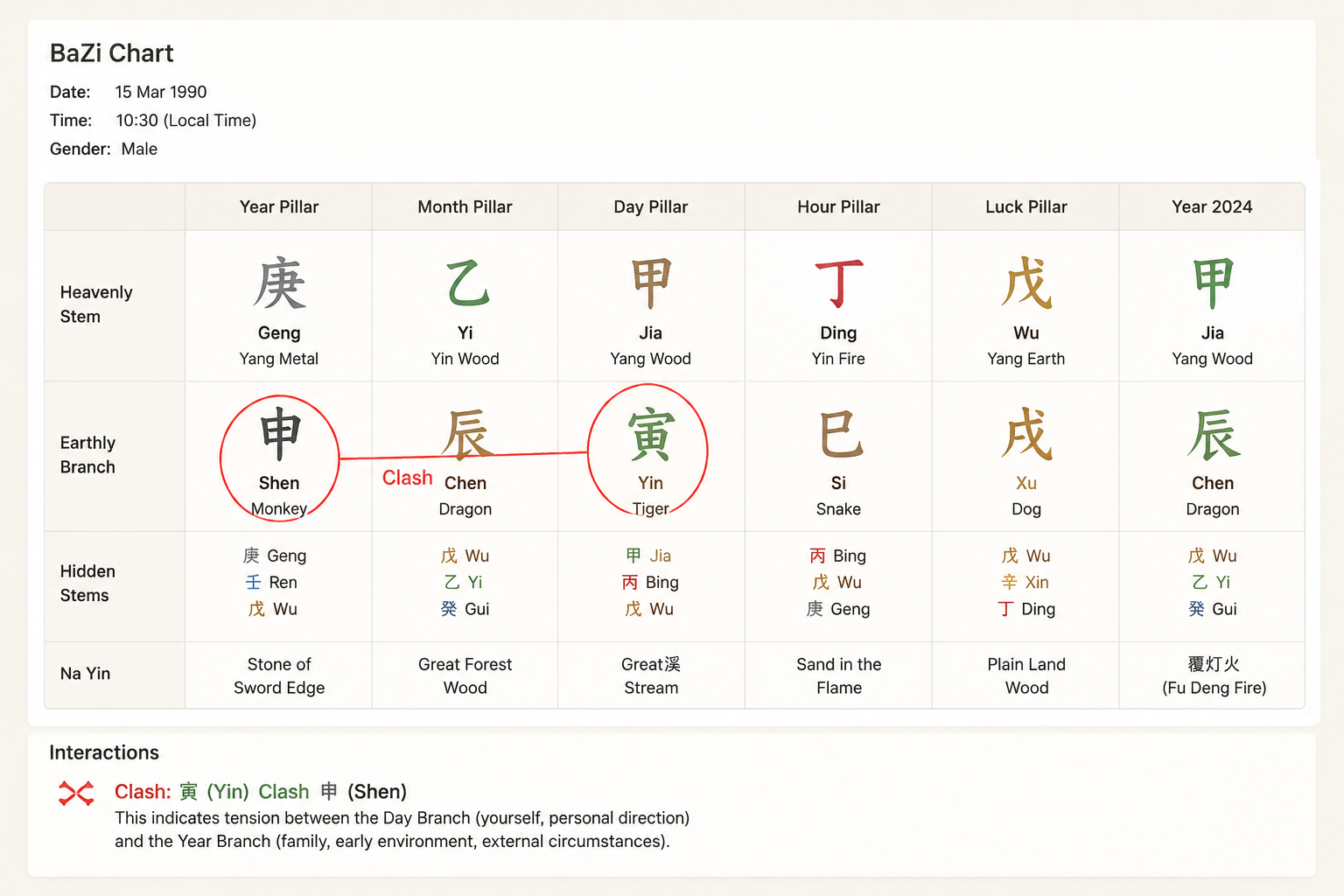
Daily interactions also matter. The Huangli calendar shows the Earthly Branch of each day, allowing you to notice temporary clashes or combinations that colour the day’s mood. Remember that these patterns are cultural reference points and reading aids, not fixed predictions. They invite attention to possible dynamics so that you can engage with life more consciously.
FAQ
Are clashes always negative in BaZi?
No. Clashes create tension that can break stalemates and accelerate necessary change. Many growth phases begin with a clash that pushes us out of comfort zones. The real question is how the energy is channelled—clashes are neutral events that gain their colour from the rest of the chart and your own response.
Can a combination cancel out a clash?
In practice, both a clash and a combination can be present between the same pillars, resulting in a layered dynamic. While a strong combination can soften a clash, it rarely erases it completely. The seasonal strength of the elements and the presence of supporting stems determine whether one influence overshadows the other. A full chart evaluation is needed for clarity.
Do all six combinations result in a transformation of the elements?
Not automatically. Transformation requires additional conditions, such as a Heavenly Stem with the same element or a season that supports the new element. Without these, the combination may only represent an alliance or attraction without fully generating a new elemental character. Detailed analysis of the whole pillar structure, including hidden stems, reveals whether transformation is active.