Ten Gods Relationship Groups
Learn how the Ten Gods are organized into five logical relationship groups based on the Five Elements. Understand the Companion, Resource, Output, Wealth, and Influence categories to begin reading a BaZi chart with clarity.
In BaZi (Four Pillars of Destiny), the Ten Gods are not a random list of labels—they are a logical system derived from the Five Element interactions with the Day Master's own element. By grouping the ten gods into five relationship categories, you can quickly grasp the core dynamics in any chart without becoming overwhelmed by memorization. This structured approach makes reading a BaZi chart more transparent and methodical, turning what can seem like an opaque list into a clear map of elemental relationships.
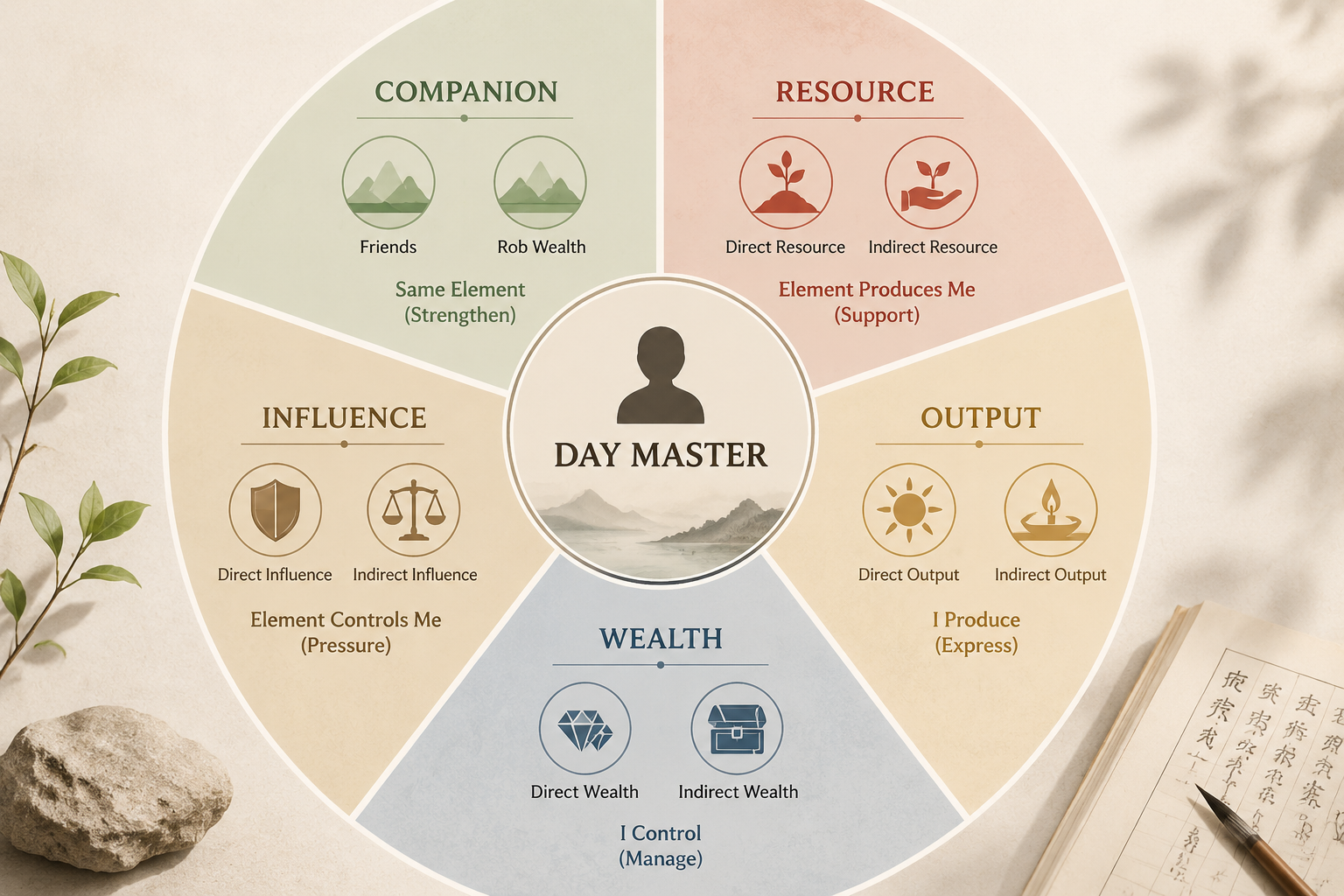
The Five Interaction Categories
Each relationship group is based on a fundamental Five Element interaction with the Day Master. The Heavenly Stem of the Day Master—the day pillar's upper character—represents the person's core element. The ten Heavenly Stems (five yin and five yang versions of Wood, Fire, Earth, Metal, Water) then create ten possible relationships depending on whether the encountered element is the same, producing, produced by, controlling, or controlled by the Day Master. The yin-yang polarity splits each interaction type into two gods, giving us five groups of two.
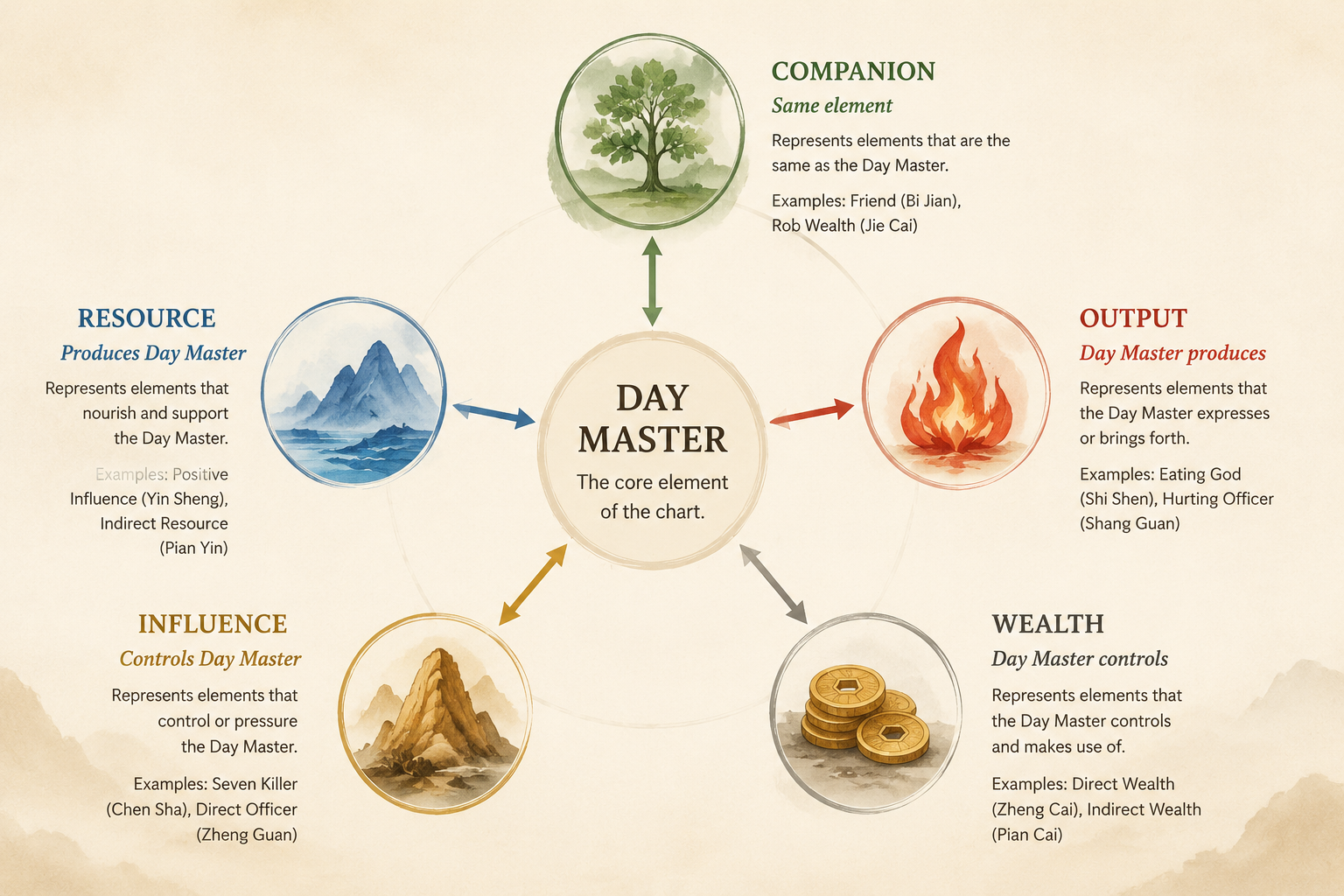
Companion Group: Friend (Bi Jian) and Rob Wealth (Jie Cai)
Both share the same element as the Day Master. When the encountered stem has the same yin-yang polarity, it is Friend; when polarity is opposite, it is Rob Wealth.
Friend represents peers, colleagues, siblings, and a sense of equal standing. It brings support, teamwork, and a sense of belonging. Rob Wealth adds a competitive edge—think friendly rivalry, resource sharing, or situations where you assert yourself among equals. While Friend strengthens your base energy, Rob Wealth can introduce financial pressure or the drive to stand out. This group reflects social circles, competition, and how you relate to people on your own level.
Resource Group: Direct Resource (Zheng Yin) and Indirect Resource (Pian Yin)
These are the elements that produce the Day Master—the "mother" element in the productive cycle. Direct Resource matches the Day Master's polarity; Indirect Resource is opposite.
Resource stars signify nurturing, knowledge, protection, and stability. Direct Resource is associated with formal education, careful study, tradition, and supportive maternal figures. It denotes a steady, structured learning style. Indirect Resource introduces a more unconventional wisdom: intuitive insights, sudden realizations, cross-disciplinary interests, and sometimes a tendency toward detachment or esoteric pursuits. Together, this group reveals how you absorb support, whether through established systems or unique personal paths.
Output Group: Eating God (Shi Shen) and Hurting Officer (Shang Guan)
The Day Master produces these elements—similar to the "child" relationship. Same polarity gives Eating God; opposite polarity yields Hurting Officer.
Eating God represents harmonious expression: creativity, talent, refined speech, and the ability to enjoy life's pleasures with moderation. It calms the mind and fosters gentle but confident output. Hurting Officer amplifies that expression into powerful, sometimes rebellious creativity. It can manifest as sharp intellect, blunt honesty, or a challenge to authority. While Eating God often supports a balanced nature, Hurting Officer brings intense drive that can either disrupt or accomplish extraordinary things. The Output group maps how you express ideas, solve problems, and share your inner world.
Wealth Group: Direct Wealth (Zheng Cai) and Indirect Wealth (Pian Cai)
These are the elements that the Day Master controls (the "subject" in the controlling cycle). Direct Wealth shares the Day Master's polarity; Indirect Wealth is opposite.
Direct Wealth points to stable, earned income: salary, savings, tangible assets accumulated through consistent effort. It embodies responsibility and long‑term planning. Indirect Wealth represents variable income: investments, bonuses, business profits, and risk‑taking. It can indicate an entrepreneurial spirit or financial fluctuation. The Wealth group isn't only about money—it also reflects how you manage resources, value systems, and ambition.
Influence Group: Direct Officer (Zheng Guan) and Seven Killings (Qi Sha)
These elements control the Day Master; they represent authority, discipline, and external pressure. Direct Officer has the same polarity, while Seven Killings (also called Indirect Officer) has opposite polarity.
Direct Officer signifies orderly career progression, respect for rules, social standing, and responsible conduct. It brings a sense of duty and the ability to work within systems. Seven Killings introduces challenge, sudden confrontations, and the need for decisive action. While it can denote stress or obstacles, it also creates leadership and the capacity to handle crises. The Influence group uncovers your relationship with power, rules, and the structures that shape your life.
Using Relationship Groups in Chart Reading
Once you identify your Day Master and generate a chart (the Free BaZi chart tool displays your Ten Gods automatically), you can begin reading by noticing which groups appear repeatedly.
- Check the stems and hidden stems in all four pillars—year, month, day (day branch, and hour).
- Note which groups dominate. For example, a chart heavy in Resource may indicate a person who values learning and security; strong Output suggests expressive, creative energy.
- Observe the balance. Overwhelming Wealth without sufficient Resource or Companion can point to a life focused primarily on material gain, possibly at the expense of personal nourishment.
- Inter-group dynamics also matter. A combination of Resource and Influence often describes a responsible, potentially authoritative figure, while Companion plus Output suggests a social, communicative personality.
These interpretations are not predictions—they are patterns that offer a structured way to understand recurring themes in a life path. Because each pillar represents a different time frame (year for early environment, month for parents and career, day for self and spouse, hour for children and later years), you can also explore how the groups shift across the life journey.
For a detailed list of each god and its archetypal meanings, see our Ten Gods reference. If you're new to the concept, the Ten Gods explained guide breaks down the basics.
Frequently Asked Questions
1. What is the difference between Direct and Indirect gods within a relationship group?
The polarity (yin/yang) differentiates them. Same polarity tends to produce a more harmonious, steady expression; opposite polarity adds dynamic, unconventional, or intense traits to the same elemental relationship.
2. Why are there 10 gods instead of 12?
The Ten Gods come from the ten Heavenly Stems—each stem is a yin or yang version of the Five Elements. When matched with the Day Master stem, you get exactly ten possible relationships. Earthly Branches may contain multiple hidden stems, so a single pillar can express more than one god.
3. Do I need to memorize all Ten Gods?
Starting with the five groups helps simplify the system. The specific gods can be learned progressively, and chart tools like the Free BaZi generator show them instantly, so you can focus on interpretation rather than memorization.
4. Can one pillar contain multiple Ten Gods?
Yes. An Earthly Branch usually contains one or more hidden stems, each yielding a Ten God relative to the Day Master. This adds layered meaning to a pillar.
5. How do Ten God groups affect compatibility?
In BaZi compatibility readings, comparing the Day Masters' Ten Gods and seeing whether the elements are supportive or controlling can highlight areas of natural harmony or tension. However, it's only one lens among many, and context always matters.
Ready to see your own Ten God relationship groups? [Generate your free BaZi chart](/ ) and start exploring the patterns in your chart today.