Day Master Strength in BaZi: How to Assess Rooted or Floating Energy
Learn the structured method for evaluating Day Master strength in BaZi, from branch roots and seasonal influence to practical interpretation. Clear, non‑predictive guidance for understanding rooted, floating, and balanced self‑energy.
In BaZi (Four Pillars of Destiny), the Day Master—the Heavenly Stem of your birth day—represents your core self. Understanding its strength lays the foundation for reading the whole chart because it tells us something about how you meet the world. This wiki article walks through a clear, transparent method for determining whether a Day Master is rooted (anchored by earthly support) or floating (more responsive to external currents), and what those observations suggest. We avoid fortune‑telling; instead, we treat BaZi as a structured cultural reference for self‑understanding.
What is Day Master Strength?
The Day Master is the element (Wood, Fire, Earth, Metal, Water) indicated by the day’s Heavenly Stem. Its “strength” describes how well this stem is supported within the chart—through hidden stems in the earthly branches, the season of birth, and the presence of fellow or nurturing stems nearby. A strong Day Master signals a self that is more autonomous and persistent; a weak or floating Day Master suggests a nature that is more sensitive to circumstance. Strength is not a measure of success or failure, only a description of how one’s core self tends to engage with the environment.
When we talk about strength, we are not assigning a fixed fate. BaZi illustrates a dynamic landscape; a Day Master that appears floating in the natal chart may still thrive if the life path (represented by Luck Pillars and annual influences) brings the right resources. Strength is just one part of a comprehensive reading.
The Role of Branch Roots: Rooted or Floating?
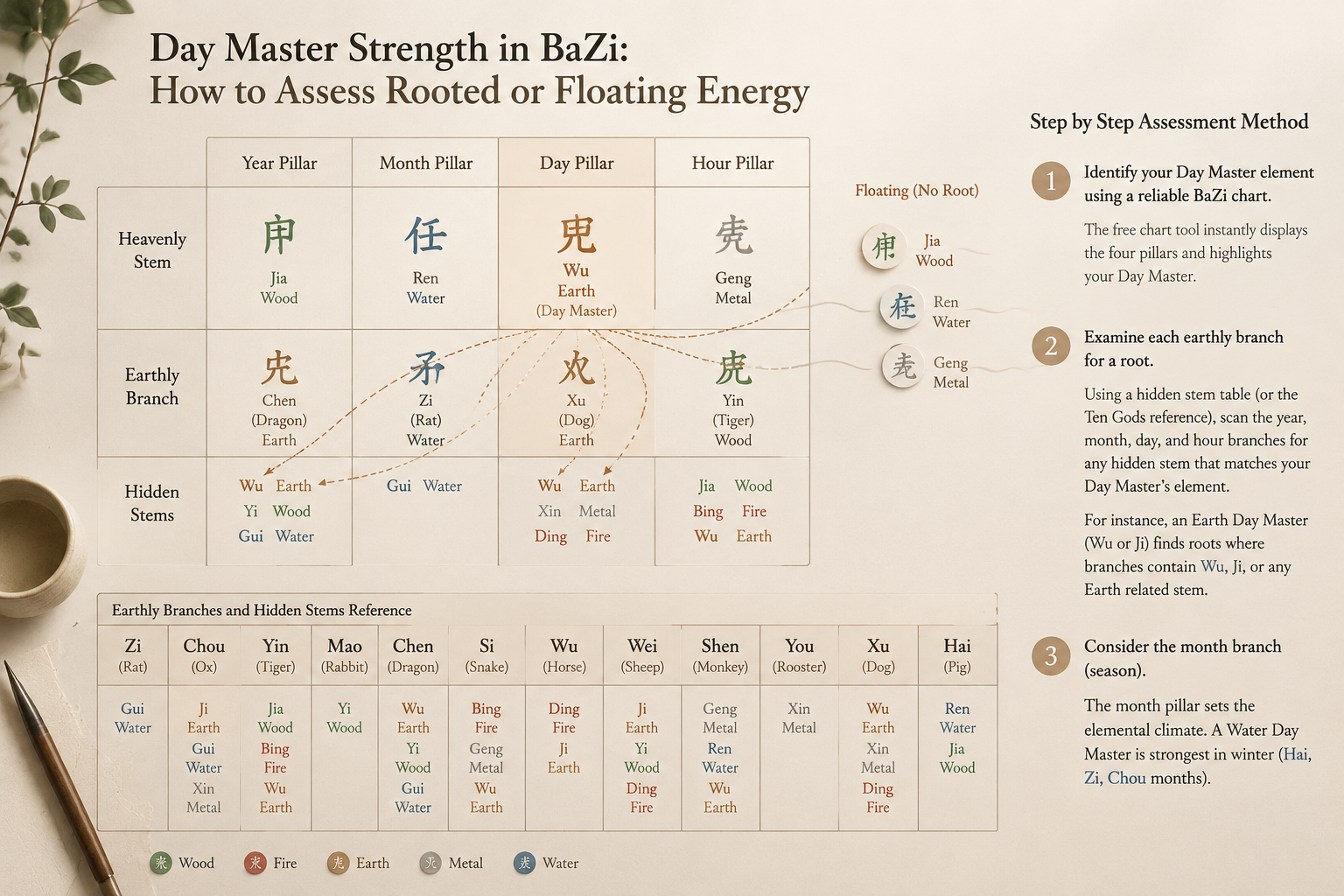
The primary source of Day Master strength lies in the earthly branches. A Day Master is rooted when its element appears among the hidden stems of any earthly branch in the chart. For example, a Yang Wood (Jia) Day Master is rooted whenever a branch contains Jia (Yang Wood) or Yi (Yin Wood) in its hidden stem collection. Without such a root, the stem is floating—it lacks a firm anchor in the terrestrial realm and is more easily swayed by the surrounding pillars.
The hidden stems are the “deeper content” within each earthly branch; they are catalogued in the Ten Gods framework, which explains the relationship of each hidden stem to the Day Master. For a full reference, see the Ten Gods structure. Roots can appear in any of the four pillars (year, month, day, or hour). Even a root in the hour branch—often associated with later life or one’s internal world—counts as a genuine anchor.
Not all roots are equally robust. A root in a branch where the element naturally prospers (e.g., Wood in spring) is stronger than the same root in a branch where the element struggles (e.g., Wood in autumn). The season, governed by the Five Elements, modulates root vitality but never creates a root from nothing.
Step-by-Step Assessment Method
A methodical approach to gauging Day Master strength helps eliminate guesswork. Follow these steps:
- Identify your Day Master element using a reliable BaZi chart. The free chart tool instantly displays the four pillars and highlights your Day Master.
- Examine each earthly branch for a root. Using a hidden stem table (or the Ten Gods reference), scan the year, month, day, and hour branches for any hidden stem that matches your Day Master’s element. For instance, an Earth Day Master (Wu or Ji) finds roots where branches contain Wu, Ji, or any Earth-related stem.
- Consider the month branch (season). The month pillar sets the elemental climate. A Water Day Master is strongest in winter (Hai, Zi, Chou months); a Fire Day Master flourishes in summer. The seasonal cycle is explained further in the Five Elements guide. Season influences the potency of any roots you found and can offer a supportive environment even to a floating stem, though it does not constitute a root itself.
- Check the other Heavenly Stems for direct support. Stems of the same element (Companion) or the element that generates yours (Resource) lend auxiliary strength. For example, a Jia Day Master gains support from other Jia or Yi stems and from Ren or Gui (Water) stems. This stem‑level support is secondary—without a root, a stem remains floating even if accompanied by allies.
- Combine the findings. A Day Master with a solid branch root in a favourable season and with companion stems is decidedly strong. One with no root at all, regardless of stems, is floating. Many charts fall in between: a single root in an unfavourable branch, or a floating Day Master in a prosperous season, leads to nuanced readings that require further balancing with the rest of the chart.
Interpreting Strength Levels
Once you’ve assessed rooting and support, you can place the Day Master in one of several general categories. These are not boxes that pronounce a life path, but patterns that help you read the rest of the chart intelligently:
- Very strong Day Master: Multiple robust roots, favourable season, plenty of stem support. The self may be resilient, self‑contained, and sometimes resistant to change. The chart’s task is often to channel this abundant energy through output (Hurt Officer, Eating God) or expression.
- Strong Day Master: At least one clear root and reasonable environmental support. Such a Day Master can shoulder responsibilities and tends to approach life with persistence. Balance is still sought, especially with wealth (Money) and output elements.
- Moderate (balanced) Day Master: Roots and support are present but not overwhelmingly so; or the Day Master has both supporting and restraining elements in equal measure. This is a harmonious, adaptable starting point that requires nuanced analysis of the full chart interaction.
- Weak Day Master: Limited or no root, perhaps a floating stem with some stem‑based companions. The self may lean on others, seek validation, or prefer supportive environments. Resource and Companion elements become especially meaningful.
- Very weak (floating) Day Master: No root at all, possibly unsupported by season or stems. The nature is highly responsive to external cues, adaptable, and sensitive. Such a configuration often benefits from stable structures and intentional grounding.
Strength is never a final verdict. A weak Day Master with a supportive Luck Pillar path often thrives by drawing on external resources. Likewise, an overly strong Day Master may face friction if the chart lacks outlets. The reading only becomes functional when the Day Master strength is placed in relationship with the Ten Gods, the Five Elements interplay, and the moving pillars of time.
Special Cases and Exceptions
A straightforward root‑or‑not assessment can be complicated by a few circumstances:
- Hidden or secondary roots: Some branches contain the Day Master’s element only in their secondary or tertiary hidden stems. These “weak roots” still count and often reflect latent or subtle support. They may become more prominent during certain Luck Pillars.
- Roots lost through combinations and clashes: When a branch that contains a root is involved in a combination (He) or clash (Chong), the root’s quality can change. The transformed element might no longer directly support the Day Master. Advanced synthesis is needed in these cases.
- Day Master transformations: If the Day Master itself combines and transforms into another element, the entire rooting discussion shifts. Transformation rules are specific and belong to more advanced study.
- Floating Day Master with a prosperous season: A stem with no root but born in a season where its element thrives may appear robust. Think of it like a boat without an anchor in calm weather—it can still function, but its stability is not assured. The lack of rooting remains a meaningful pattern.
- Luck Pillar influence: Over time, Luck Pillars may activate dormant roots or erode existing ones. The natal chart, however, provides the baseline constitution. A Day Master that is floating at birth tends to carry a responsive template even if later pillars bring stronger period‑specific support.
Always remember: BaZi is a cultural model for reflection, not a deterministic forecast. Strength analysis is one piece of a larger framework that includes the Ten Gods, the Five Elements interactions, and the dynamic layers of time.
Frequently Asked Questions
How do I check if my Day Master has a root?
Use a hidden stem reference table for each earthly branch in your chart. If your Day Master is, say, Bing (Yang Fire), look for any branch containing Bing or Ding (Yin Fire) among its hidden stems. Even a single occurrence qualifies as a root. Our chart tool provides the full pillar layout, making root identification straightforward.
Does a floating Day Master mean my chart is poor?
No. Floating simply means the core self is more influenced by surroundings and may be less rigid. Many people with floating Day Masters build remarkable lives because they learn to read the environment and adapt quickly. BaZi is about understanding propensities, not issuing value judgments.
Can a Day Master be too strong?
In terms of balance, yes. An overly strong Day Master can become fixed and resistant to necessary change. The reading then turns to output stars (Hurting Officer, Eating God) or wealth stars to see if there is a healthy channel for expression. Over‑strength is not a flaw; it just shifts the emphasis of the chart.
What if my Day Master’s root is in the hour branch?
A root in the hour pillar is as valid as any other. Some traditions assign slightly different weight to the hour pillar because it reflects later years and inner life, but for a general strength assessment, all four pillars count equally. The root still anchors the Day Master.
How does the season affect strength?
The month pillar governs the seasonal climate of the chart. A Wood Day Master is naturally vigorous in spring (Tiger, Rabbit, Dragon months) and subdued in autumn. Season does not create roots, but it can make an existing root significantly stronger or a floating stem slightly more durable. Without a root, the seasonal boost alone cannot make a Day Master rooted.
Ready to see how these principles play out in your own chart? Open the Free BaZi tool and examine your Day Master’s earthly connections and seasonal backdrop.