BaZi Career and Wealth Reading Boundaries | Free BaZi
Understand how BaZi charts map career and wealth indicators through Ten Gods, Day Master, and Luck Pillars—clear method, cultural reference, and realistic boundaries.
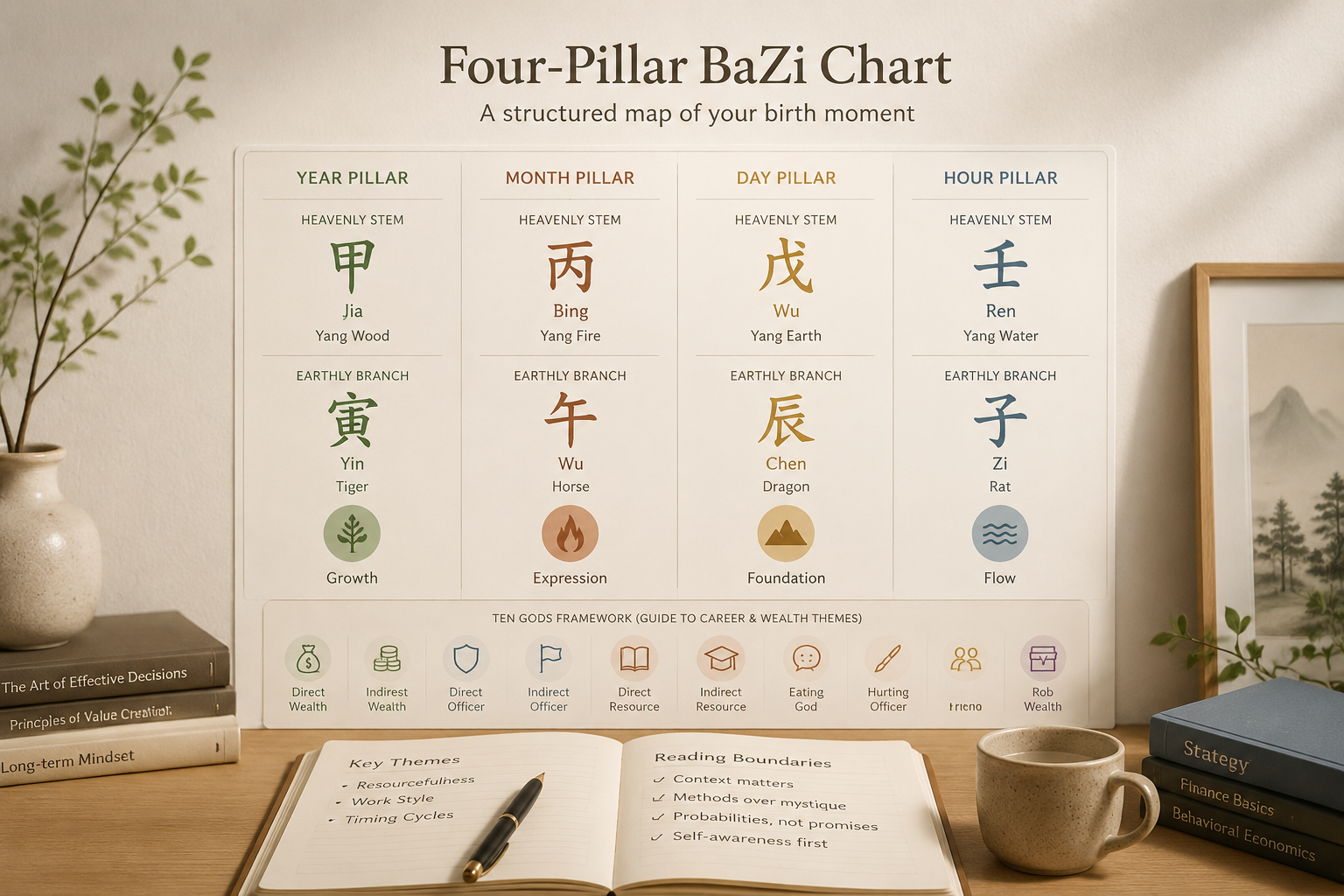
A BaZi chart is not a ledger of guaranteed earnings or a job‑title generator. It is a cultural reference system—a structured four‑pillar map that describes the elemental signature of a birth moment. When read with method and restraint, it can highlight themes around career and wealth: repeated patterns of resourcefulness, tendencies toward certain work styles, and periods of higher or lower material friction. This article explains how you can approach career and wealth readings within clear boundaries, using Free BaZi’s tools and the underlying Ten Gods framework.
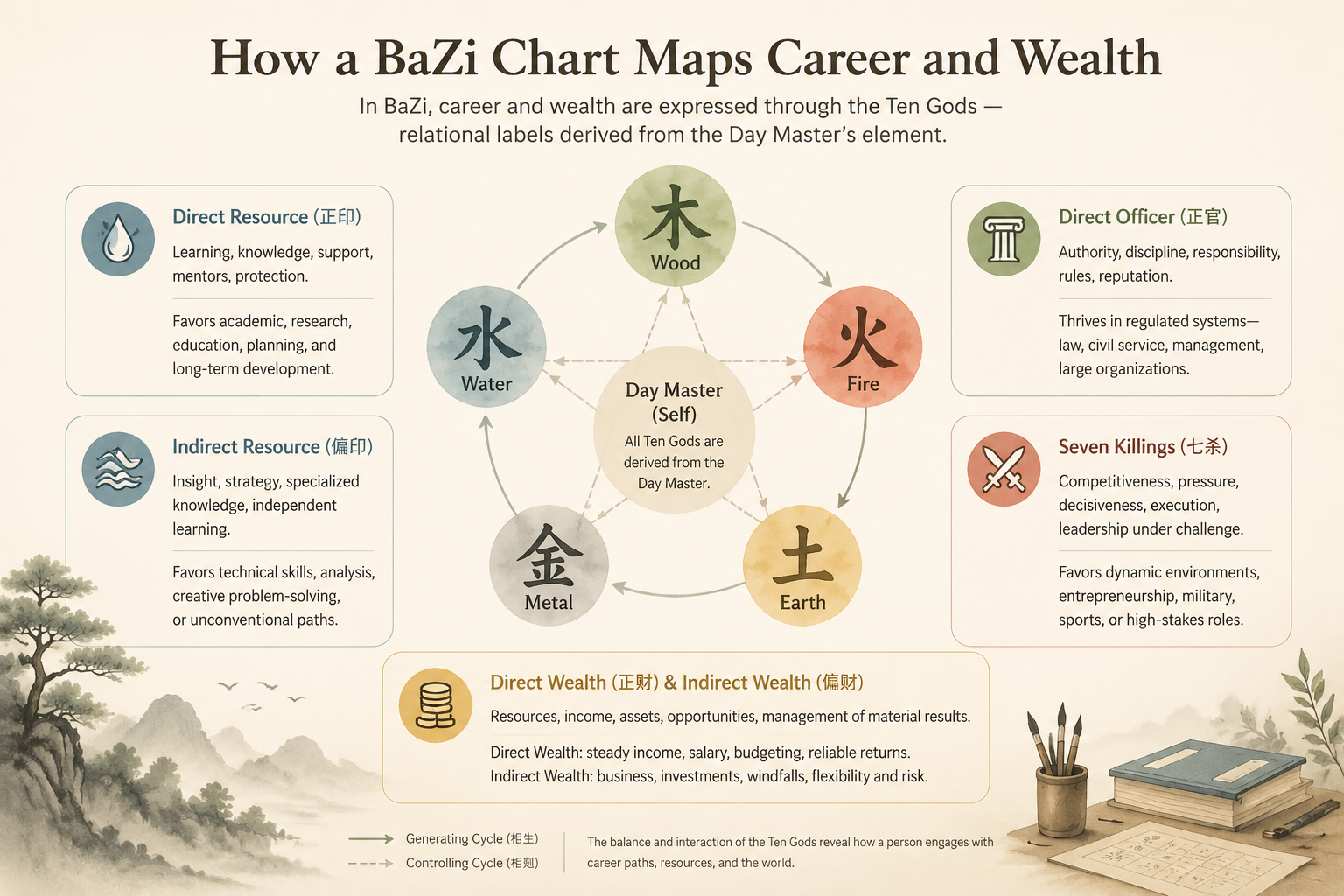
How a BaZi Chart Maps Career and Wealth
In BaZi, career and wealth are not literal bank balances or promotions. They are expressed through the Ten Gods—relational labels derived from the Day Master’s element. Each god can indicate a type of activity, pursuit, or relationship toward resources and material outcome.
For career, the most frequently examined gods are:
- Direct Officer (正官) and Seven Killings (七杀): authority, discipline, competitiveness, and structural work environments. A chart with a strong Officer star often suggests a person who thrives in regulated systems—think law, civil service, or large corporations—depending on the Day Master’s strength and the season.
- Direct Resource (正印) and Indirect Resource (偏印): learning, mentorship, credentialing. These signal careers built through knowledge and formal qualifications, but they can also point to inward‑focused paths like research or advisory roles.
- Eating God (食神) and Hurting Officer (伤官): creative output, problem‑solving, technical skill. These are the “makers” and “analysts.” When these stars appear prominently, especially in the month or hour pillar, the chart suggests a person who adds value through ideas, craft, or communication.
For wealth, the key gods are:
- Direct Wealth (正财): steady, earned income, often linked to salary, a primary occupation, or tangible assets. Its presence in the chart indicates a capacity for consistent accumulation.
- Indirect Wealth (偏财): variable income, side ventures, windfalls, or entrepreneurial gain. It carries a more opportunistic, risk‑taking flavor.
The interaction between these gods and the Day Master’s elemental balance determines whether the “wealth” is accessible or if it puts pressure on the person. For instance, a weak Day Master surrounded by strong Direct Wealth stars may feel overwhelmed by financial responsibility rather than empowered. Context always matters.
The Role of Day Master and Favorable Elements
The Day Master (the Heavenly Stem of the day pillar) is your reference point. Its element—Wood, Fire, Earth, Metal, or Water—determines how you relate to every other component in the chart. Reading career and wealth without understanding Day Master strength is like reading a map without a compass.
A core step is to evaluate whether the chart is balanced or extreme. A balanced chart typically benefits from a favorable element: the element that supports the Day Master if it is weak, or controls it if it is too strong. An extreme chart may follow a special “follow” pathway, where the unfavorable elements actually become the useful ones.
Why does this matter for career and wealth?
- A person with a strong Wood Day Master and Fire as the favorable element may find career momentum through Output (Fire, which Wood produces) or Wealth (Earth, which is produced by Fire). Their ideal environment often involves action, expression, and using their creative resources.
- A person with a weak Metal Day Master and Earth as the favorable element might lean on Resource (Earth) for support, thriving in structured, knowledge‑rich roles.
When you see a promising Wealth star, check the Day Master’s capacity to carry it. A Wealth star that is also the favorable element is usually more accessible and less draining than one that is hostile. This reading path prevents the over‑enthusiasm of spotting “good stars” without the necessary structural backing.
Timing with Luck Pillars
Even if the natal chart shows strong career indicators, timing shapes their expression. The Luck Pillars map 10‑year phases that activate different stems and branches. A person might have a chart that suggests an entrepreneurial indirect wealth orientation, but only when the pillar hosting that energy arrives does the window open.
A careful reading:
- Compares the Luck Pillar elements with the natal chart.
- Notes which Ten Gods are brought into play—if a Luck Pillar ushers in a Direct Officer period, it may be a time of career establishment or increased responsibility, regardless of the original chart’s preference.
- Recognizes that transits (annual pillars) can prompt short‑term events, but no pillar overrides personal effort and context.
The boundary here is critical: a Luck Pillar shows a “climate,” not a script. Two people with the same pillar might experience different results if one actively builds the skills needed for that phase and the other waits passively. BaZi maps the season of opportunity; it doesn’t do the planting.
Reading Boundaries: What a BaZi Chart Cannot Do
Clarity about limitations preserves the value of the method. Here are specific boundaries to keep in mind:
- It does not fix earnings or job titles. A strong Direct Wealth star doesn’t mean you’ll earn $X by age 30, nor does it name your profession. It suggests a relationship with earned income; how you express that depends on education, industry, geographic and cultural context.
- It is not a personality test. BaZi describes elemental configurations, not psychological profiles. Two people with the same Day Master might behave differently; the chart offers themes, not a box.
- It doesn’t override external reality. Macroeconomics, personal health, and social structures heavily influence career and wealth outcomes. A favorable Luck Pillar during a recession won’t guarantee a raise.
- No element is inherently “better.” A chart without obvious Wealth stars isn’t doomed to poverty; it may instead have strong Output or Resource indicating non‑financial fulfillment. The reading must respect the whole configuration.
- Cultural reference, not fortune‑telling. BaZi is a heritage tool, not a predictive certainty machine. Use it to understand tendencies and potentials, not to solicit guaranteed outcomes.
Using the Free BaZi Chart Tool for Career and Wealth Indicators
To apply this method, you can start with the Free BaZi chart tool and follow a simple reading path:
- Generate your chart. Note the Day Master element and its strength by looking at the season and surrounding stems/branches.
- Identify the career‑related gods. Check the stems, especially the month and hour pillars, for Officer, Resource, or Output stars. The Ten Gods Explained guide helps with recognition.
- Locate wealth indicators. Find Direct and Indirect Wealth stems; if they appear in the stems, they are more visible; in the branches, they are latent.
- Cross‑reference favorable elements. Look up your favorable element and see if the career or wealth gods align with it. Alignment suggests ease; misalignment suggests effort and adaptation.
- Review current Luck Pillar. Note which element and Ten God are currently active. Are career or wealth themes being supported? This adds a time layer to the reading.
- Interpret with humility. Treat the reading as a reflective framework, not a command. The goal is insight, not anxiety.
This process reframes career and wealth as evolving dynamics, not fixed fates.
FAQ
Can BaZi tell me my perfect career?
No. BaZi can highlight themes and tendencies—such as whether you might prefer structured environments or creative autonomy—but it doesn’t name specific jobs. Use it alongside your interests, skills, and real‑world opportunities.
Is my wealth potential fixed?
Wealth indicators in a chart show a certain relationship with resources, but they are not a cap. Education, skill development, and timing all modulate outcomes. A chart with modest wealth stars can still lead to a comfortable life through effort and wise choices.
How accurate are career readings from BaZi?
Accuracy depends on the reader’s method, the quality of chart analysis, and the questions asked. A well‑structured reading maps probabilities and tendencies, not certainties. Always combine BaZi insights with practical career planning.
What if my chart shows weak wealth stars?
Weak wealth stars simply mean the chart doesn’t emphasize material accumulation as a central theme. People with this configuration often find fulfillment in Output (skill, art) or Resource (knowledge, service) instead. It’s not a negative judgment.
Can I change my career path even if my Luck Pillars seem unfavorable?
Yes. Luck Pillars describe a background climate; how you respond to it is up to you. Unfavorable pillars may require more effort or a different strategy, but they don’t prevent career changes. Many people build resilience and pivot successfully regardless of pillar phases.
A Calm Approach to Career and Wealth Readings
A BaZi reading should leave you with more questions about how you work with your natural tendencies, not fewer. The method is best used as a lens for self‑understanding: What kinds of environments bring out your reliability or creativity? When might you feel more financial pressure so you can prepare? What latent strengths could you develop further?
If you’re ready to see your own chart’s career and wealth indicators, explore the Free BaZi chart tool and cross‑reference the Ten Gods wiki for a deeper, grounded reading. Keep the method restrained, the questions open, and the chart as a map—not a verdict.
Related reading
Related guide
BaZi Luck Pillars: How the 10-Year Cycles Shape Your Life
A methodical introduction to luck pillars in BaZi: how the 10-year cycles are structured, how to read them with your natal chart, and why they offer an interpretive layer, not a fixed prediction.
Related guide
BaZi Annual Forecast: How to Read the Current Year in Your Chart
A methodical guide to reading your BaZi annual forecast (Liu Nian). Learn how the current year pillar overlays your natal chart and Luck Pillar to reveal themes and tendencies—without mystique or guaranteed predictions.
Related guide
How to Use the Free BaZi Calculator: Step-by-Step Guide
Learn how to use the Free BaZi Calculator with a clear step-by-step guide. Enter birth data, generate a Four Pillars chart, and interpret Day Master, Ten Gods, and Luck Pillars—no sign-up required.