BaZi Annual Forecast: How to Read the Current Year in Your Chart
A methodical guide to reading your BaZi annual forecast (Liu Nian). Learn how the current year pillar overlays your natal chart and Luck Pillar to reveal themes and tendencies—without mystique or guaranteed predictions.
An annual BaZi reading—often called _Liu Nian_ (流年)—is one of the most practical ways to engage with your chart. It doesn’t predict what will happen; it outlines which energies are temporarily amplified, where your attention may be drawn, and how the year’s stem and branch interact with your core configuration.
Think of it as a seasonal weather map: you can’t change the forecast, but you can understand the prevailing conditions and adjust your approach. This guide walks through the method step by step, from the components you need to a worked example. If you don’t yet have your natal chart, you can generate one right now with the Free BaZi chart tool.
What Is a BaZi Annual Forecast (Liu Nian)?
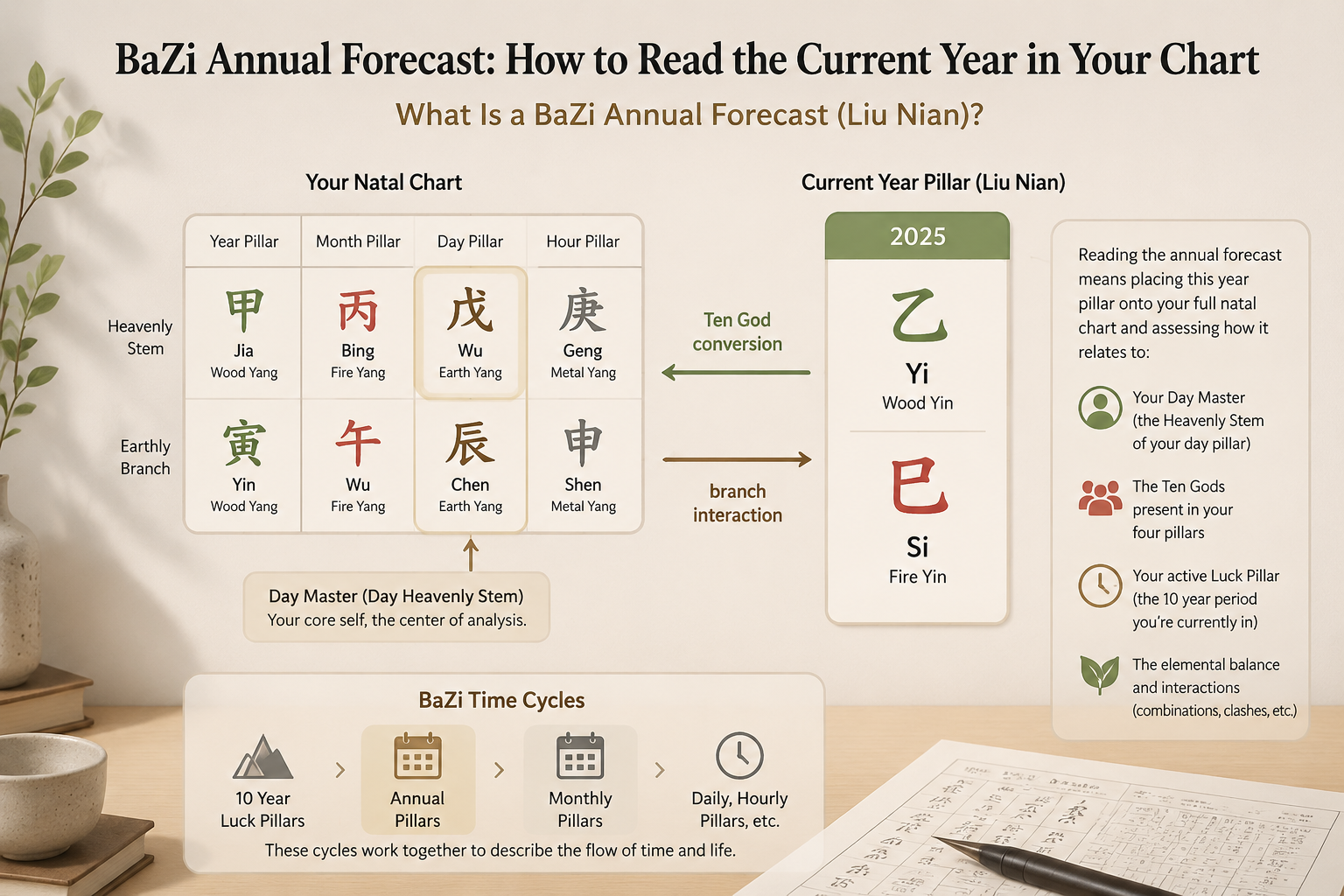
In BaZi, time is organized into cycles: 10-year Luck Pillars, annual pillars, monthly pillars, and so on. The annual pillar—often referred to as the _current year pillar_ or _Liu Nian_—is the 60-year Stem-Branch combination governing a particular calendar year. For example, 2025 is a _Yi Si_ year, where _Yi_ is the Heavenly Stem and _Si_ is the Earthly Branch.
Reading the annual forecast means placing this year pillar onto your full natal chart and assessing how it relates to:
- Your Day Master (the Heavenly Stem of your day pillar)
- The Ten Gods present in your four pillars
- Your active Luck Pillar (the 10-year period you’re currently in)
- The elemental balance and interactions (combinations, clashes, harms, punishments)
This layered reading reveals which life areas (represented by the pillars and gods) are most activated. The annual pillar does not override your natal chart; it temporarily interacts with it, much like a guest visiting a house. The structure of the house remains, but the guest brings a specific tone.
The Four Components That Shape a Yearly Reading
To read any year pillar systematically, you need to examine four dimensions. Each one adds a layer of specificity and helps avoid overgeneralization.
1. The Heavenly Stem – Ten God Conversion
The Heavenly Stem of the year pillar is converted into a Ten God relative to your Day Master. For instance, if your Day Master is _Xin Metal_ and the year stem is _Yi Wood_, Yi is the Direct Wealth star for Xin. This immediately gives you a thematic lens: resources, negotiation, pragmatic decisions, or tangible outcomes may be highlighted.
Understanding Ten God meanings is essential. If you’re unfamiliar, our Ten Gods guide explains each star’s function and how it varies by Day Master strength.
2. The Earthly Branch – Internal and Relational Dynamics
Branches carry hidden stems that represent sub-agendas, interpersonal undercurrents, and longer-term undercurrents. The main branch of the year (e.g., _Si_) can combine with any branch in your natal chart or Luck Pillar. A Si-Shen combination, for example, forms Water and can drastically shift the elemental climate for a fire-weak chart.
Branches also carry the potential for clashes (e.g., Si-Hai clash) or harms. These aren’t negative events by default; they indicate tension that demands attention. If a clash involves your Day Branch, the year often brings relational re-negotiation or a change in personal priorities.
3. The Luck Pillar Context
The annual pillar always operates within the field of your current Luck Pillar. A year that looks supportive on paper may have its effects dampened if the Luck Pillar is already saturating the same element, or it may be a trigger that sets off a larger pattern. Compare the Luck Pillar’s stem and branch with the year’s to see whether the year reinforces or counters the 10-year trend. More on Luck Pillars can be found in our Luck Pillars resource.
4. Elemental Balance in the Chart
Finally, step back and look at the Five Element tally. Adding the year stem and branch to the chart—and removing any elements neutralized by combinations—gives you a provisional count. An excess of Water in a chart that already runs cold may bring a year of inertia; a sudden influx of Metal in an already rigid chart might intensify control themes. The Five Elements dynamics page breaks down how excess and deficiency tend to manifest.
Step-by-Step: Overlaying the Year Pillar on Your Natal Chart
Let’s move from theory to process. You’ll need your natal chart and the current year pillar. If you don’t have the current year pillar handy, the Huangli tool displays the stem and branch for any year.
- Place the year pillar beside your four pillars. Treat it as a temporary fifth pillar, though it technically sits outside the natal structure.
- Convert the year stem into a Ten God for your Day Master. Note whether it’s a resource, output, wealth, power, or companion star.
- Check the year branch against every branch in your natal chart and Luck Pillar. Look for:
- Combinations (合): Seasonal or directional merges that change element flow.
- Clashes (冲): Direct opposition between two branches (e.g., Zi-Wu, Si-Hai).
- Harms (害) and punishments (刑): Subtler frictions that often affect specific pillar relationships.
- Look at the Luck Pillar: If the year branch merges or clashes with your Luck Pillar branch, the 10-year period may intensify or pivot. For example, an annual clash with the Luck Pillar branch can mark a year of external disruption within an otherwise stable period.
- Identify the “useful god” implications: If your chart relies on a specific element for balance, see whether the year strengthens or weakens it. This doesn’t “bring luck”; it indicates whether the year supports or challenges your inherent coping style.
- Synthesize: Combine all observations into a few key sentences. Avoid listing ten different interactions; instead, pinpoint the dominant theme—often the interaction that involves the Day Master or Luck Pillar stem.
Interpreting Key Interactions: Stem, Branch, and Gods
A single year can produce many technical interactions. The skill lies in selecting what matters. Here are some common scenarios and how to read them with restraint.
- Year stem is the same as your Day Master (Companion star): A year of self-focus, peer dynamics, or heightened competition. If chart is strong, this may bring rivalry; if weak, it can provide needed support.
- Year branch merges with your Month Branch: This can reshape your career or external environment, as the Month Branch governs your professional and social role.
- Year stem produces a combination with a natal stem: If the year _Yi_ stem combines with a _Geng_ stem in your chart, they may transform into Metal, temporarily altering the element distribution. Such combinations often signal negotiated outcomes, partnerships, or compromise.
- Direct Officer (Zheng Guan) appears as the year stem for a strong Day Master: A year where structure, responsibility, or external expectations become prominent. This doesn’t guarantee a promotion; it indicates a context that rewards discipline.
- A clash against your Day Branch: A fundamental year of movement, relocation, or relationship shifts. The nature of the clash (e.g., Water vs. Fire) adds color.
In every case, the interpretation should stick to observable tendencies: “When a Direct Officer star is active and your chart can accommodate it, years often involve visible accountability” rather than “You will get promoted.”
Example Walkthrough: Reading a Xin Metal Day Master in a Yi Si Year
To ground the method, let’s walk through a simplified example. Suppose your Day Master is Xin Metal, born in autumn, with a relatively strong chart. Your Luck Pillar is _Gui Chou_ (Water Ox). The current year is Yi Si.
Step 1: Year stem → Ten God. Yi Wood, for Xin Metal, is Indirect Wealth. For a strong chart, Indirect Wealth often signals speculative thinking, side ventures, or unconventional resource management. The year theme tilts toward opportunity cost and bold financial decisions, but it requires the chart to have capacity for Wood (which autumn Xin usually does).
Step 2: Year branch Si interactions. Si contains Bing (Fire), Wu (Earth), Geng (Metal). Si combines with Shen (Monkey) to form Water, but if no Shen exists, it may clash with Hai (Pig) or harm Yin (Tiger). Assume a Shen branch in the natal Hour Pillar. The Si-Shen combination triggers a Water formation, which is an output element for Xin Metal. This suggests a year where creative expression, communication, or releasing control becomes important—especially in the life area governed by the Hour Pillar (e.g., aspirations, children, personal projects).
Step 3: Luck Pillar tie-in. The Luck Pillar is Gui Chou: Gui Water is an output, and Chou is a wet Earth branch that contains Xin Metal as a hidden companion. The Si-You-Chou metal frame could form if You (Rooster) exists, but here we only have Chou and Si, so no full frame. Nevertheless, Si and Chou share a hidden stem dynamic (both contain Metal). The year strengthens a latent Metal resonance, which can bolster the Day Master’s confidence without making it overbearing.
Synthesis: The year amplifies both Indirect Wealth (Yi) and Water output (via Si-Shen). It’s a year that rewards initiative, unconventional earning, and speaking up, but it also requires monitoring of risk. No prediction—just a thematic map.
Limitations and Practical Use of Annual Charts
A methodological reading acknowledges what annual pillars cannot do. They are not standalone forecasts. They reveal situational tendencies that are always filtered through your own decisions, environment, and the broader context of your Luck Pillar and natal constitution.
Some best practices:
- Combine with Luck Pillar reading. Avoid reading a year in isolation; always note what decade-sized background is running.
- Prioritize the Day Master relationship. If the year stem clashes with the Day Master, that single interaction often overrides minor branch details.
- Use it as a reflection tool, not an instruction manual. The most grounded way to engage with an annual reading is to ask: “What quality of attention does this year ask of me?” rather than “What will happen?”
- Beware of the Five Element illusion. A year stem-branch adding an element your chart lacks may sound “good,” but if the entire chart’s momentum goes against it, the influence may be fleeting.
If you’d like to generate your own chart and immediately overlay the annual pillar, the Free BaZi chart tool includes a current year overlay option. It simplifies the technical steps so you can focus on interpretation.
FAQ
How is the BaZi annual forecast different from a Luck Pillar reading?
The Luck Pillar is a 10-year energy field that sets the long-term tone. The annual pillar is a temporary visitor within that field. A Luck Pillar may emphasize career building (e.g., Output decade), while an individual year highlights a specific season within that decade—such as a year of resource-stem that refuels you. Together they form a nested reading: the annual pillar modifies the Luck Pillar, and both modify the natal chart.
Do I need my exact birth time to read the annual pillar?
For the Hour Pillar interactions, yes—but even without it, you can still derive useful information from the Day, Month, and Year pillars plus the Luck Pillar. The annual branch’s relationship to your Month Branch often reveals the year’s impact on your public role or work life, which is relevant for most people.
What does it mean if the annual branch clashes with my Day Branch?
A clash with the Day Branch typically signals a year of movement at the personal level: relocation, relationship changes, or redefinition of identity. It’s not a crisis by default; many people use such years to make necessary life transitions. The element of the branches involved (e.g., Fire clashing Water) adds emotional or motivational color, but a calm assessment of what area of life is represented by the Day Branch (self, partnership) is more useful than alarm.
Can I read an annual forecast if I don’t know all the Ten Gods?
You can, but the reading will be shallow. Ten Gods are the primary language for the stem’s influence. We recommend familiarizing yourself with the Ten Gods meanings before attempting a full annual interpretation. Even a basic understanding of which gods are resources vs. outputs will greatly improve your reading.
How often should I re-check the annual chart?
Once per year is typical. Some people also look at the monthly pillar overlays, but that adds complexity. For most users, a single annual reading combined with the Luck Pillar provides enough thematic guidance to reflect on throughout the year.
Related reading
Related guide
BaZi Luck Pillars: How the 10-Year Cycles Shape Your Life
A methodical introduction to luck pillars in BaZi: how the 10-year cycles are structured, how to read them with your natal chart, and why they offer an interpretive layer, not a fixed prediction.
Related guide
Ten Gods in BaZi: What Each One Means in Your Chart
A methodical guide to the Ten Gods in BaZi: how they arise from the Day Master, what each represents, and how to read them in context using the Free BaZi chart tool.
Related guide
BaZi Career and Wealth Reading Boundaries | Free BaZi
Understand how BaZi charts map career and wealth indicators through Ten Gods, Day Master, and Luck Pillars—clear method, cultural reference, and realistic boundaries.