Ten Gods in BaZi: What Each One Means in Your Chart
A methodical guide to the Ten Gods in BaZi: how they arise from the Day Master, what each represents, and how to read them in context using the Free BaZi chart tool.
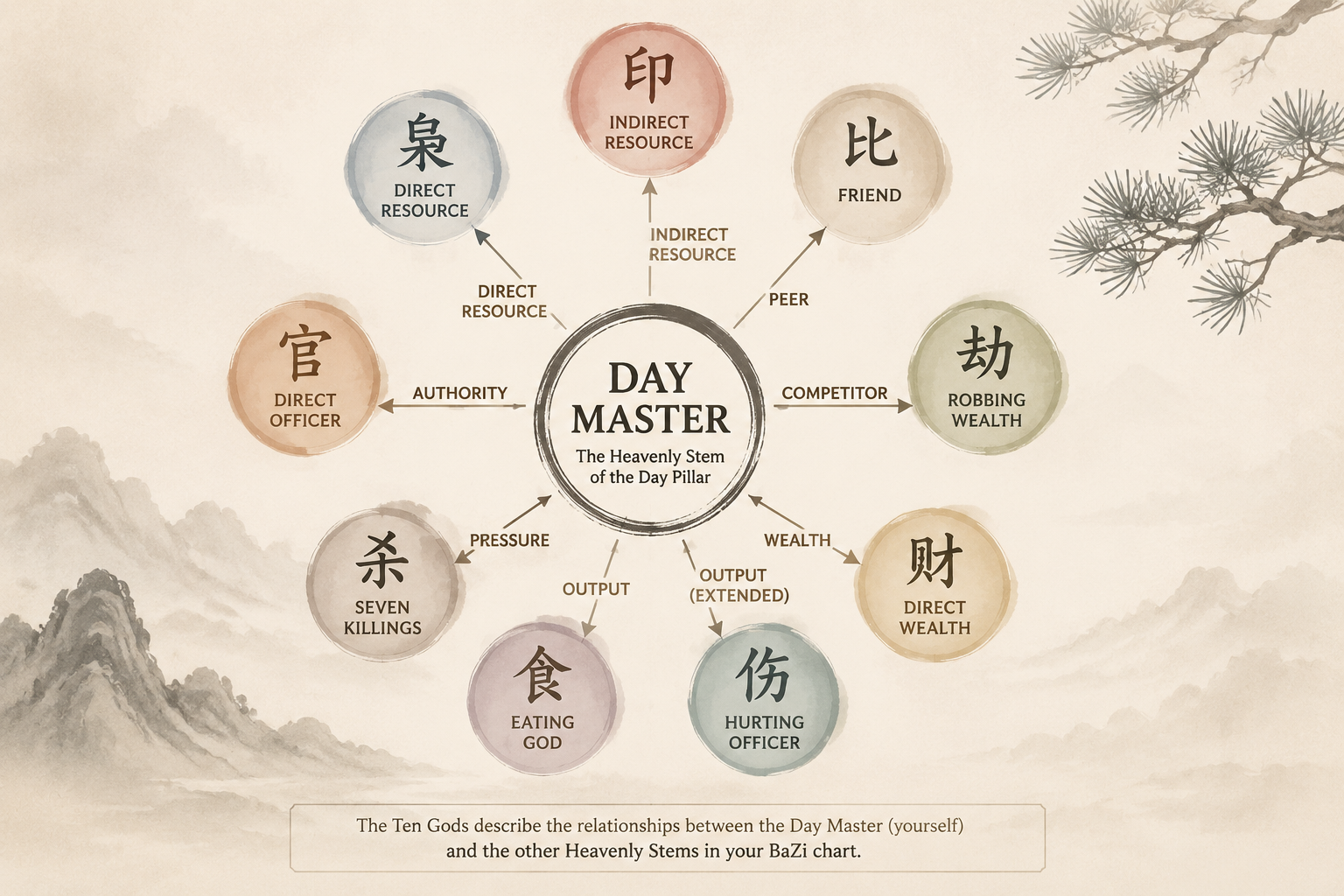
In BaZi (Four Pillars of Destiny), the Ten Gods are not deities or supernatural forces. They are a systematic set of relational labels that describe how the Heavenly Stem of your Day Master interacts with every other stem in the chart. If you have seen terms like “Direct Wealth” or “Eating God” on a Free BaZi chart, these are Ten Gods—and they give the chart its first layer of readable structure.
Understanding what each Ten God stands for, how it is derived, and why no single one should be read in isolation is essential groundwork for anyone exploring their own chart. This article walks through the method behind the Ten Gods, profiles each one, and explains how they operate as a set of reading signals rather than fixed pronouncements.
What Are the Ten Gods?
The Ten Gods are a naming convention rooted in the cycle of the Five Elements. Every Heavenly Stem carries an elemental nature (Wood, Fire, Earth, Metal, or Water) and a polarity (Yang or Yin). When you take one stem as the reference point—your Day Master—the other stems can be classified by two variables:
- Does the other stem’s element produce, control, be produced by, be controlled by, or match the Day Master’s element?
- Do the two stems share the same polarity (Yang-Yang or Yin-Yin) or opposite polarity (Yang-Yin)?
These two factors combine to produce exactly ten possible relationship types, hence the “Ten Gods.” The label you apply to another stem tells you at a glance the nature of its link to the Day Master. This method gives a reader a shared vocabulary to discuss a chart without slipping into vague or mystical language.
It is important to note that the Ten Gods are derived purely from stem-to-stem relationships. They do not require the Earthly Branches or hidden stems, although those add further depth once you move into a full chart reading.
How Are the Ten Gods Determined?
Every complete BaZi chart contains four pillars (year, month, day, hour), each with a Heavenly Stem and an Earthly Branch. The Day Master is the Heavenly Stem of the day pillar. To determine the Ten God of any other stem in the chart, you follow a two-step process:
- Element relationship: Compare the element of the stem to the Day Master’s element. Wood produces Fire, Fire produces Earth, Earth produces Metal, Metal produces Water, and Water produces Wood. The reverse flow (e.g., Wood is produced by Water) is just as important. Similarly, Wood controls Earth, Earth controls Water, and so on. A matching element means the stems belong to the same elemental “family.”
- Polarity check: If the two stems share the same polarity (both Yang or both Yin), the relationship is “direct.” If they differ, it is “indirect.”
For example, if your Day Master is Yang Wood and another stem is Yin Water, Water produces Wood but the polarities differ, so that stem is your “Indirect Resource.” If instead the other stem were Yang Water, it would be “Direct Resource.” The polarity distinction is not a value judgment; it simply influences whether the expression of that relationship tends to be more overt or subtle—a nuance that becomes meaningful only when combined with other chart factors.
This derivation process is mechanical, which is why tools like the Free BaZi chart calculator can compute all Ten Gods instantly once a birth date is entered. Manual charts follow the same rules; no intuition is required at this stage.
The Ten Gods at a Glance
Below is a brief profile of each Ten God. The descriptions offer the core thematic signal that the relationship suggests, not a list of outcomes. Context—strength of the element, presence of combinations, and the luck pillar stage—always modulates how that signal manifests.
- Direct Resource (Zheng Yin): The element that produces the Day Master, same polarity. Suggests themes of support, knowledge, stability, and learning. Often points to what nourishes a person internally.
- Indirect Resource (Pian Yin): The element that produces the Day Master, opposite polarity. Linked to unconventional knowledge, intuition, and adaptability. May indicate a more creative or sporadic form of support.
- Direct Officer (Zheng Guan): The element that controls the Day Master, same polarity. Associated with structure, discipline, rules, and reputation. It points toward a person’s relationship with authority and order.
- Indirect Officer (Qi Sha / Pian Guan): The element that controls the Day Master, opposite polarity. Carries the idea of challenge, competition, and decisive action. Often referred to as the “Seven Killings” star, it requires careful reading because its strong expression depends heavily on the Day Master’s strength.
- Direct Wealth (Zheng Cai): The element controlled by the Day Master, same polarity. Connected to earned income, tangible assets, and steady effort. It implies a methodical approach to resources.
- Indirect Wealth (Pian Cai): The element controlled by the Day Master, opposite polarity. Associated with windfalls, speculative ventures, and less predictable financial flows. It can also represent an affinity for seizing unusual opportunities.
- Eating God (Shi Shen): The element produced by the Day Master, same polarity. Relates to creativity, self-expression, and enjoyment. Often shows where a person finds natural talent or a source of output.
- Hurting Officer (Shang Guan): The element produced by the Day Master, opposite polarity. Points to sharp intelligence, unconventional thinking, and a tendency to challenge norms. It can be highly productive but sometimes clashes with authority structures.
- Friend (Bi Jian): The same element and same polarity as the Day Master. Represents peers, siblings, and direct competition. It reinforces the Day Master’s character but may also create rivalry.
- Competitor (Jie Cai): The same element but opposite polarity. Suggests colleagues, partnerships, and shared resources. It can denote support that comes at a cost or a need to negotiate one’s position.
Again, these profiles are starting points. A chart with a strong Day Master and a well-supported Direct Officer might point to a career-oriented personality, while the same Direct Officer in a weak chart could suggest feeling overwhelmed by external rules. The Ten Gods only speak clearly when read together.
Context Matters: Ten Gods in Combination
A common misstep when learning BaZi is to treat each Ten God as an isolated label that “means” something absolute. In practice, Ten Gods interact with one another, and their story changes depending on whether the element is strong or weak in the overall chart.
Consider someone who has both Eating God and Direct Officer prominently positioned. On their own, Eating God speaks to creative output while Direct Officer points toward structure. Together, they can indicate a person who channels creativity within a disciplined framework—a writer on a strict deadline, for example. But if the Eating God is too strong and the Direct Officer too weak, the same pair might describe a constant friction between personal freedom and external constraints.
Other dimensions matter just as much:
- Chart balance: The strength of the Day Master, assessed via the full Eight Characters and season of birth, determines whether a Ten God acts as a helpful ally or a challenging pressure.
- Luck Pillars: The Ten Gods in a natal chart are fixed, but the 10-year luck pillars introduce temporary stems that bring new Ten God relationships. For more on this mechanism, see the guide on Luck Pillars.
- Interactions with Earthly Branches: While this article focuses on stems, many readings also factor hidden stems within the branches, which repeat the Ten God derivation on a subtler layer.
Because so many variables are in play, no responsible BaZi reading will claim that “Having Indirect Wealth means you will become rich.” Instead, the method asks the reader to weigh the message of that Indirect Wealth against the rest of the chart and the current luck cycle. This transparent, bounded approach is what distinguishes cultural reference reading from fortune-telling.
Practical Steps to Identify Your Ten Gods
If you are new to BaZi, the fastest way to see your Ten Gods in action is to use a chart tool rather than derive them by hand. Follow these steps:
- Generate your chart: Input your birth date and hour into the Free BaZi chart tool. The system will plot the four pillars and label every stem with its Ten God relative to your Day Master.
- Start with the Year and Month stems: These often represent your public persona and early environment. Notice which Ten Gods appear here.
- Look at the Day and Hour stems: The Day stem is your Day Master, but the Hour stem often reflects inner drives and later-life tendencies. Compare its Ten God to the others.
- Check the Luck Pillar stems: Most chart tools display the current 10-year luck pillar’s stem. Observing which Ten God is temporarily active can help you understand why certain themes feel more prominent at a given time.
- Avoid one-god conclusions: Remind yourself that no single Ten God defines your whole chart. The value lies in seeing how they relate to one another.
Taking these steps turns the Ten Gods from abstract categories into a practical reading framework. If you later decide to study manual calculation, the same derivation logic will apply.
FAQ
What do the Ten Gods actually tell me?
The Ten Gods provide a structural vocabulary for reading the relationships in your BaZi chart. They highlight areas of natural inclination, potential friction, and shifting thematic emphasis over time, not fixed predictions or guaranteed outcomes.
Can two people with the same Ten God have different experiences?
Yes. The Ten God is only one part of the picture. Differences in element strength, the presence of other gods, and the timing of luck pillars all influence how a given Ten God is expressed. Context is always king.
Is one Ten God better than another?
No Ten God is inherently good or bad. Each describes a function—nourishing, controlling, outputting, matching—that can manifest in helpful or challenging ways depending on balance. BaZi readings avoid value judgments about the gods themselves.
How do I find my Ten Gods?
The quickest method is to generate your complete chart using the Free BaZi tool—all Ten Gods are labeled automatically. Look at the stems surrounding your Day Master. For a manual approach, you apply the element-plus-polarity derivation rules described above.
Can the Ten Gods change over time?
The Ten Gods in your birth chart are fixed, but the stems of the 10-year luck pillars introduce temporary Ten God influences. These shifts can alter which themes come to the foreground, much like moving from one chapter to the next.
Ready to see how the Ten Gods pattern your own chart? Use the Free BaZi chart calculator to generate your full Four Pillars and explore each relationship in a structured, transparent way.
Related reading
Related guide
BaZi Luck Pillars: How the 10-Year Cycles Shape Your Life
A methodical introduction to luck pillars in BaZi: how the 10-year cycles are structured, how to read them with your natal chart, and why they offer an interpretive layer, not a fixed prediction.
Related guide
Ten Gods Quick Reference Table: A BaZi Reference Guide
A clear quick reference table for the Ten Gods in BaZi, explaining how to identify them from your Day Master and providing a practical lookup for every heavenly stem.
Related guide
BaZi Compatibility Reading Boundaries
Learn how BaZi compatibility reading works through the structured method of Day Master interaction, Five Elements, and Ten Gods—with clear boundaries and no promises.