BaZi Luck Pillars: How the 10-Year Cycles Shape Your Life
A methodical introduction to luck pillars in BaZi: how the 10-year cycles are structured, how to read them with your natal chart, and why they offer an interpretive layer, not a fixed prediction.
When people first encounter a BaZi chart, they see eight characters—four pairs of Heavenly Stems and Earthly Branches—that capture the energetic imprint of a birth moment. This natal chart maps the Five Elements, the Day Master, and the Ten Gods, offering a static picture of tendencies and potentials. But life doesn’t stand still, and neither does BaZi. The luck pillars—most prominently the 10‑year cycles—add the dimension of time, showing how those natal patterns meet evolving energetic seasons.
This article explains what luck pillars are, how they work, and how to read them without slipping into absolutes. You’ll find a calm, structured method you can use alongside a Free BaZi chart to explore the rhythm of your own cycles.
What Are BaZi Luck Pillars?
Luck pillars (Da Yun) are successive 10‑year periods that unfold from a person’s birth. Alongside the yearly pillar (annual luck), they form the main timing layer in BaZi. Think of the natal chart as a landscape—mountains, rivers, fertile plains—and the luck pillars as long stretches of weather. A rainy decade doesn’t erase the mountain; it changes what grows on its slopes.
Every luck pillar contains two components:
- A Heavenly Stem (top) representing an overt, external influence.
- An Earthly Branch (bottom) carrying a deeper, internal environment and often one or more hidden stems.
Together, these characters interact with the natal chart’s stems and branches, activating certain Ten Gods and strengthening or weakening specific elements. Because a pillar lasts a full decade, it colours broad life domains: career direction, relationships, health tendencies, and personal growth.
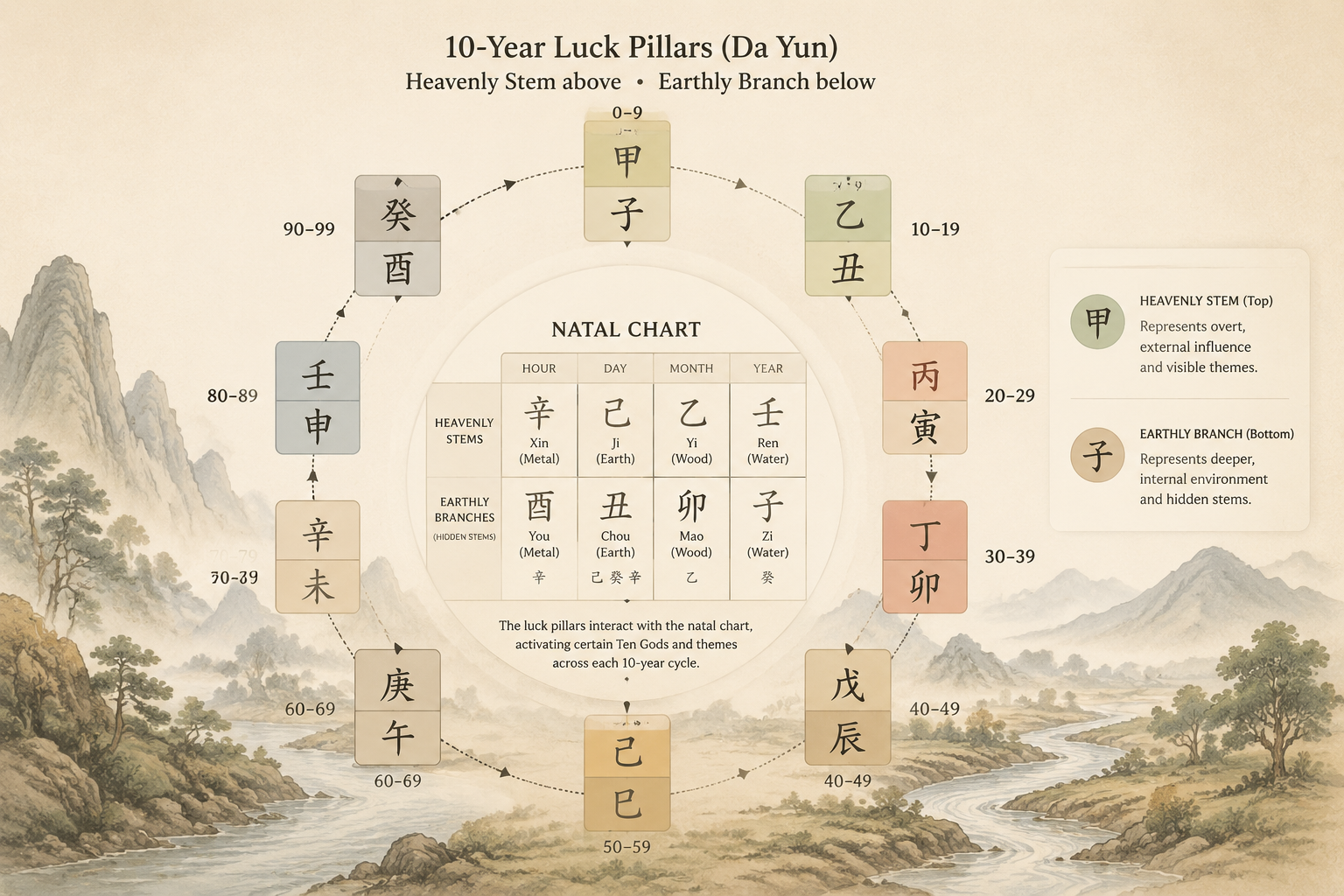
Critically, luck pillars don’t inject fate from outside. They resonate with what already exists in the chart. A pillar that brings the "Output" star (What You Express) will feel more expansive for a Day Master whose chart already supports expression; the same pillar can feel draining if the chart is weak. So reading luck pillars always means reading them in dialogue with the natal foundation.
The Mechanics of Luck Pillars: Heaven Stems and Earthly Branches
To use luck pillars confidently, you need to understand the building blocks. Both the stem and branch of a luck pillar are drawn from the 60‑stem‑branch cycle (Sexagenary Cycle), ordered sequentially from the person’s birth year or month pillar, depending on gender and the yin/yang polarity of the year stem.
Heaven Stems and Surface Influence
The Heavenly Stem of a luck pillar acts like a direct, visible message. If the stem is Yang Wood (Jia) and your Day Master is Yin Earth (Ji), the pillar brings the “Direct Officer” star—an arch that often correlates with structure, responsibility, and a push toward order. Because the stem’s energy is outward, you might notice changes in your work role, public image, or conscious pursuits first.
Earthly Branches and Underlying Environment
The Earthly Branch carries the deeper season. A Branch of Tiger (Yin), for example, holds hidden stems of Jia, Bing, and Wu Earth. Those hidden elements can stir unplanned events or emotional undercurrents. Even when the surface stem feels calm, the branch may silently nourish a particular element inside your chart—like a gentle shift in the water table that only later becomes visible.
When you read a luck pillar, always look at both levels. A stem that looks supportive may sit on top of a branch that clashes with your month pillar, creating an experience of “help that doesn’t quite land”. This layered reading helps avoid simplistic “good pillar / bad pillar” labelling.
Reading Your Luck Pillars: Step-by-Step
Here is a reproducible method you can apply to any BaZi chart. It doesn’t predict luck; it organises what the interactions suggest so you can reflect on life themes.
- Establish your Day Master and chart balance. Without knowing the strength of the Day Master element and the dominant element in the chart, a luck pillar’s effect remains fuzzy. If you haven’t already, get your chart with the Free BaZi chart tool.
- Identify the current luck pillar’s stem and branch. Note their elements and their Ten God labels relative to your Day Master. For example, if your Day Master is Yang Metal (Geng) and the stem is Yang Water (Ren), you’re looking at the “Eating God” star.
- Check for key interactions with the natal chart. Look for:
- Combinations (He) – a merging of two stems or branches that can temporarily change elements.
- Clashes (Chong) – direct clashes between branches that stir change, movement, and sometimes turmoil.
- Harms and punishments – subtler forms of friction.
- Support or control cycles – does the pillar feed your Day Master’s element, control it, or drain it?
- Layer in the annual pillar. Once you understand the 10‑year backdrop, the yearly pillar (annual luck) pinpoints short‑term emphasis. A supportive year inside a draining 10‑year pillar often looks like a window of opportunity within a long winter. You can cross‑check the yearly stem and branch using the Huangli calendar.
- Translate into themes, not certainties. If the pillar activates the “Seven Killings” star and clashes your Day Branch, one possible theme is a period of heightened pressure and competition—but whether that pressure breaks or forges depends on the whole chart, the person’s choices, and real‑world context. The chart offers a reading, not a verdict.
How Luck Pillars Interact with the Natal Chart
Understanding interactions is where the method moves from abstract to useful. Let’s walk through a few common patterns.
Elemental Strengthening and Weakening
A luck pillar can fill a missing element or flood an already strong one. If a chart lacks Water and the luck pillar brings it, the person may experience a decade of newfound fluidity—better communication, increased adaptability. Conversely, if the chart already has excessive Water, the same pillar may amplify indecision or a sense of drifting. The natal balance sets the baseline; luck pillars modulate the volume.
Ten God Activation
The Ten Gods of a luck pillar color the decade’s themes. A pillar marked by the “Direct Wealth” star often ties to income, tangible outcomes, and a practical mindset—but only if the Day Master can handle that energy. A weak Day Master faced with strong Wealth energy might see financial pressures rather than gains. This is why responsible readings always pair Ten Gods with element strength assessments, as explained in our Day Master guide.
Clashes and Combinations with Core Pillars
Some of the most noticeable life transitions occur when a luck pillar clashes with the month or day pillar of the natal chart. A clash with the month pillar can affect career foundations and family; a clash with the day pillar often touches partnerships and the sense of self. In the language of the Five Elements, these clashes represent dynamic tension rather than disaster—an earthquake that reshapes the landscape rather than destroys it permanently.
Practical Interpretative Frameworks
Because a 10‑year pillar is a long stretch, it’s helpful to think in arcs rather than isolated events. Consider these lenses:
- The Opening Arc (early pillar): The first year or two of a new luck pillar often feel transitional, as the old pillar’s energy recedes and the new one settles.
- The Stabilised Arc: Once the pillar’s environment is established, its flavour becomes the new normal. By year four or five, people often look back and see the thematic thread clearly.
- The Closing Arc: As the pillar draws to a close, the next pillar’s energy begins to bleed in, creating anticipation or restlessness.
This arc view also helps when a “difficult” pillar appears. A clash‑heavy decade doesn’t mean 10 years of chaos; it may mean a concentrated period of restructuring that eventually leaves the person with clearer boundaries or a more authentic path. Respecting the long timeframe helps readers avoid anxious over‑interpretation of a single year.
Limitations and Responsible Reading
Luck pillars are a cultural reference and a structured reading tool—not a guaranteed prediction. Several boundaries are important:
- No pillar acts in isolation. Environment, geography, personal decisions, health, and social context all matter. Two people with identical charts and the same luck pillar will still live different lives.
- Favourable and unfavourable are relative. A pillar that controls a strong, unbalanced chart may feel uncomfortable but brings needed steadiness. A “favourable” nourishing pillar can lead to complacency. It’s the interaction that matters.
- The chart is not the person. BaZi reads patterns, not souls. Use it as a reflective tool, not a substitute for wise counsel or professional guidance.
If you’re new to this, start by studying your Day Master and the Ten Gods before diving into timing. A steady foundation makes the luck pillar overlay far more meaningful.
Frequently Asked Questions
How are BaZi luck pillars calculated?
Luck pillars start from the month pillar and move forward or backward depending on the gender of the person and the yin/yang polarity of the birth year’s Heavenly Stem. The first pillar’s starting age is determined by the number of days between the birth date and the nearest seasonal junction (Li Chun or one of the 12 solar terms). Each subsequent pillar spans exactly 10 years. Most chart tools, like the one at Free BaZi, calculate this automatically so you can focus on the reading.
Do luck pillars override my natal chart?
No. The natal chart sets the permanent energetic ground. Luck pillars modify the expression—they season the landscape but don’t replace it. A person with a naturally courageous chart won’t become timid because of a mild pillar; rather, the pillar may reduce occasions that call out that courage. Always read the natal chart first, then add luck pillars as a shifting context.
Can I change the energy of a difficult luck pillar?
BaZi describes what’s energetically coherent in a period, but it doesn’t cancel free will. You might choose actions that align with the pillar’s supportive elements while managing the risks that the clash signals. For example, if a pillar threatens financial recklessness, structured budgeting is a practical response. The pillar doesn’t force recklessness—it highlights a tendency that awareness can transform.
Chart Your Own Luck Pillars
Understanding the theory is the first step. To see how the 10‑year cycles overlay your own chart, visit the Free BaZi chart tool and generate your chart for free. Once your natal chart appears, scroll to the luck pillars section and start with the current pillar. Use the disciplined reading approach outlined here—chart balance, stem‑branch analysis, interaction check, then yearly layer via the Huangli calendar. Let the method, not the mystique, guide your exploration.
Related reading
Related guide
Ten Gods Quick Reference Table: A BaZi Reference Guide
A clear quick reference table for the Ten Gods in BaZi, explaining how to identify them from your Day Master and providing a practical lookup for every heavenly stem.
Related guide
Ten Gods in BaZi: What Each One Means in Your Chart
A methodical guide to the Ten Gods in BaZi: how they arise from the Day Master, what each represents, and how to read them in context using the Free BaZi chart tool.
Related guide
BaZi Annual Forecast: How to Read the Current Year in Your Chart
A methodical guide to reading your BaZi annual forecast (Liu Nian). Learn how the current year pillar overlays your natal chart and Luck Pillar to reveal themes and tendencies—without mystique or guaranteed predictions.