How to Use the Free BaZi Calculator: Step-by-Step Guide
Learn how to use the Free BaZi Calculator with a clear step-by-step guide. Enter birth data, generate a Four Pillars chart, and interpret Day Master, Ten Gods, and Luck Pillars—no sign-up required.
BaZi (八字) is a classical Chinese system that maps a person’s birth moment into a set of stems and branches known as the Four Pillars of Destiny. Far from a fortune‑telling machine, it offers a structured framework for understanding energetic patterns, personal style, and life-phase shifts. The Free BaZi Calculator makes this framework accessible: you enter a birth date, time, and place, and you receive a complete chart with Day Master, element balances, Ten Gods, and Luck Pillars—all without a sign‑up.
This guide walks you through each step of using the tool, from birth‑data entry to interpreting the reading. You’ll learn what you see on the screen, how the pieces fit together, and where to go next once you have your chart.
What the Free BaZi Calculator Provides
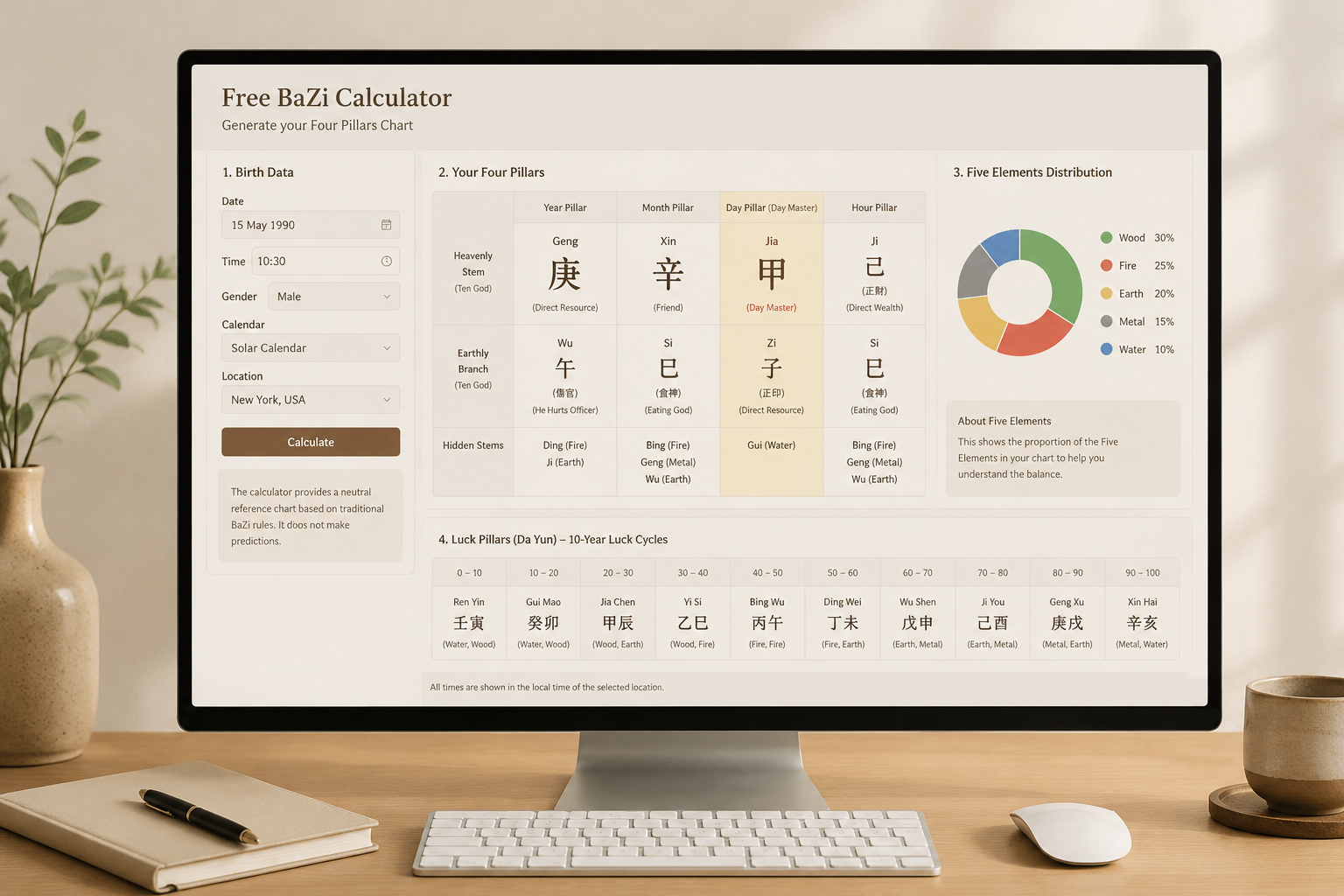
The calculator does not make predictions. It generates a neutral, transparent reference chart built from the traditional BaZi formula. At a glance you will see:
- Four Pillars table – Year, Month, Day, and Hour columns, each with a Heavenly Stem (top) and an Earthly Branch (bottom).
- Hidden Stems inside each Earthly Branch, hinting at underlying qualities.
- Day Master highlighted—the stem of the Day Pillar, treated as the self in the reading.
- Ten Gods labels beside each stem and branch, showing how they relate to the Day Master.
- Five Element distribution, often displayed as a small graph or percentage, indicating the balance among Wood, Fire, Earth, Metal, and Water.
- Luck Pillars (Da Yun) — 10‑year blocks computed automatically from the month of birth and gender.
Everything on the screen is derived from the same transparent logic used by traditional BaZi practitioners. The tool asks only for birth data; it does not store personal information, and no account is needed.
Step 1: Enter Your Birth Information Accurately
Start on the Free BaZi Calculator homepage. You will see fields for the birth date, exact time, and location (time zone).
Date and time – Use the Gregorian calendar date of birth and the local time, ideally to the minute. The tool automatically converts this into the Chinese solar calendar and the appropriate two‑hour time block (the “Hour Pillar”). If you have only the approximate hour, you can still proceed; the chart will be somewhat less specific, but the Day Master and broader pillars remain valid.
Location – Select your birth city or time zone. Accurate time‑zone handling ensures the Hour Pillar reflects the actual local time at birth, avoiding offset errors common in manual calculation.
Gender – Gender is used exclusively for the Luck Pillar calculation (the direction of the 10‑year cycles). It does not affect any other aspect of the chart.
Once you’ve filled in the fields, click “Generate Chart.” The system applies the standard stem‑branch assignment formulas and displays your Four Pillars immediately below the form.
Step 2: Read the Four Pillars Structure
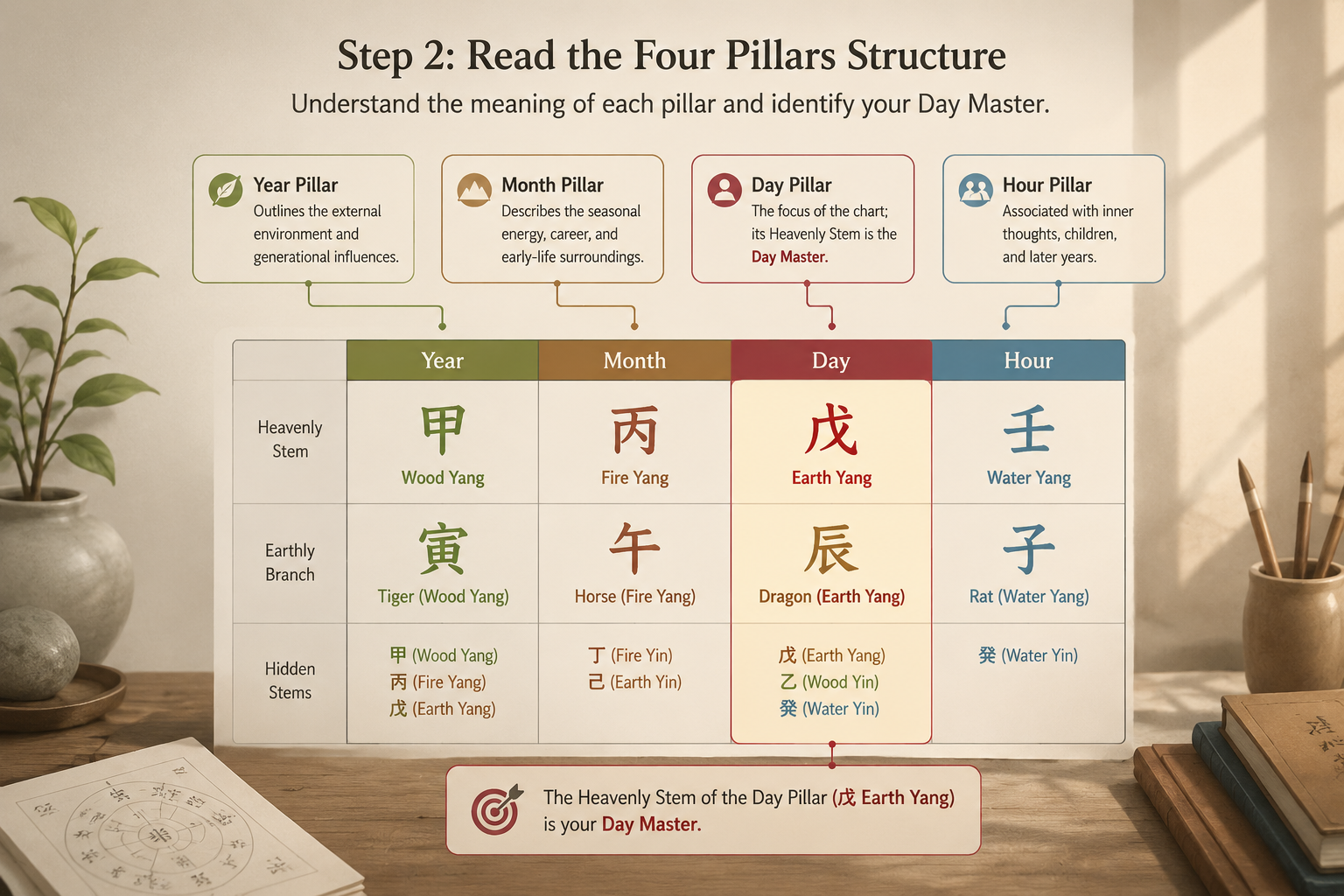
The core of the reading is the Four Pillars table. Each column stands for a time unit:
- Year Pillar – Outlines the external environment and generational influences.
- Month Pillar – Describes the seasonal energy, career, and early‑life surroundings.
- Day Pillar – The focus of the chart; its Heavenly Stem is the Day Master, and its Earthly Branch is the “spouse palace.”
- Hour Pillar – Associated with inner thoughts, children, and later years.
Every pillar contains a Heavenly Stem (one of the 10 celestial stems) and an Earthly Branch (one of the 12 animals sign). The stems and branches each carry a fixed Element and Yin‑Yang polarity, and they interact with each other according to the Five Element cycles. Hidden Stems sit within the Earthly Branch, often shown in a smaller font underneath, adding subtle layers to the reading.
If you are new to the stem‑branch system, the Stems and Branches article offers a more detailed breakdown.
Step 3: Identify the Day Master and Element Balance
The Day Master is the Heavenly Stem of the Day Pillar. In BaZi analysis, it represents the person themselves—the core energy that interacts with all other pillars. Next to the Day Master you will see an Element (Wood, Fire, Earth, Metal, or Water) and a Yin or Yang sign.
For example, a Day Master labeled 甲 (Jia) is Yang Wood: a tall, straightforward, growing energy. 丁 (Ding) is Yin Fire: a warm, gentle, illuminating force. Recognizing your Day Master’s nature gives a starting metaphor, not a fixed personality label.
Alongside the Day Master, the tool often shows an Element Distribution chart. A chart heavy in Water might suggest adaptability and reflective tendencies; one with abundant Earth might feel steady and grounded. These patterns are not good or bad—they are descriptions of qualities. The calculator helps you notice imbalances, which you can then explore through the Ten Gods and Luck Pillars. For further reading, visit the Day Master guide.
Step 4: Interpret the Ten Gods
The Ten Gods are not deities; they are role‑descriptions that emerge when you compare each stem or branch to the Day Master. A stem that shares the same polarity with the Day Master’s element might be labeled “Direct Resource,” while an opposite polarity appears as “Indirect Resource.” Every relationship—Friend, Rob Wealth, Output, Wealth, Resource, and Officer/Seven Killings—points to a different mode of support, expression, or challenge.
Look at the Ten Gods labels beside each pillar:
- A Direct Resource in the Month Pillar could indicate a supportive early environment or a tendency to rely on knowledge and mentors.
- A Hurting Officer in the Hour Pillar might suggest creative or expressive thinking.
- An Indirect Wealth in the Year Pillar could point toward an entrepreneurial instinct or a broad external network.
The tool automatically computes these labels, so you do not need to memorize the transformation tables. Use them as prompts for self‑inquiry, not as fixed verdicts. A deeper explanation is available on the Ten Gods overview.
Step 5: Explore Luck Pillars (Da Yun)
Below the Four Pillars table, the calculator lists the Luck Pillars—10‑year periods that begin after a certain age (the “start age”). Each Luck Pillar consists of a Heavenly Stem and an Earthly Branch, derived by rotating the Month Pillar forward or backward according to gender and the stem‑branch order.
The Luck Pillars describe shifting external circumstances over time. A Metal‑heavy luck pillar might emphasize structure, discipline, or career pressures; a Wood‑heavy one might bring growth, learning, or expansion. Again, these are energetic tendencies, not certain events.
Because the calculator automatically computes the sequence and the start age, you can quickly see which phase you are currently in and which is next. If you’d like to know how the mechanics work, read the Luck Pillars guide.
Practical Tips for Using Your Reading
- Keep notes as you read. Jot down what each component suggests to you, then revisit after a few weeks to see which patterns feel relevant. The reading is a reference, not a one‑time answer.
- Cross‑reference with the Five Elements. If you feel a certain element is overemphasized or lacking, you might explore balancing activities. The Five Elements article explains the nourishing and controlling cycles.
- Use the Huangli Calendar for timing. The Free Huangli Calendar shows the day’s stem, branch, and suitability for certain activities. Aligning a reading with a daily Huangli check can add another layer of cultural context.
- Focus on the Day Master first. Before getting lost in Ten God interactions, understand your Day Master’s element and season. This alone often clarifies the overall tone of the chart.
Limitations and Cultural Context
BaZi is a cultural and philosophical framework originating from Chinese metaphysics. The Free BaZi Calculator presents it in a structured, transparent way, but it cannot—and does not intend to—predict personal destiny, guarantee outcomes, or replace personal judgment. The patterns it shows are best used as a mirror for reflection, much like a personality framework such as the Enneagram or MBTI, though rooted in a different cultural lineage.
A chart reading is highly sensitive to the accuracy of birth time and place. Approximate data produce approximate charts. Moreover, the same chart can be interpreted differently by different schools of thought. Use the information as a starting point for exploration, not as a definitive statement about yourself or others.
FAQ
What is the Day Master and why is it central?
The Day Master is the Heavenly Stem of your Day Pillar. It represents your core self in the BaZi system. Every other pillar and Ten God is compared against it, making it the reference point that shapes the entire reading.
Do I need an exact birth time to use the calculator?
No, but an accurate time produces a more precise Hour Pillar and Luck Pillar start age. If you don’t know the exact time, you can use 12:00 PM (noon) as a default. The Day Master and broader structure will still be correct; only the Hour Pillar’s specific Ten Gods and the Hidden Stems will be less reliable.
Can the calculator predict my future?
BaZi is a structured reading method, not a fortune‑telling service. The calculator maps elemental and relational patterns from your birth data. These patterns can suggest inclinations or life‑phase themes, but they are not deterministic predictions. Personal choice, environment, and countless other factors shape lived experience.
What are the Ten Gods and why are they called “Gods”?
“Ten Gods” (十神) is a translation of a technical term. They are not deities but relationship categories that describe how the other stems and branches interact with the Day Master. The labels—Direct Resource, Indirect Wealth, Hurting Officer, etc.—help you see role dynamics such as support, expression, or control in your chart.
Is the Free BaZi Calculator really free?
Yes. There is no payment, sign‑up, or registration required. The tool generates a full chart instantly and does not store any personal data on its servers.
Where can I learn more about a specific component of my chart?
The Free BaZi site includes a growing set of guides and references. You can start by exploring the Day Master series, the Ten Gods explanation, or the Luck Pillars deep dive. For even broader context, the Five Elements and Stems and Branches articles provide the foundational theory.
Related reading
Related guide
Free BaZi Calculator: How to Read Your Four Pillars Chart
Learn to interpret your BaZi (Four Pillars of Destiny) chart step by step using the free BaZi calculator. Understand Day Master, Five Elements, Ten Gods, and Luck Pillars for a structured cultural reading.
Related guide
BaZi Career and Wealth Reading Boundaries | Free BaZi
Understand how BaZi charts map career and wealth indicators through Ten Gods, Day Master, and Luck Pillars—clear method, cultural reference, and realistic boundaries.
Related guide
BaZi Compatibility Reading Boundaries
Learn how BaZi compatibility reading works through the structured method of Day Master interaction, Five Elements, and Ten Gods—with clear boundaries and no promises.