Ten Heavenly Stems Table — Quick Reference & Guide
A clear reference table for the ten heavenly stems (Tian Gan), including elements, polarity, and practical use in BaZi chart reading. Structured method with no fortune-telling.
The ten heavenly stems (天干, tiān gān) are among the oldest symbolic systems in Chinese metaphysics, predating even the I Ching. In BaZi (Four Pillars of Destiny) reading, they form the "Heaven" part of the chart—the visible, celestial influence that combines with the earthly branches to shape a complete interpretive picture. A stem is not a static label but a character that carries an element, a yin or yang polarity, a direction, a season, and a network of relationships.
This guide provides a clean reference table of all ten stems, explains how to read it, and shows how the stems appear in your own BaZi chart. We stay within the limits of cultural reference and transparent method: no predictions, no guarantees, just the structures readers can use to start reading with clarity.
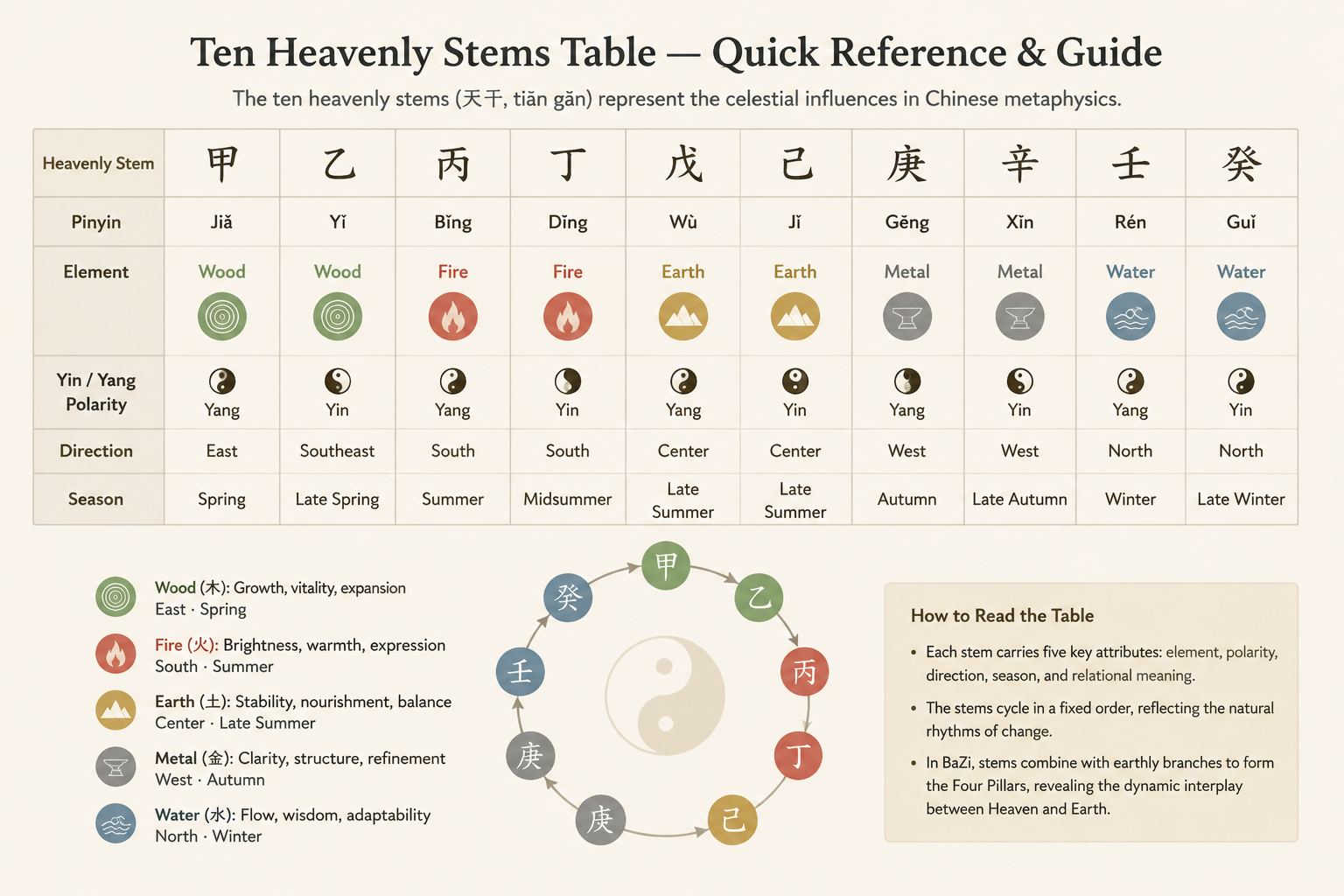
What Are the Ten Heavenly Stems?
The ten stems are a sequence of ten symbols. They originate from a very old observation cycle: the ten-day week (旬, xún) used in ancient Chinese calendars. Over time, each stem became paired with a direction, a season, a planet, and—most importantly—one of the five elements (Wu Xing), repeated in a yin form and a yang form. That pairing gives the ten stems their full character.
In BaZi, every pillar (year, month, day, hour) has a heavenly stem on top and an earthly branch below. The stem is often described as the "visible" expression of the pillar—the part that interacts directly with other stems, with the luck pillars, and with years. The Day Master (the stem of the day pillar) is the primary reference point for reading character and balance.
Because the stems appear in straightforward order, a reference table is an excellent first checkpoint when you open a BaZi chart. Instead of memorising all ten at once, you learn to scan the table for element, polarity, and position.
The Complete Ten Heavenly Stems Reference Table
Below is a clean, sortable table that you can use while reading a BaZi chart. Each row gives the stem number, the Chinese character, pinyin, the associated five elements classification, its yin or yang polarity, the traditional direction, and the season where the stem’s element is most robust. The final column notes the fixed elemental identity—this never changes and is the basis for all interactions.
| # | Character | Pinyin | Element | Polarity | Direction | Season | Fixed Element |
|---|---|---|---|---|---|---|---|
| 1 | 甲 | Jiǎ | Wood | Yang | East | Spring | Wood |
| 2 | 乙 | Yǐ | Wood | Yin | East | Spring | Wood |
| 3 | 丙 | Bǐng | Fire | Yang | South | Summer | Fire |
| 4 | 丁 | Dīng | Fire | Yin | South | Summer | Fire |
| 5 | 戊 | Wù | Earth | Yang | Centre | Transition | Earth |
| 6 | 己 | Jǐ | Earth | Yin | Centre | Transition | Earth |
| 7 | 庚 | Gēng | Metal | Yang | West | Autumn | Metal |
| 8 | 辛 | Xīn | Metal | Yin | West | Autumn | Metal |
| 9 | 壬 | Rén | Water | Yang | North | Winter | Water |
| 10 | 癸 | Guǐ | Water | Yin | North | Winter | Water |
How to use this table: Find the stem that appears in any pillar of your chart. Note its element and polarity; this tells you the baseline energy of that pillar. For the Day Master (day stem), write down its element and polarity—they become the key to the entire BaZi chart. From there, you can see how the other stems either support (produce the same element) or control (destruct according to the five-element cycle).
It’s helpful to keep a printed version or screenshot of this table next to your chart until you’ve internalised the stem qualities. Over time, you will begin to recognise patterns without needing to look up every symbol.
The Yin-Yang and Elemental Cycle of the Stems
The sequence 1‑10 alternates yang then yin for each element. This pairing is fundamental. A yang stem is expansive, initiating, outward; its yin counterpart is contractive, sustaining, inward. In reading terms, this offers an additional layer of texture when two stems of the same element meet. For example, Jiǎ (yang wood) is a sturdy tree, while Yǐ (yin wood) is grass or vines—both wood, but their strategic meaning in a chart differs.
The five-element cycle runs in the producing order: Wood, Fire, Earth, Metal, Water, then back to Wood. Because stems represent phases of that cycle, you can see at a glance whether a year stem in a luck pillar reading is entering a favourable or challenging phase based on its relationship to the Day Master’s element. This is the core of the method: not prediction, but pattern recognition.
Note that Earth stems (5 and 6) sit at the centre. In many chart layouts they are not tied to a cardinal direction but represent the pivot, the transitions between seasons. Their role is often to stabilise or to buffer interactions between other elements.
How Heavenly Stems Work with Earthly Branches
A common point of confusion for new readers is the difference between heavenly stems and earthly branches. The stems are pure element. The branches are composite: each branch hides one to three stems inside. The branch gives the terrain, the stem gives the weather.
When you look at a full pillar—say, 甲子 (Jiǎ on Zǐ)—you see yang wood on top and a Rat branch below. The Rat (子) is fundamentally water, but it also contains hidden stems (癸 water). The interaction between the visible stem and the branch’s hidden stems creates richness, but it also means the simple reference table for stems stays your first point of orientation. Start with the stem, then explore the branch.
In practice, you can read the stems alone for a quick chart impression. The branches add context, depth, and the specific timing of events. This is why many readers begin by noting the Day Master stem, its element, and the elements of the other visible stems, before moving to the branches.
Using the Heavenly Stems in Your BaZi Chart
Let’s walk through a basic reading path with the stem table. Go to the Free BaZi chart tool and generate your chart. Look at the top row of each pillar—those are your four heavenly stems. Write them down:
- Year stem – social environment, outer influences.
- Month stem – season of birth, strongest external element.
- Day stem (Day Master) – your core interpretive stem.
- Hour stem – later life, inner world, personal pursuits.
Now take the Day Master element. Cross-reference with the table to understand its baseline quality. If your Day Master is Gēng (yang metal), you are working with a metal-person type in BaZi terms. Then look at the month stem: is it producing (earth), weakening (fire), or matching (metal)? This gives a first structural impression of the chart’s balance—a reading of strengths and tensions, not a fortune.
From here, you can layer in Ten Gods relationships. The Ten Gods are not deities; they are the relational designations that appear when you compare another stem’s element to the Day Master’s element. The table above is the pre-requisite: you must know each stem’s fixed element before you can assign the correct Ten God.
A quick example
Suppose the Day Master is丙 (Bǐng, yang fire) and you see甲 (Jiǎ, yang wood) in the month stem. Wood produces Fire, so甲 is the Resource god—supportive influence. Compare that to seeing庚 (Gēng, yang metal) in the year stem: Metal controls Fire, so庚 becomes the Authority star—a controlling influence. Every stem you identify using the table opens a door to a specific reading layer.
Reading Caution: What the Stems Cannot Do
It is easy to oversell a symbolic system. The heavenly stems offer a reading framework, not a measurement of fate. They describe an environment of elements and relationships, and suggest patterns that have been observed across cultures. No stem—taken alone—predicts money, marriage, or misfortune. The value of the table is in how it helps you ask better questions: Which element is dominant right now? Where is the strongest tension? What support is available?
When you use the Huangli (Chinese Almanac) tool, you’ll notice the day’s stem-branch combination. The table helps you quickly spot whether the day stem is the same as, supportive of, or controlling your Day Master. This is a method for gauging daily energy, not for determining lucky or unlucky actions. Keep the tone sober, and the method keeps its integrity.
Frequently Asked Questions
What are the ten heavenly stems used for in BaZi?
They are the primary symbolic markers that give each pillar its elemental identity and polarity. In a reading, the stems help you identify the Day Master, assess the elemental balance of a chart, and define the dynamic relationships (Ten Gods) between different pillars and time cycles.
How do I find my heavenly stem in my chart?
Use the free BaZi chart tool. Enter your birth date and time. The result shows four pillars; the top character of each pillar is the heavenly stem. The day pillar’s top stem is your Day Master. Cross-reference it with the table above to confirm its element and polarity.
What is the difference between heavenly stems and earthly branches?
The stems are pure, ten elemental symbols that rotate in a fixed sequence. The branches are twelve composite symbols that carry hidden stems and represent complex terrestrial conditions. Stems give the quality of a pillar; branches give the ground and context. In reading, stems are often read first for clarity.
Why are stems divided into yin and yang?
The yin-yang division encodes observable dualities within each element: expansive vs. contractive, hard vs. soft, initiating vs. sustaining. It allows the same element to express two different qualities. In practice, this refines relationship readings—for instance, yang metal (Gēng) can "chop" yin wood (Yǐ) in a way that differs from yin metal (Xīn) shaping yang wood (Jiǎ).
Do I need to memorise the entire table?
Not immediately. Reference the table regularly while learning. Over time, the element and polarity of each stem become automatic. Most practitioners internalise the Day Master stem first, then the month stem, and gradually the full set. The table exists precisely so you don’t need to rely on memory alone.
Next Steps in Your Reading
With the stem table at hand, you have the first layer of your BaZi reading unlocked. The logical next step is to study the Day Master types in more depth, then explore how five-element cycles work across pillars. For a hands-on approach, revisit your chart and try identifying the element of each stem and its relationship to your Day Master. The goal is pattern familiarity, not swift conclusions.
The free tools on this site—the BaZi chart generator and the Huangli daily reference—are built with this same transparent method. They provide the symbols; you bring the careful reading.
Related reading
Related guide
Free BaZi Calculator: How to Read Your Four Pillars Chart
Learn to interpret your BaZi (Four Pillars of Destiny) chart step by step using the free BaZi calculator. Understand Day Master, Five Elements, Ten Gods, and Luck Pillars for a structured cultural reading.
Related guide
Five Elements Balance in BaZi: How to Read Your Chart's Strengths
Learn how to read the five elements balance in your BaZi chart. Understand strengths, imbalances, and the interplay of Day Master and Ten Gods for a clearer self-reading.
Related guide
Ten Gods in BaZi: What Each One Means in Your Chart
A methodical guide to the Ten Gods in BaZi: how they arise from the Day Master, what each represents, and how to read them in context using the Free BaZi chart tool.