Free BaZi Calculator: How to Read Your Four Pillars Chart
Learn to interpret your BaZi (Four Pillars of Destiny) chart step by step using the free BaZi calculator. Understand Day Master, Five Elements, Ten Gods, and Luck Pillars for a structured cultural reading.
BaZi—often called Eight Characters or Four Pillars of Destiny—is a structured reading system that grew out of the Chinese lunisolar calendar. It translates your birth year, month, day, and hour into four pairs of Heavenly Stems and Earthly Branches. Each pillar combines a celestial stem and a terrestrial branch, giving you eight characters that map elemental and yin‑yang qualities onto your life timeline. The free BaZi calculator on Free BaZi generates this chart in seconds, no registration required. This guide walks you through every layer of the chart so you can approach it as a transparent, method‑driven cultural reference rather than a fixed pronouncement.
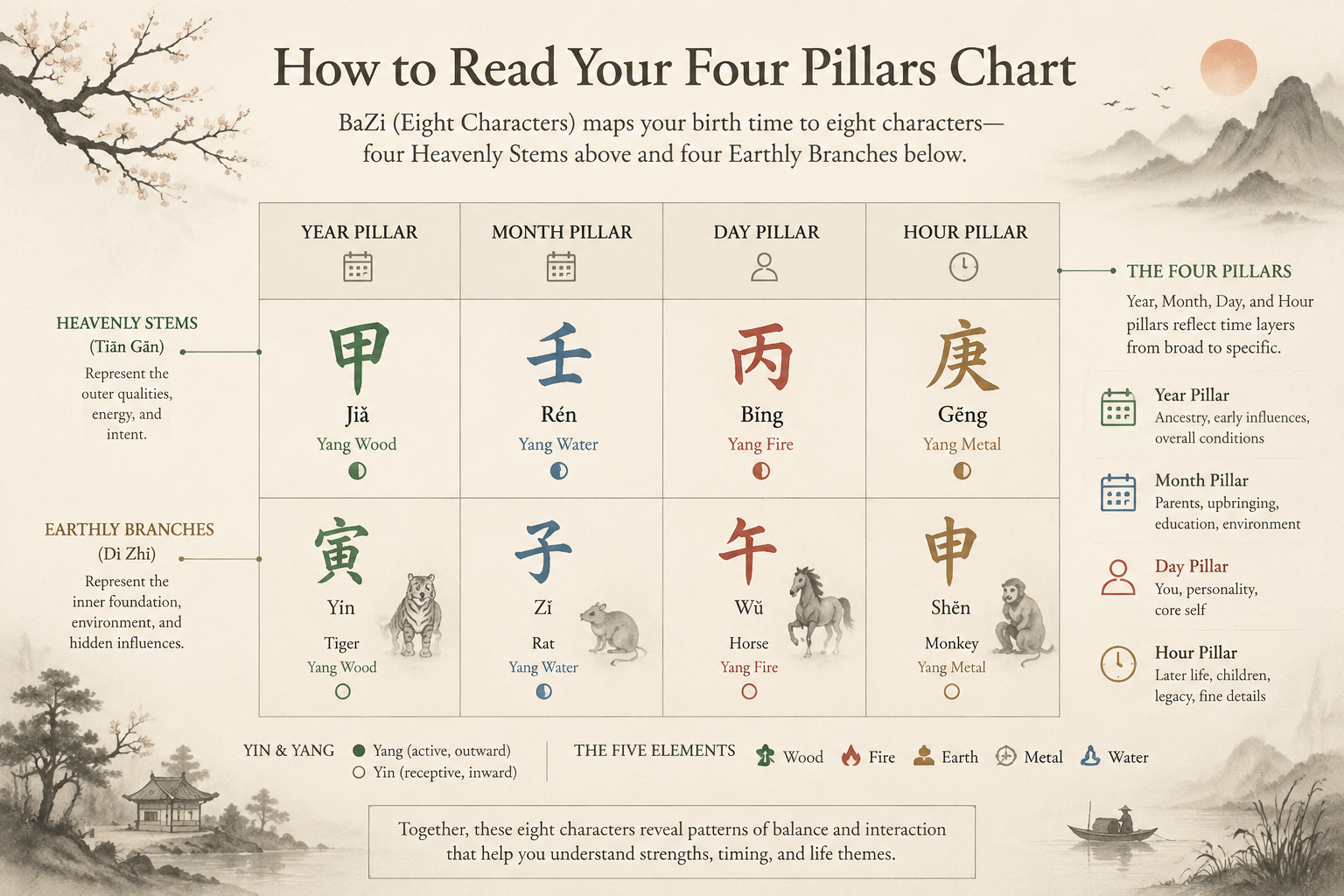
What Is a Four Pillars Chart?
Each pillar corresponds to a time frame and a set of life themes, though the boundaries are fluid and meant as a lens rather than a rigid diagnosis:
- Year Pillar — often associated with ancestry, extended family, and the outer social environment.
- Month Pillar — linked to parents, upbringing, career direction, and the formative adult years.
- Day Pillar — represents the self and the spouse or close partner. The Heavenly Stem of the Day Pillar is called the Day Master; the Earthly Branch of the Day Pillar is the spouse palace.
- Hour Pillar — points toward children, creative output, inner world, and later life.
These pillars interact through the two‑cycle logic of the Five Elements: the productive (nourishing) cycle and the controlling (balancing) cycle. Reading the chart means observing how the elements and their yin‑yang polarities are distributed across the pillars, and then exploring the derived relationships known as the Ten Gods and the later‑life timing of the Luck Pillars. No chart is “good” or “bad” in an absolute sense; the framework highlights tendencies, tensions, and areas of ease.
Step‑by‑Step: Using the Free BaZi Calculator
Getting your Four Pillars takes only a moment, but a few inputs make the output more precise.
- Enter your birth date — the calculator uses the solar year, so the Gregorian date works directly.
- Add your birth time — the Hour Pillar shifts every two hours (standard Chinese double‑hour). Even a rough estimate can shift the Day Master’s branch.
- Adjust for location and time zone — the tool automatically adjusts to a default time zone, but you can refine it. If you’re unsure, use the local time at your place of birth.
- Generate the chart — you’ll see the Four Pillars, the Luck Pillars (Da Yun), hidden stems within the earthly branches, and a brief reading.
Once your chart is on screen, the calculator highlights your Day Master so you can immediately begin your reading. If you want to understand how the lunisolar calendar underpins the stems and branches, the Huangli calendar page gives the background without mystique.
Decoding Your Chart’s Day Master
The Day Master is the Heavenly Stem of the Day Pillar—your core reference point. There are ten possible Day Masters: one yin and one yang version of each of the Five Elements.
| Yang Stem | Yin Stem | Element | Broad Tendency (a lens, not a label) |
|---|---|---|---|
| Jia 甲 | Yi 乙 | Wood | Growth‑oriented, flexible, expansive |
| Bing 丙 | Ding 丁 | Fire | Warm, expressive, outwardly focused |
| Wu 戊 | Ji 己 | Earth | Grounded, stable, accommodating |
| Geng 庚 | Xin 辛 | Metal | Structured, principled, decisive |
| Ren 壬 | Gui 癸 | Water | Adaptive, reflective, communicative |
For example, if your Day Master is Jia Wood (Yang Wood) , you may recognise traits like leadership, initiative, and a tendency to push forward like a tall tree. But the Day Master alone never tells the full story—it only becomes meaningful when you weigh it against the surrounding elements, the Ten Gods, and the climate of the chart. For a deeper exploration of each type, see the Day Master guide.
Reading the Five Elements Balance
The Five Elements (Wood, Fire, Earth, Metal, Water) are the basic substance of every BaZi chart. Imbalance does not mean “problem”; it simply shows where attention flows naturally and where extra effort or awareness may surface.
A structured reading path:
- List all eight characters — the Heavenly Stem and Earthly Branch of each pillar.
- Classify each character by element — use a standard conversion table (Wood, Fire, Earth, Metal, Water).
- Count the occurrences — which element appears most? Which appears least?
- Check the productive and controlling cycles — does a weak element get nourished by a productive source, or does it face a controlling force that may constrain it?
Often a chart shows a cluster of one or two elements and a notable absence of others. A predominantly Wood and Fire chart leans toward growth and expression; a Metal‑heavy chart tends toward order and precision. Again, these are tendencies, not verdicts. The full element interaction—including the hidden stems inside the earthly branches and the elements flowing in during Luck Pillars—adds richness. The Five Elements reference explains the cycles and their manifestations in daily life.
Understanding the Ten Gods
The Ten Gods are not deities; they are relational markers that describe how the other seven characters interact with your Day Master. They give themes for the personal roles, work styles, and resource dynamics suggested by the chart.
A simplified mapping from Day Master to any other Heavenly Stem:
- Same element, same polarity → Friend (Parallel)
- Same element, opposite polarity → Rob Wealth
- Element that produces Day Master, same polarity → Direct Resource
- Element that produces Day Master, opposite polarity → Indirect Resource
- Element Day Master produces, same polarity → Hurting Officer
- Element Day Master produces, opposite polarity → Eating God
- Element that controls Day Master, same polarity → Direct Officer
- Element that controls Day Master, opposite polarity → Seven Killings
- Element Day Master controls, same polarity → Direct Wealth
- Element Day Master controls, opposite polarity → Indirect Wealth
For example, a Jia Wood Day Master with Geng Metal (Yang Metal) in the Month Stem would see a Seven Killings relationship, often described as a pressure that can sharpen discipline. A Jia Wood Day Master with Gui Water (Yin Water) would see an Indirect Resource, which may hint at unconventional learning or intuition. The Ten Gods are a relational map, not a scorecard. Consult the Ten Gods reference for a full guide.
Luck Pillars and the Timeline of Change
Luck Pillars (Da Yun) are rolling ten‑year cycles that begin after a person’s birth, calculated from the Month Pillar and birth sex. Each Luck Pillar brings a Heavenly Stem and Earthly Branch that temporarily overlay the natal chart, acting like a seasonal shift in the personal climate.
You can use Luck Pillars to reflect on life phases. A Luck Pillar that introduces Wood into a chart with sparse Wood might coincide with a period of growth and expansion. A pillar that clashes with the Day Master’s branch may prompt uncomfortable but necessary adjustments. These patterns are not deterministic; they are like noticing the weather so you can dress accordingly, not like being handed a fixed script.
Reading Luck Pillars is an advanced skill, but even a beginner can note which element enters during a current or upcoming decade and ask, “What themes does this element carry in my chart?” The Luck Pillars guide breaks down the calculation and interpretation.
Frequently Asked Questions
Is the BaZi chart a prediction of my future?
No. A BaZi chart is a cultural framework for self‑reflection, not a fortune‑telling device. It offers a structured lens through which you can examine tendencies, strengths, and areas of tension. Outcomes are not locked into the chart.
How accurate is a free online BaZi calculator?
The Free BaZi calculator uses the traditional lunisolar conversion and the widely accepted rules for stems, branches, and Luck Pillar calculation. The accuracy of the chart itself is high, but interpretation is a human art—not an exact science—and any reading benefits from thoughtful engagement rather than blind acceptance.
Can I use the chart to choose a career or relationship?
The chart can suggest inclinations. For example, a person with a strong Wood presence might find themselves naturally drawn to growth‑oriented fields or collaborative environments. However, chart patterns should never override personal judgment, real‑world skills, or genuine emotional connection. A BaZi compatibility reading can serve as a conversation starter between partners, never as a verdict on a relationship’s worth.
Do I need my exact birth time?
Yes, whenever possible. The Hour Pillar shifts every two hours, so an incorrect time can place you in the wrong branch and alter the Day Master’s stabilizing influence. If your exact time is unknown, some practitioners default to solar noon, but the reading becomes less nuanced. The calculator respects whatever time you provide, so a close estimate is better than guessing.
Ready to explore your own Four Pillars? Use the free BaZi calculator to generate your chart, then come back to this guide and read each section with your own stems and branches in front of you. Treat the chart as a map, not a destiny—and enjoy the structure it brings to your inner reflections.
Related reading
Related guide
BaZi Compatibility Reading Boundaries
Learn how BaZi compatibility reading works through the structured method of Day Master interaction, Five Elements, and Ten Gods—with clear boundaries and no promises.
Related guide
BaZi Luck Pillars: How the 10-Year Cycles Shape Your Life
A methodical introduction to luck pillars in BaZi: how the 10-year cycles are structured, how to read them with your natal chart, and why they offer an interpretive layer, not a fixed prediction.
Related guide
How to Use the Free BaZi Calculator: Step-by-Step Guide
Learn how to use the Free BaZi Calculator with a clear step-by-step guide. Enter birth data, generate a Four Pillars chart, and interpret Day Master, Ten Gods, and Luck Pillars—no sign-up required.