Five Elements Balance in BaZi: How to Read Your Chart's Strengths
Learn how to read the five elements balance in your BaZi chart. Understand strengths, imbalances, and the interplay of Day Master and Ten Gods for a clearer self-reading.
BaZi (also known as the Four Pillars of Destiny) is a structured Chinese metaphysical system that translates a person’s birth year, month, day, and hour into eight characters – each consisting of a Heavenly Stem and an Earthly Branch. At the very center of this system lies the dynamic interplay of the five elements: Wood, Fire, Earth, Metal, and Water. Understanding whether these elements are balanced, excessive, or absent in your chart is one of the most accessible ways to read inherent strengths, tendencies, and areas of creative friction. This guide explains the method clearly, using the Free BaZi tool as a practical companion, and treats the five elements as a cultural reading lens rather than a deterministic prediction.
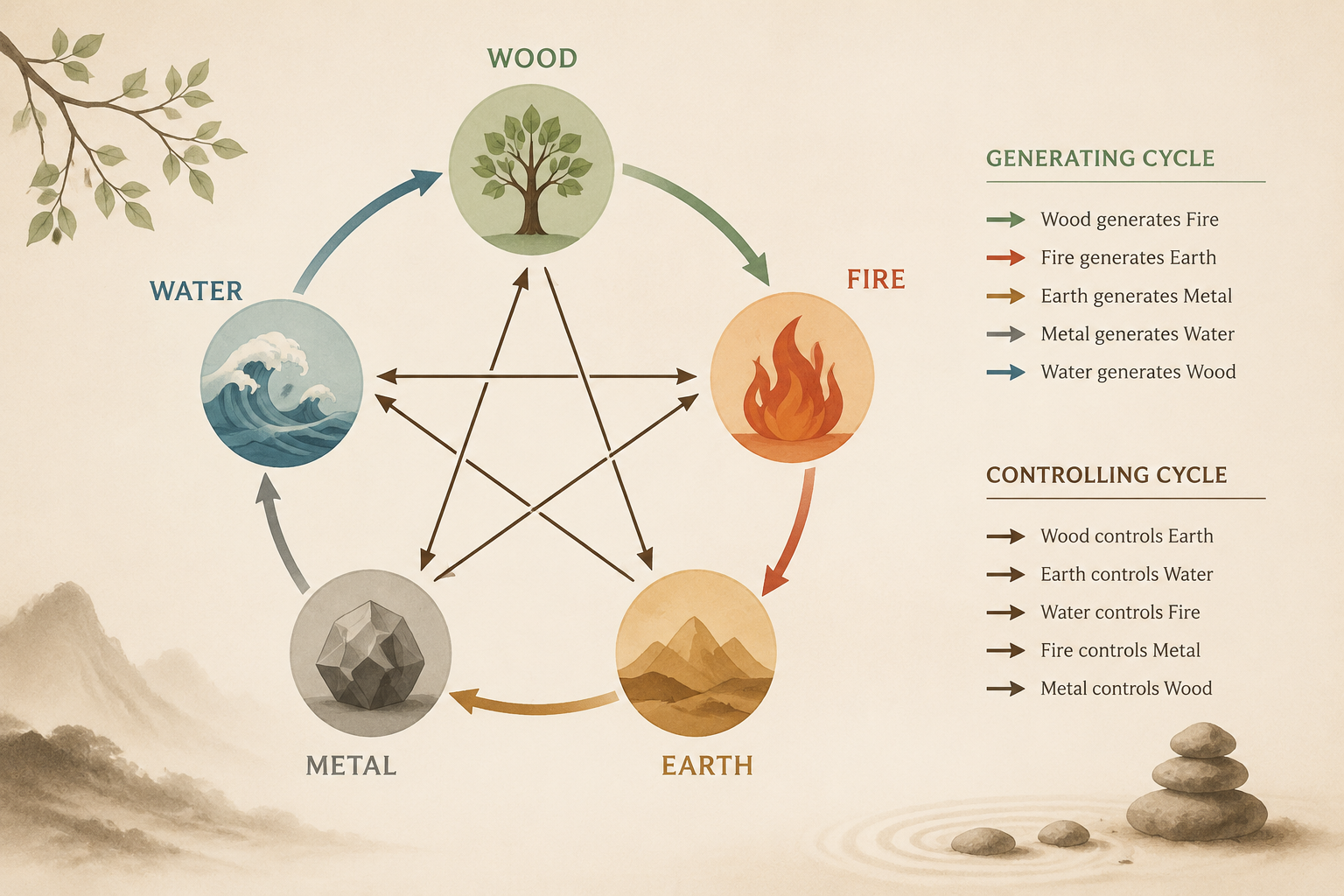
The Five Elements Framework
The five elements are not literal substances; they are symbolic categories that describe the movement of qi (energy) through phases of change. Each element carries a set of qualities and resonates with a season:
- Wood – growth, expansion, planning; spring.
- Fire – passion, transformation, visibility; summer.
- Earth – stability, nurturing, grounding; late summer and transitions between seasons.
- Metal – structure, refinement, clarity; autumn.
- Water – wisdom, introspection, flow; winter.
These elements interact through two fundamental cycles: the Generating Cycle (Wood feeds Fire, Fire creates Earth, Earth bears Metal, Metal enriches Water, Water nourishes Wood) and the Controlling Cycle (Wood restrains Earth, Earth dams Water, Water extinguishes Fire, Fire melts Metal, Metal chops Wood). In a BaZi chart, the presence and strength of each element – and how they relate to these cycles – paints a picture of both support and constraint. These interactions form the basic grammar of elemental balance.
Identifying Elemental Balance in a BaZi Chart
When you cast your chart with the Free BaZi chart tool, the layout immediately reveals the element assigned to each Heavenly Stem and to the main qi of each Earthly Branch. A straightforward first step is to simply count how many times each element appears. While stems are often considered more direct in their expression and branches contain hidden secondary elements, the raw tally gives a useful initial overview.
Take a hypothetical chart with the Day Master Yin Earth. You might find stems: Earth, Metal, Water, Wood; and branch main elements: Earth, Earth, Fire, Water. The count: Earth appears three times, Water twice, Metal once, Wood once, Fire once. That suggests an Earth-dominant constitution. An Earth-strong reading may point toward reliability, caution, and a tendency to hold onto ideas or situations longer than others. Yet the balance of the chart also depends on how the Day Master interacts with those elements. An Earth Day Master, for example, receives Resource support from Fire, produces Output as Metal, controls Water as Wealth, and is influenced by Wood. A heavy Earth presence might feel steady but could also indicate inertia if the nurturing Fire or releasing Metal is insufficient.
No single tally is “good” or “bad” – it simply describes a starting point. A chart in which all five elements appear in roughly equal numbers is often described as versatile, whereas one with a clear surplus or absence highlights more focused energetic patterns.
Interpreting Imbalances: Too Much or Too Little
When one element dominates, the qualities associated with that element tend to color the personality and life themes. Too much Wood can manifest as overextension, too many simultaneous projects, or a restless drive that struggles with patience. A Fire-heavy chart often burns brightly but may tip into restlessness or burnout if not grounded by Earth or cooled by Water. An excess of Earth can suggest a deeply stable but sometimes rigid approach – someone who has trouble letting go. Too much Metal may bring exceptional standards and precision but can also feel emotionally distant or overly self-critical. Water in abundance deepens intuition, yet it can also lead to overwhelm, fluctuating emotions, or a tendency to over-reflect.
The absence of an element is not a flaw. If Water is missing, it does not mean the person lacks wisdom; rather, the reading lens might note that the qualities of introspection and fluidity do not come as naturally in their baseline disposition. The person may approach life with a steady, predictable rhythm and may need to consciously cultivate moments of stillness or creative ambiguity. As with many aspects of BaZi, the missing element can appear in a different form through the Ten Gods or enter during specific periods of the Luck Pillars, bringing its influence in a temporary but educational way.
Equally important is the controlling cycle. If a strong Metal appears in a chart with a Wood Day Master, the reading may suggest a life prone to external structure, rules, and potential stifling of one’s innate expansive tendencies. The feeling of being “chopped” is not a curse; it can be reframed as repeated encounters with discipline that, when channeled well, lead to refinement. Context, supported by the Ten Gods, transforms a simple surplus into a more nuanced narrative.
Using the Day Master and Ten Gods to Refine the Reading
The five elements never operate in isolation – they are always filtered through the prism of the Day Master, the Heavenly Stem of the day pillar that represents the self. Understanding your Day Master’s element (see Day Master guide) is the first step toward a richer reading. The Day Master then relates to every other stem and branch element through the Ten Gods: Resource (element that produces the Day Master), Output (element the Day Master produces), Wealth (element the Day Master controls), Influence (element that controls the Day Master), and Companion (same element).
This means the same element can play very different roles depending on the Day Master. Water as Resource for a Wood Day Master suggests access to wisdom and support; the same Water as Influence for a Fire Day Master points to challenges that force adaptation and emotional regulation. A chart that looks elementally balanced at first glance may still reveal functional tension when, for example, all the Wood appears in the Influence position – a configuration that can indicate strong external pressures or authority figures. Conversely, a chart that seems overly Fire‑dominant may actually be nurturing an Earth Day Master through a supportive Resource relationship, making that fire feel energizing rather than overwhelming.
A practical reading therefore moves from the raw element count to an analysis of the Day Master’s strength and the Ten Gods framework (explore Ten Gods introduction). By layering these perspectives, the five elements balance becomes a dynamic, role‑based portrait rather than a static checklist.
Practical Steps to Read Your Balance with the Free BaZi Tool
Here is a reproducible workflow you can follow when you open your chart on Free BaZi:
- Cast your chart. Enter your birth data in the Free BaZi chart tool to generate your full Four Pillars and Luck Pillar table.
- Locate your Day Master. Note the element of the Day Stem – this is your self‑element. Observe whether it sits in a supportive season (e.g., a Wood Day Master born in spring is naturally stronger) by checking the month branch.
- Count the elements. Use the element breakdown available in the tool to tally the appearances of Wood, Fire, Earth, Metal, and Water across the stems and the main Earthly Branch qi. Look for any element appearing three or more times (a surplus) or zero times (a gap).
- Check the Ten Gods distribution. Examine which role each element plays relative to your Day Master. Are your supportive Resources and Outputs plentiful, or is the chart dominated by Influences and Competitors? The quality of the balance often hinges more on these functional roles than on the raw element counts.
- Factor in the season. The month pillar indicates the seasonal temperature and moisture, which can amplify or moderate an element’s strength. A Fire Day Master born in summer is already strong; even a small amount of extra Fire might tip it into excess.
- Look into your current Luck Pillar. The 10‑year Luck Pillar cycle overlays a temporary elemental emphasis. A person with a missing element may live through a decade where that element arrives, making it a period of learning a new quality. Read more about these cycles in the Luck Pillars overview.
- Interpret with restraint. An imbalance suggests habitual patterns and themes, not fixed outcomes. Use the reading as a framework for self‑observation: if your chart is Earth‑heavy, you might ask whether your steadiness sometimes becomes procrastination. If Water is scarce, notice when you last made time for quiet reflection.
For day‑to‑day context, some people also reference the Huangli calendar, which notes the daily elemental combinations and can offer a gentle nod to the changing energetic landscape, though always within a cultural‑reference frame rather than a prescriptive one.
Frequently Asked Questions
What if my chart has all five elements present?
A chart with all elements visible is sometimes described as balanced at a basic level; it can indicate a versatile, adaptable nature. However, the real balance still depends on the Day Master’s strength and the functional distribution of the Ten Gods. An even element count does not automatically guarantee an easy life – it simply means the spectrum of elemental qualities is accessible.
How can I tell if an element is “too strong” in my chart?
An element is often considered strong when it appears three or more times in the stems and main branch elements, especially if it aligns with the season of birth. For instance, a Fire element appearing four times in the branches during summer is notably strong. Check your element breakdown on the Free BaZi chart tool for a quick tally. If that strong element sits in the Influence (controlling) position relative to your Day Master, it may indicate consistent pressure, while the same element as Resource could be read as abundant support.
Does a missing element mean I will have bad luck?
No. BaZi is a cultural reference system for understanding tendencies, not a predictor of fortune. A missing element simply highlights a quality that may be less pronounced in your innate disposition. Through life experience, exposure to people who embody that element, or entering a Luck Pillar where that element becomes active, you can engage with and integrate its qualities over time.
Can the five elements balance change over time?
The birth chart is fixed, but the temporary influence of the Luck Pillars (10‑year cycles) and annual cycles can shift the emphasis. For example, if your chart has no Metal, a Metal Luck Pillar may bring a phase where you encounter more structure, discipline, and refinement. Understanding these shifts helps you read the evolving narrative of your chart without losing sight of its core blueprint. See the Luck Pillars overview for more detail.
A Reading Lens, Not a Verdict
The five elements balance in BaZi is one of many lenses through which to explore a chart. It offers a structured way to notice patterns – what comes easily, where friction arises, which qualities may need conscious cultivation. When paired with the clarity of the Day Master and the functional map of the Ten Gods, it becomes a rich cultural reference for self‑understanding. The goal is never to pigeonhole but to illuminate.
Use the Free BaZi chart tool to see your own elemental profile without guesswork. Let the chart open a conversation, not a conclusion.
Related reading
Related guide
Free BaZi Calculator: How to Read Your Four Pillars Chart
Learn to interpret your BaZi (Four Pillars of Destiny) chart step by step using the free BaZi calculator. Understand Day Master, Five Elements, Ten Gods, and Luck Pillars for a structured cultural reading.
Related guide
Ten Gods in BaZi: What Each One Means in Your Chart
A methodical guide to the Ten Gods in BaZi: how they arise from the Day Master, what each represents, and how to read them in context using the Free BaZi chart tool.
Related guide
BaZi Compatibility Reading Boundaries
Learn how BaZi compatibility reading works through the structured method of Day Master interaction, Five Elements, and Ten Gods—with clear boundaries and no promises.