BaZi Compatibility Reading Boundaries
Learn how BaZi compatibility reading works through the structured method of Day Master interaction, Five Elements, and Ten Gods—with clear boundaries and no promises.
BaZi, or the Four Pillars of Destiny, is a structured system rooted in Chinese metaphysics that maps a person’s birth time into eight characters—Heavenly Stems and Earthly Branches—representing Wood, Fire, Earth, Metal, and Water. When used to explore compatibility, it identifies elemental affinities, support cycles, and points of friction between two charts. This article outlines what BaZi compatibility readings can and cannot do, the core method, and the boundaries that keep the practice transparent and useful.
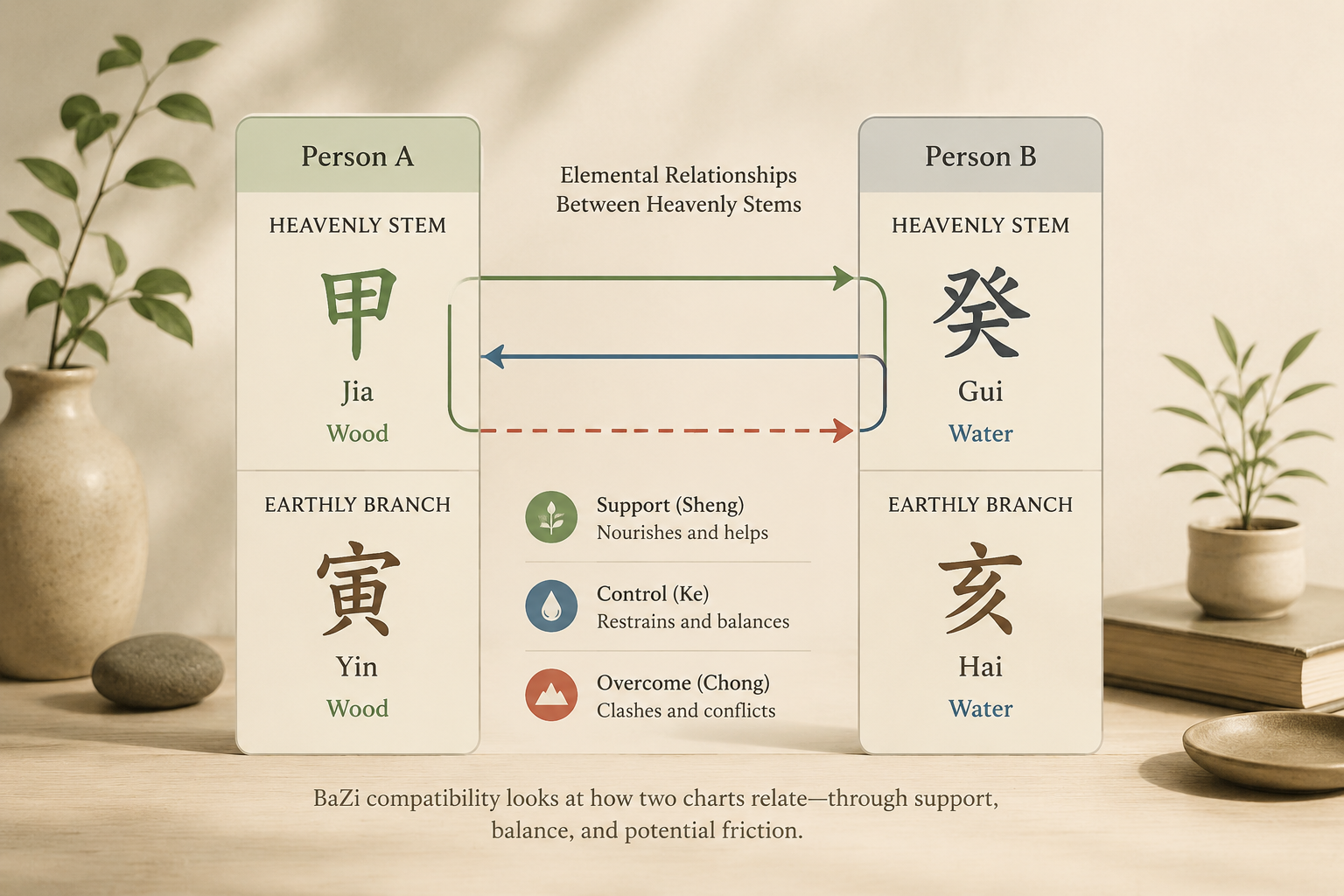
What BaZi Compatibility Really Measures
A BaZi compatibility reading is not a love meter or a future guarantee. Instead, it’s a comparative analysis of two natal charts. The reading looks at:
- Day Master interaction: the elemental nature of each person’s self (Day Master) and how these elements relate—generating, controlling, or clashing.
- Five Element balance: the overall distribution of Wood, Fire, Earth, Metal, Water across both charts, and what that suggests about a dynamic (e.g., one chart may supply the missing element in the other’s structure, creating a complementary loop).
- Ten Gods relationships: derived from the Day Master, the Ten Gods describe roles and interactions like Friend, Rob Wealth, Output, and Influence. These archetypes show how individuals instinctively project and receive energy in a relationship.
- Luck Pillar alignment: timing matters. Two charts may have tension in natal elements, but if concurrent Luck Pillars bring supportive elements, the friction can ease.
The key is that BaZi doesn’t predict a fixed outcome. It reveals elemental tendencies that may incline a relationship toward certain communication styles, growth challenges, or areas of ease. The interpretation relies on reading these patterns against known principles, always allowing for personal effort and context.
The Core Method: How to Read Compatibility Step by Step
At Free BaZi, we advocate a transparent, repeatable method. Here is a structured reading path:
1. Establish Both Day Masters
Take, for example, a Yang Wood (甲) Day Master and a Yin Fire (丁) Day Master. Wood burns to feed Fire; thus, the Yin Fire person may feel energized by the Yang Wood’s actions, but the Yang Wood may feel consumed if Fire is too strong. This is not “good” or “bad”—it is a pattern that requires management.
2. Assess the Five Element Interaction Between Day Masters
Use the generating and controlling cycles. Wood generates Fire (support), Fire generates Earth, Earth generates Metal, Metal generates Water, Water generates Wood. Wood controls Earth (weakening), Earth controls Water, Water controls Fire, Fire controls Metal, Metal controls Wood. A Day Master that generates the other suggests a supportive or nurturing dynamic; controlling interactions suggest challenge or friction that can spur growth.
3. Overlay the Full Charts
Check the elemental quantity of each element across all eight characters in both charts. Does one chart have a missing element that the other supplies? This can indicate a filling of a void, but beware: over-reliance on a single element from a partner’s chart may create imbalance in the long run. Also note Earthly Branch combinations and clashes (六合, 六冲). A clash between the Day Branch or Year Branch can indicate fundamental tension in core personality or background, while harmonious combinations suggest easy rapport.
4. Examine Ten Gods Prominent in Each Chart and Their Interplay
If person A’s Day Master produces Output (食神/伤官) that is person B’s Direct Wealth (正财) or Indirect Wealth (偏财), their interaction may be creative and materially beneficial. If person A has a strong Rob Wealth (劫财) star and person B’s chart is Metal, the Rob Wealth (Wood) might cause competitive tension. Understanding the Ten Gods requires reading our detailed guide on Ten Gods.
5. Consider the Current Luck Pillars
Even if natal charts show clashes, a current Luck Pillar bringing a healing element can smooth interactions. Conversely, a difficult Luck Pillar phase might amplify existing tensions. This is why compatibility is dynamic, not static.
6. Synthesize
Rather than labeling a pair as “compatible” or “incompatible,” the reading should outline the dominant pattern: “This pair shows strong elemental support in communication, but potential friction in financial or goal-oriented matters because of a Rob Wealth dynamic. Both individuals need to consciously manage competition and allow space for individual expression.”
This method ensures that the reading stays grounded in observable chart relationships, not in sweeping pronouncements.
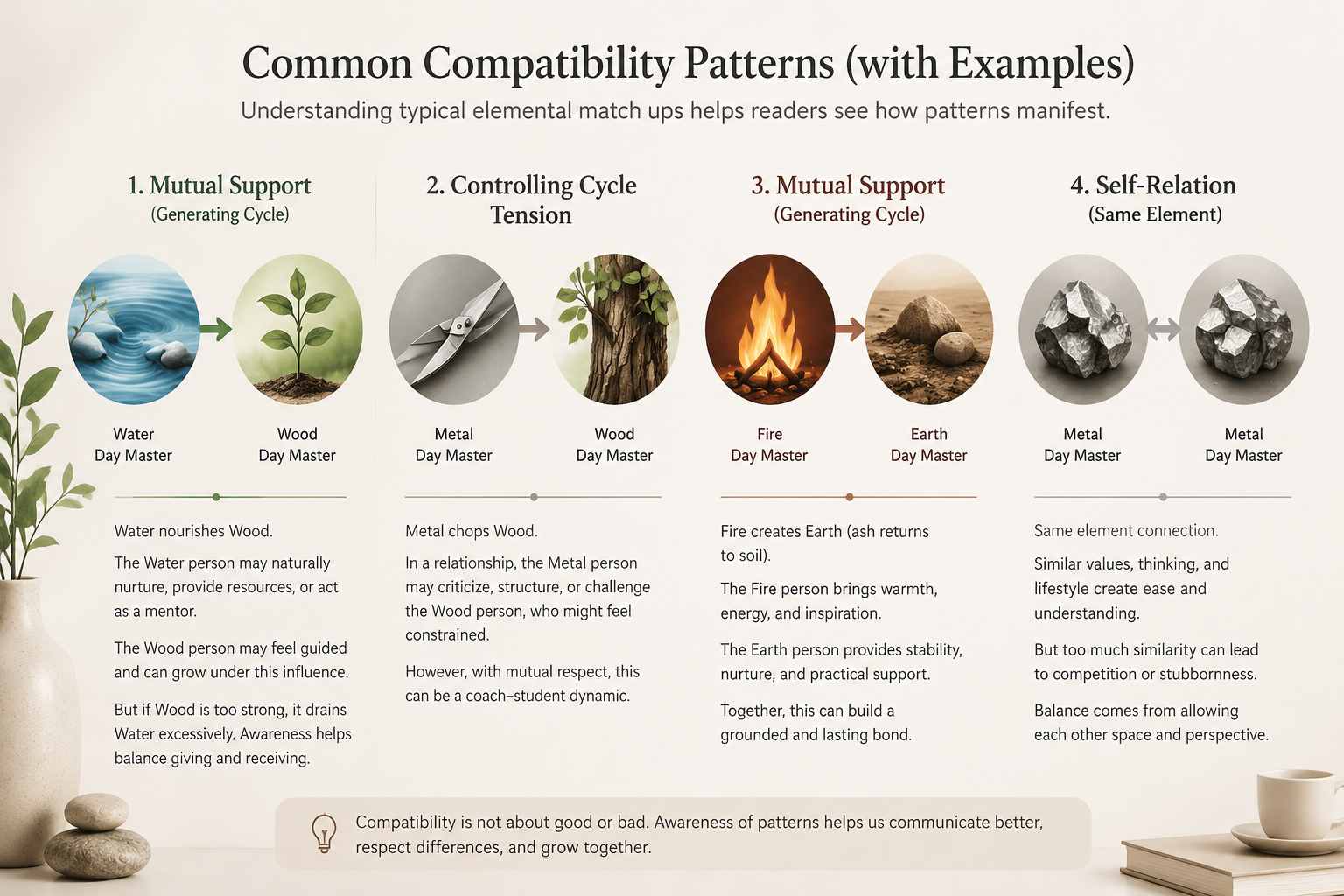
Common Compatibility Patterns (with Examples)
Understanding typical elemental match-ups helps readers see how patterns manifest.
- Mutual Support (Generating Cycle): A Water Day Master and a Wood Day Master: Water nourishes Wood. The Water person may naturally nurture, provide resources, or act as a mentor. The Wood person may feel guided and can grow under this influence. But if Wood is too strong, it drains Water excessively. Awareness helps balance giving and receiving.
- Controlling Cycle Tension: A Metal Day Master and a Wood Day Master: Metal chops Wood. In a relationship, the Metal person may criticize, structure, or challenge the Wood person, who might feel constrained. However, with mutual respect, this can be a coach-student dynamic where Wood’s raw creativity is refined by Metal’s discipline. Without awareness, it can turn into controlling resentment.
- The “Warmth” Dynamic (Fire and Earth): Fire Day Master and Earth Day Master: Fire ashes into Earth. This often indicates a grounded, stable partnership where the Fire person’s passion is absorbed and channeled into practical outcomes by the Earth person. It can feel emotionally steady, but the Fire person might miss the excitement if Earth is too inert.
- Shared Element Clash: Two Metal Day Masters may seem alike, but if both charts have strong Metal, they compete for the same elemental resource. The relationship might involve power struggles unless other elements (like Water, the Output of Metal) provide an outlet for self-expression.
- Heavenly Stem Combinations (天干合): When two day stems combine, like 甲 (Yang Wood) and 己 (Yin Earth) forming Earth, it can indicate a natural, often magnetic attraction. But this is just one factor; the rest of the chart must support the combination for it to be a lasting theme.
Each pattern offers a starting point, not a verdict. The reading is only as useful as the self-awareness it fosters.
Boundaries of BaZi Compatibility Readings
It is vital to draw clear lines:
- Not a prediction of relationship outcome. BaZi identifies elemental dynamics, but human relationships involve communication, shared values, and conscious choices that transcend any birth chart. Two charts with challenging patterns can thrive through effort, while harmonious charts can fail through neglect.
- Not a personality judgment. A chart with many clashes does not mean a person is “difficult.” It may indicate a life of change and resilience, which could enrich a partnership. The reading interprets interactions, not character flaws.
- Cultural reference, not absolute truth. BaZi comes from a tradition of observation and correspondence. Free BaZi presents it as a cultural reference and structured lens, not a scientific or deterministic system. All interpretations are possibilities to reflect on, not commands to follow.
- Privacy and context matter. A compatibility reading should never be used to invade privacy or make decisions for others. The individuals involved ultimately define their relationship boundaries.
By maintaining these boundaries, a compatibility reading becomes a thoughtful conversation starter rather than an authoritative judgment.
Using Free BaZi’s Tool for Compatibility
Free BaZi provides a simple way to generate two charts side by side. While the site does not produce an automated “compatibility score,” you can visually compare the Day Masters, elemental distributions, and Ten Gods. For a deeper dive, you can refer to our favorable element guide to see what each chart needs, then check if the partner’s chart provides that element. This manual approach respects the nuance of the system and avoids oversimplification.
Ready to begin? Open the Free BaZi chart tool, enter both birth details, and explore the patterns with a curious, grounded mindset.
FAQ
Can BaZi compatibility readings tell me if we’re soulmates?
BaZi does not identify “soulmates.” It shows elemental interactions that might feel supportive or challenging. “Soulmate” is a personal, emotional concept beyond the scope of structured reading. Use BaZi to understand relationship patterns, not to seek a definitive yes/no on destiny.
If our charts show a clash, should we worry?
Clashes aren’t inherently negative. A clash like 子午 (Rat-Horse) indicates dynamic tension, which can be productive if both individuals channel it into honest communication and growth. Many long-term relationships have clashing branches and thrive because of the energy they bring. Context, maturity, and other chart factors determine how it plays out.
What if my partner’s chart doesn’t have my favorable element?
Not every partner needs to supply a favorable element. Relationships exist for many reasons beyond elemental support—companionship, shared goals, emotional safety. Sometimes a missing element encourages personal development rather than reliance. Use a reading to discuss balance, not to rule someone out.
How accurate is a BaZi compatibility reading?
“Accuracy” depends on the reader’s skill and the reflective openness of the individuals. Since BaZi is interpretive, not empirical, it isn’t “accurate” in a scientific sense. It offers a structured framework for conversation about relational dynamics. The value lies in the insights it prompts, not in any predictive power.
Can I use Free BaZi to check compatibility before a first date?
The tool can show elemental patterns, but a first date involves real human connection—something no chart can replicate. Using BaZi as a screening filter may rob you of unexpected, valuable experiences. Approach it as a post-connection reflection tool, not a pre-date litmus test.
Explore compatibility with an open mind. Generate both charts on Free BaZi and start the conversation.
Related reading
Related guide
Free BaZi Calculator: How to Read Your Four Pillars Chart
Learn to interpret your BaZi (Four Pillars of Destiny) chart step by step using the free BaZi calculator. Understand Day Master, Five Elements, Ten Gods, and Luck Pillars for a structured cultural reading.
Related guide
Ten Gods in BaZi: What Each One Means in Your Chart
A methodical guide to the Ten Gods in BaZi: how they arise from the Day Master, what each represents, and how to read them in context using the Free BaZi chart tool.
Related guide
Day Master Compatibility in BaZi: What It Shows and What It Misses
Explore Day Master compatibility as a structured reading path, not a guaranteed prediction. Learn how Day Master interactions work, what they can suggest about relational patterns, and where their limits lie.