Day Master Compatibility in BaZi: What It Shows and What It Misses
Explore Day Master compatibility as a structured reading path, not a guaranteed prediction. Learn how Day Master interactions work, what they can suggest about relational patterns, and where their limits lie.
Interest in Day Master compatibility often begins with a simple question: “Are we compatible?” It’s a natural query when people first meet BaZi. At Free BaZi, we see compatibility not as a fixed answer but as a structured reading path that highlights relational themes, elemental balance, and the assumptions that go into classical pairings.
This article explains what Day Master compatibility means in method terms, how to approach it with curiosity instead of certainty, and where the framework stops being useful. No outcome is guaranteed. Instead, you’ll learn a way of seeing relational patterns through BaZi’s own logic.
Understanding Day Master Compatibility
The Day Master is the Heavenly Stem of the day pillar in a BaZi chart. It represents the self in the chart’s symbolic language. When we talk about compatibility, we’re comparing the Day Masters of two people’s charts—and sometimes the larger interactions between their stems and branches—to identify repeating themes like mutual support, creative tension, or elemental exhaustion.
Because the Day Master is a single stem, a Day Master–only comparison is intentionally narrow. It answers a very specific question: In terms of elemental relationship, what is the natural tendency when these two stems meet? Classical BaZi texts describe these tendencies using categories derived from the Five Elements cycles.
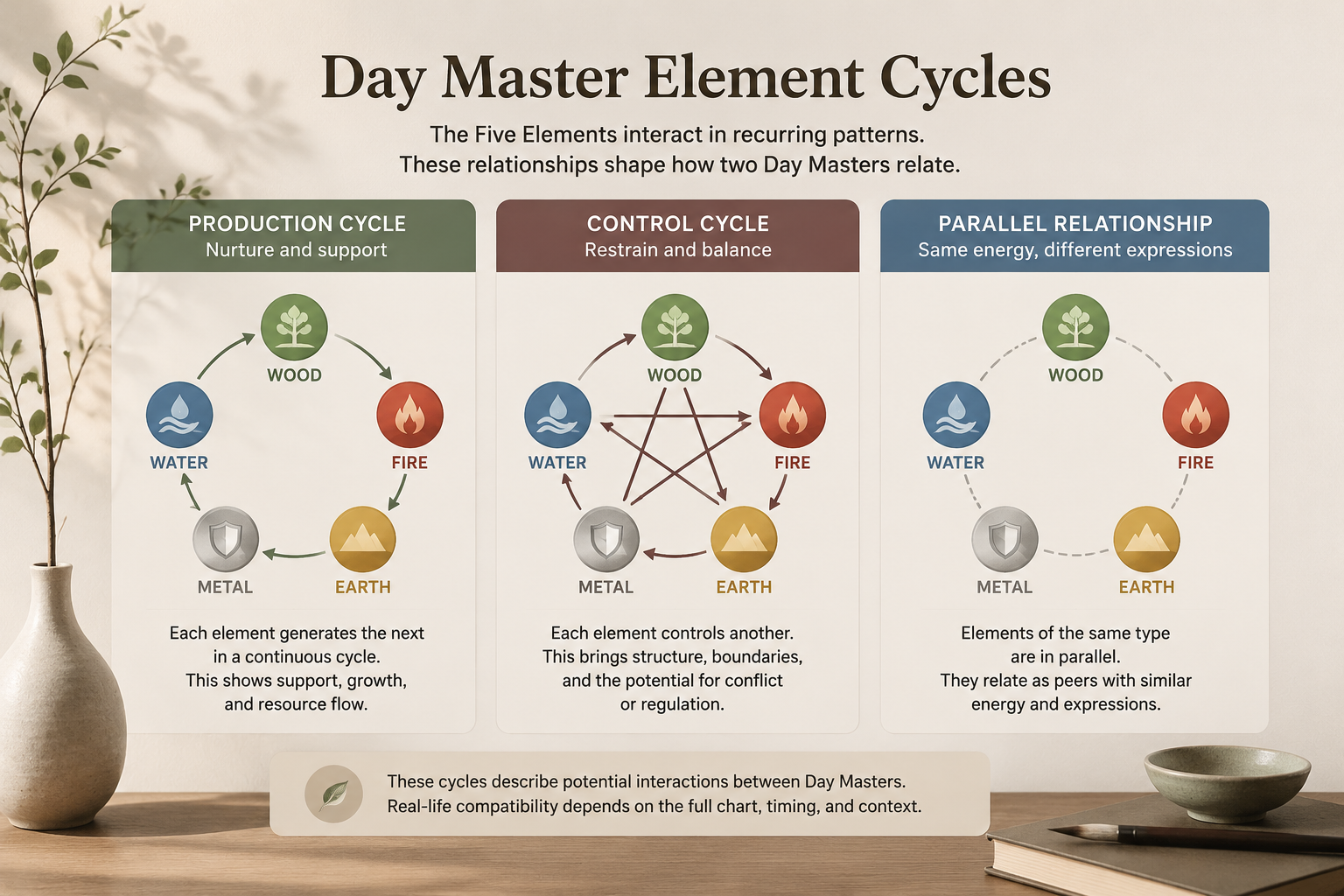
Those categories fall into three broad groups:
- Productive (相生 cycle): One element gives birth to the other. The dynamic can feel nourishing or overly dependent.
- Controlling (相克 cycle): One element controls or suppresses the other. The dynamic can bring structure and friction in equal measure.
- Parallel / Same element (比和): The stems share the same element or belong to the same polarity. The dynamic often emphasizes similarity, competition, or mutual resonance.
Each category is a starting point—a hypothesis about emotional tonality, not a verdict on relationship health.
Why Day Master Compatibility Alone Is Incomplete
A full BaZi compatibility reading normally considers much more than the Day Master. Earthly Branches carry hidden stems, luck pillars add timing, and the Ten Gods layers of relationship role. A Day Master comparison skips all of that. It’s a first glance, useful for noticing broad elemental fit, but insufficient for deeper insight.
For example, a Yang Wood (甲) Day Master and a Yin Earth (己) Day Master have a “Wood controls Earth” relationship at the stem level. That sounds unbalanced on paper. But if both charts have strong Water or strong Wood in the branches, the controlling dynamic might soften into a productive stream. A stem-only reading can’t catch that.
Free BaZi’s own free BaZi chart tool lets you pull up a full chart instantly. Seeing the entire configuration—stems, branches, hidden stems, and luck pillars—helps you move beyond Day Master labels and into a more realistic picture of interaction.
How Day Master Interactions Work
Day Master compatibility uses the Five Elements as the main framework. Each Day Master belongs to one of the ten Heavenly Stems, which are paired into five elements with a Yang/Yin distinction: Yang Wood (甲), Yin Wood (乙), Yang Fire (丙), Yin Fire (丁), Yang Earth (戊), Yin Earth (己), Yang Metal (庚), Yin Metal (辛), Yang Water (壬), Yin Water (癸).
When two Day Masters are placed side by side, we check:
- The element of each stem.
- The polarity (Yang or Yin) if using the harmonious attraction model common in Chinese relationship lore.
- The controlling or producing cycle that links those elements.
The Production Cycle in Pairings
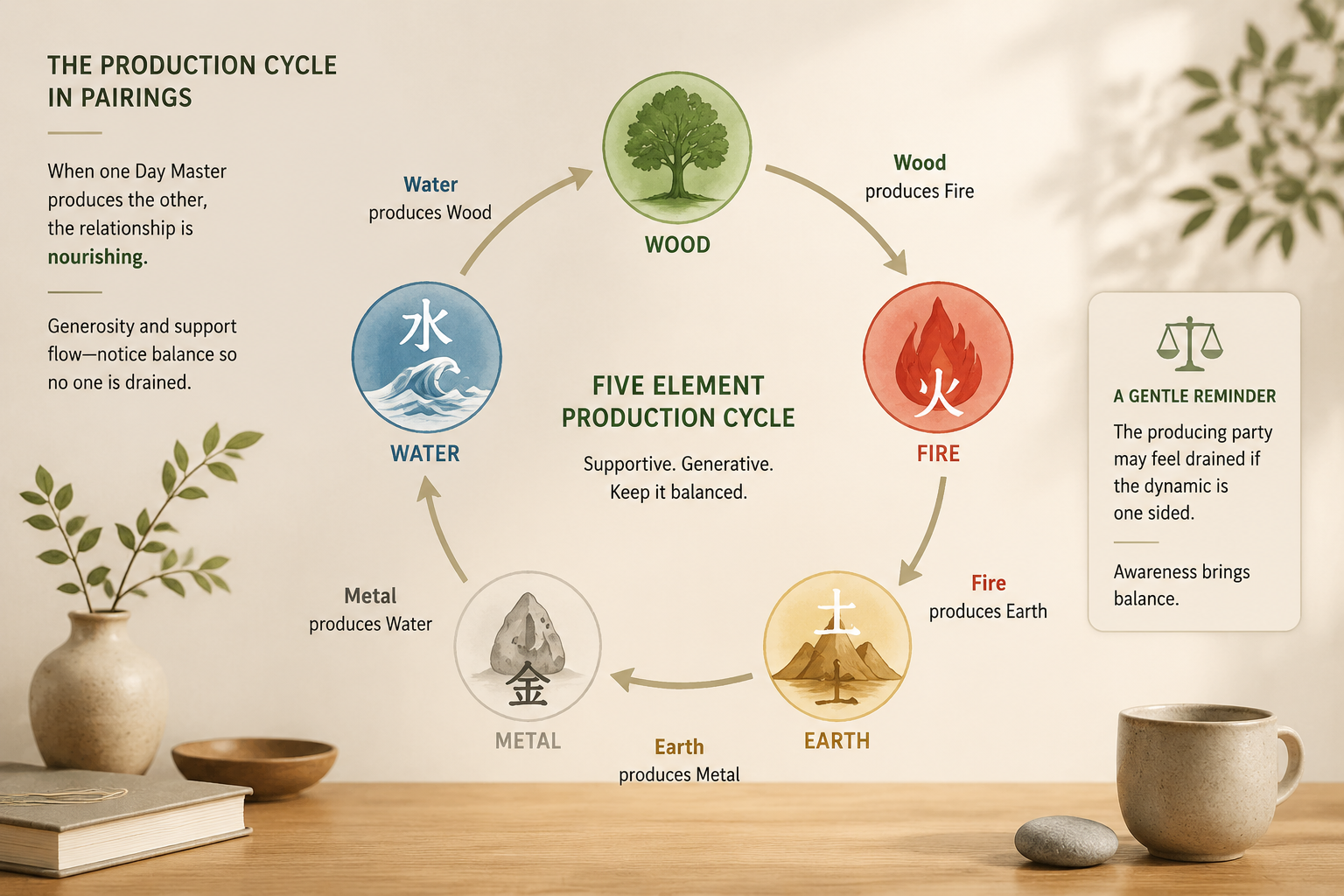
- Wood produces Fire.
- Fire produces Earth.
- Earth produces Metal.
- Metal produces Water.
- Water produces Wood.
When one Day Master produces the other, classical texts often describe the relationship as nourishing, but with a warning: the producing party may feel drained if the dynamic is one-sided. This isn’t a prediction of failure; it’s a prompt to notice generosity, support, and potential resource imbalance.
The Control Cycle in Pairings
- Wood controls Earth.
- Earth controls Water.
- Water controls Fire.
- Fire controls Metal.
- Metal controls Wood.
These pairings are sometimes labeled “conflict” or “clash.” In a reading context, they point toward natural friction and also natural structure. A control relationship doesn’t mean constant fighting. It can indicate that one person sets boundaries, challenges the other, or brings discipline. Like all Five Element interactions, the outcome depends on the whole chart.
The Parallel (Same Element) Dynamic
Two Day Masters of the same element—for example, both Metal—fall into the parallel category. If they’re opposite polarities (Yang Metal with Yin Metal), there may be a subtle magnetic quality in classical folklore, but the elemental dynamic is one of similarity. A parallel dynamic can bring ease or amplify shared blind spots. Excess of the same element in a combined reading might suggest a need to introduce the missing elements through environment or shared goals.
Practical Reading Paths for Compatibility
If you want to use Day Master compatibility as a tool for reflection rather than a yes/no answer, a structured reading path helps keep the method honest.
Step 1: Identify the Two Day Masters
Pull the chart for each person using the free BaZi chart tool. The Day Master is the top character in the Day Pillar. Confirm the element and polarity. Write them down: for example, Person A is Yin Earth (己), Person B is Yang Water (壬). Earth controls Water, so the baseline stem relationship is controlling.
Step 2: Look Beyond the Stem
Check the Earthly Branch of each day pillar. The branch contains hidden stems that often reveal secondary dynamics. If Person A’s Day Branch is 卯 (Rabbit, pure Yin Wood), it suggests a strong Wood undertone that can change how the Earth–Water interaction expresses. In this case, Wood bridges Earth and Water through the production cycle (Water feeds Wood, Wood feeds Earth). The branch softens the control relationship into something more circular.
As a principle: a single stem is always incomplete; the Day Branch adds context.
Step 3: Observe the Self-Element Strength
See whether each Day Master is strong or weak in its own chart. A strong Water Day Master meeting a weak Earth Day Master may not feel controlled; it may simply feel unbothered. Conversely, a weak Earth Day Master facing a strong Water might experience overwhelm—unless the chart’s other elements provide a counterbalance.
At Free BaZi, you can check the percentage breakdown of elements in the chart panel. This at least gives a rough signal about relative strength.
Step 4: Factor in the Ten Gods
When you compare two charts, the Ten Gods derived from one Day Master assign a role to the other Day Master’s stem. For instance, if your Day Master is Yang Wood (甲), and the other person’s Day Master is Yin Metal (辛), then the other stem is your Direct Officer (Zheng Guan). That Ten God carries overtones of structure, responsibility, or boundaries. It frames why the Metal-Wood control relationship might feel like order rather than aggression.
This layer is essential because it explains why the same elemental control pair can feel different for different Day Masters. A Yin Metal Day Master is the Direct Officer to Yang Wood, but it’s the Indirect Officer to Yin Fire. Understanding the role shifts the reading from “element vs. element” to “relationship theme.”
What Day Master Compatibility Doesn’t Show
It’s just as important to clarify what this method misses. Keeping the limits in view prevents overinterpretation.
It Does Not Predict Relationship Outcome
BaZi is a symbolic system, not a causal model of human behavior. A productive Day Master pair can exist in a difficult relationship if real-world communication, values, or timing are out of step. A controlling Day Master pair can thrive under the right circumstances. Compatibility suggestions are never promises.
It Cannot See Personal History or Individual Choices
The chart doesn’t know about upbringing, mental health, shared goals, or relationship skills. Two people with the same Day Master pair can have radically different experiences. Use BaZi as a reflective lens, not as a substitute for conversation and understanding.
It Ignores Luck Pillars and Timing
Many real-world relationship shifts occur during specific 10-year luck pillar phases. Day Master compatibility alone can’t capture when a relationship will enter a period of ease or strain. For that, you need the full chart with timing layers.
It Is Not a Substitute for the Full Chart
Even a complete BaZi chart is only one system among many. Compatibility in classical practice also looks at Na Yin, symbolic star overlap, and House blends. Day Master comparison is a useful entry point, but it’s just the first sentence of a longer text.
Using Free BaZi’s Tools to Explore Day Master Relationships
If you’d like to move from theory into a hands-on exploration, Free BaZi gives you a way to do that without guesswork.
- Generate each chart with the free BaZi chart tool. Enter the birth details for both people. The tool calculates the full chart instantly, including the Day Master, Ten Gods, element percentages, and luck pillars.
- Compare Day Masters side by side. Look at the element cycle first, then check the Day Branch hidden stems. Observe whether secondary elements are bridging or reinforcing the stem-level relationship.
- Use the element breakdown to see if either chart leans heavily toward a single element. That can indicate a need for missing elements in shared activities, living space, or even seasonal timing.
- If you want to expand the reading, explore the BaZi element cycle pages on this site to understand how Water, Wood, Fire, Earth, and Metal behave in combination. The Huangli tool can also show you which days carry a strong elemental signature that might either support or challenge a particular relationship dynamic—useful for choosing a date for important conversations or joint decisions.
Reading compatibility through BaZi works best when we treat it as a cultural reference tool, not a fortune-telling machine. The method helps you name patterns. The rest is up to you.
FAQ
Can Day Master compatibility tell me if a relationship will last?
No. Day Master compatibility describes a symbolic layer of elemental interaction. It does not account for personal history, communication, shared values, or life timing. Use it as a reflection tool, not a prediction of durability. A strong elemental clash can coexist with a highly functional relationship, and a harmonious stem pair doesn’t guarantee mutual understanding.
Which Day Master pairs are considered most “compatible”?
In classical Five Element thinking, productive pairs (Wood–Fire, Fire–Earth, etc.) and some same-element pairs are often described as harmonious. However, “most compatible” depends on the full chart, including the Day Branch, chart strength, and luck pillar phase. No single pair is universally better. A controlling pair can bring much-needed structure; a producing pair can tip into dependency if unbalanced.
Does polarity (Yang/Yin) really matter in Day Master compatibility?
Polarity adds finesse but doesn’t override the elemental cycle. In folk tradition, opposite polarities are sometimes seen as magnetically attractive, while same polarity suggests a more competitive or straightforward dynamic. Modern practitioners treat polarity as a secondary note. The elemental interaction (production, control, or parallel) carries the main signal.
If my Day Master and someone else’s clash, should I avoid the relationship?
No. A clash at the stem level is a starting point for awareness, not an instruction to avoid someone. Many stable, creative relationships include a Day Master control relationship. The clash signals where natural friction may exist, which can be productive if both people recognize it. Context—the rest of the charts, the Ten Gods, and real-world dynamics—always matters more than the stem pair alone.
How can I use Free BaZi to check two charts together?
Open the free BaZi chart tool and generate a chart for each person. Note each Day Master and Day Branch. Compare the stem interaction using the five-element cycle, then check the hidden stems in the Day Branch for mediating influences. The element distribution panels can give you a quick sense of relative elemental strength. For a broader view, add the Huangli tool to examine elemental weight on particular days.
Ready to see the pattern that your own chart reveals? Open the free BaZi chart tool now and read the layers, not just the labels.
Related reading
Related guide
BaZi Compatibility Reading Boundaries
Learn how BaZi compatibility reading works through the structured method of Day Master interaction, Five Elements, and Ten Gods—with clear boundaries and no promises.
Related guide
Ten Gods in BaZi: What Each One Means in Your Chart
A methodical guide to the Ten Gods in BaZi: how they arise from the Day Master, what each represents, and how to read them in context using the Free BaZi chart tool.
Related guide
BaZi Luck Pillars: How the 10-Year Cycles Shape Your Life
A methodical introduction to luck pillars in BaZi: how the 10-year cycles are structured, how to read them with your natal chart, and why they offer an interpretive layer, not a fixed prediction.