What Is BaZi? A Beginner’s Guide to Four Pillars of Destiny
Learn the fundamentals of BaZi (Four Pillars of Destiny), a structured Chinese reading method that maps your birth data into a chart of eight characters. This guide explains the Five Elements, Day Master, Ten Gods, and Luck Pillars, and shows how to read your own chart with Free BaZi’s tool.
BaZi, or Four Pillars of Destiny, is a structured Chinese reading method that translates your birth date and time into a chart of eight characters. This chart serves as a framework for exploring personality tendencies, relationship dynamics, and life-stage rhythms through the interplay of the Five Elements and the Chinese calendar. Rather than a system of fixed prediction, BaZi offers a lens for understanding your own makeup and the natural cycles around you.
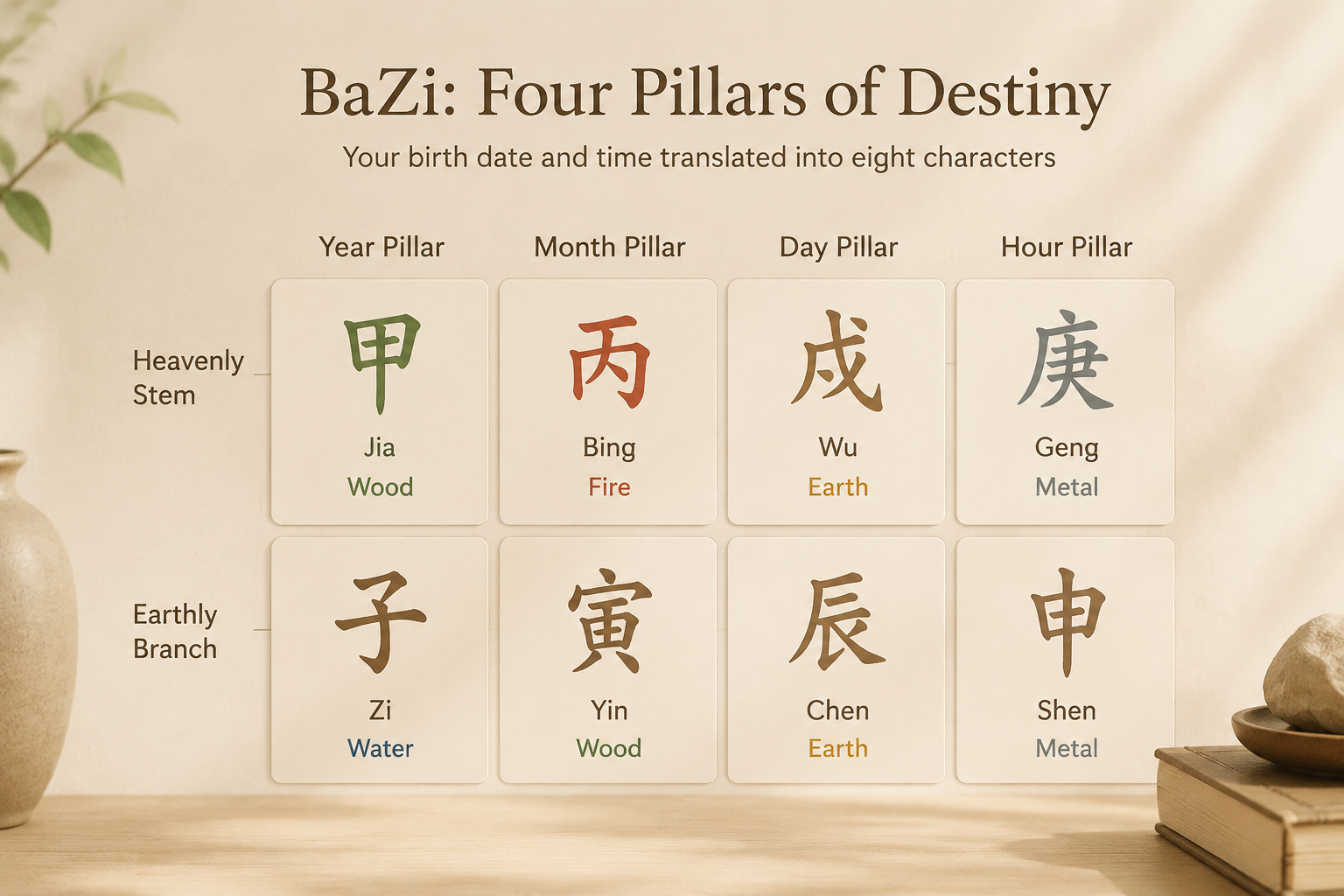
In this guide, we will walk through the essential concepts every beginner needs to know: how the chart is constructed, what the stems, branches, and Five Elements mean, the roles of the Day Master and Ten Gods, and the timeline provided by Luck Pillars. By the end, you will have a clear path for generating and reading your own chart using the Free BaZi tool.
How the Four Pillars Represent Your Birth Moment
A BaZi chart is made up of four pillars: the Year, Month, Day, and Hour of birth. Each pillar contains one Heavenly Stem (a celestial energy) and one Earthly Branch (a terrestrial energy, which corresponds to an animal sign). Together they form the Eight Characters (Ba Zi). The Stems and Branches are drawn from the Chinese sexagenary cycle, a long-count calendar that pairs ten stems with twelve branches to produce 60 unique combinations. Every year, month, day, and hour can be assigned one of these stem-branch pairs, so your chart becomes a snapshot of the cosmic climate at the moment you were born.
For example, a person born at 8:30 AM on 15 March 1990 might have the Year Pillar Geng Wu (Yang Metal, Horse), the Month Pillar Ji Mao (Yin Earth, Rabbit), the Day Pillar Jia Chen (Yang Wood, Dragon), and the Hour Pillar Wu Chen (Yang Earth, Dragon). The Day Pillar’s Heavenly Stem—Jia—becomes the Day Master and the central character of the entire chart.
These assignments are not arbitrary; they use the solar calendar (Jie Qi) rather than the lunar calendar, so the exact degree of the sun determines the Month Pillar. The Free BaZi chart tool automatically calculates the correct pillars from your birth date and location, eliminating the need for manual calendar cross-referencing.
The Five Elements: Foundation of Balance
The Five Elements—Wood, Fire, Earth, Metal, and Water—are the core substances of BaZi reading. Each Heavenly Stem and Earthly Branch carries elemental qualities, and the relationships among these elements set the tone of the chart. There are two fundamental cycles:
- The Nourishing (productive) cycle: Wood feeds Fire, Fire creates Earth (ash), Earth bears Metal, Metal collects Water (condensation), Water nurtures Wood.
- The Controlling (destructive) cycle: Wood parts Earth, Earth absorbs Water, Water extinguishes Fire, Fire melts Metal, Metal chops Wood.
A BaZi chart is interpreted by observing which elements are abundant, which are weak, and how they interact. When the elements move in a smooth, generating flow, the chart is perceived as balanced—suggesting a personality that handles challenges with flexibility. When certain elements overwhelm or clash, those tensions point to areas of life that may require more attention or a different approach. You can explore these dynamics in our Five Elements guide.
Importantly, element balance is not a score of good or bad—it is a map of innate tendencies. Someone with strong Wood energy may show creativity and drive but could benefit from softening that intensity with Metal or Water, depending on the whole chart.
The Day Master: Your Self-Element
The Heavenly Stem of the Day Pillar—the Day Master—denotes the person the chart represents. Each of the ten possible Day Masters (Jia, Yi, Bing, Ding, Wu, Ji, Geng, Xin, Ren, Gui) is associated with a specific element and yin-yang polarity. For example, Jia is Yang Wood, while Yi is Yin Wood; Bing is Yang Fire, and Ding is Yin Fire. This elemental identity becomes the reference point for reading every other character in the chart.
Once you know your Day Master, you can ask: does the chart support or drain my element? Is my Day Master strong enough to handle the surrounding influences? The answers come from the relationship between the Day Master’s element and the other stems and branches. For a deeper walkthrough of this concept, see our Day Master wiki.
The Ten Gods: Relationships Between Stems
When you compare your Day Master (Day Stem) with every other stem in the chart, a relationship emerges based on two factors: element family and yin-yang polarity. These relationships are traditionally called the Ten Gods, and they work as descriptive archetypes rather than literal deities. The Ten Gods include:
- Direct Wealth and Indirect Wealth – how you approach material resources and goal pursuit.
- Direct Officer and Seven Killings – attitudes toward discipline, authority, and stress.
- Direct Resource and Indirect Resource – sources of support, learning, and protection.
- Eating God and Hurting Officer – creative expression, talent, and output.
- Friend and Rob Wealth – peers, competition, and collaboration.
For example, if your Day Master is Jia (Yang Wood) and a stem in the chart is Xin (Yin Metal), that forms a Direct Officer relationship because Metal controls Wood and the polarities are opposite. Each stem thus gains a specific meaning relative to the Day Master. Reading these relationships reveals patterns in how the person navigates work, relationships, and personal growth. You can find a full reference in our Ten Gods guide.
These terms can sound heavy, but they are merely labels for recurring elemental dynamics. Knowing which Ten Gods appear in your chart helps you understand your natural style: a strong Direct Officer might indicate a person who thrives on structure, while a powerful Eating God often points to a love of communication and creativity.
Luck Pillars: The Unfolding Timeline
BaZi charts are not static; they unfold over time through Luck Pillars, which are 10-year periods determined from the Month Pillar and the person’s gender. The starting age and direction of the sequence are calculated using the Chinese solar terms, and each pillar brings a distinct elemental emphasis that interacts with the original natal chart.
Think of Luck Pillars as seasonal weather moving over a landscape. The chart is the landscape—your Day Master, element balance, and Ten God structure—while the Luck Pillar (and even annual and monthly cycles) influence what areas of life become more active or subdued. For example, a Luck Pillar of strong Water may nourish a Wood Day Master, supporting a period of growth and learning, whereas a Fire pillar could bring intensity and transformation. Explore the mechanics in our Luck Pillars article.
These timed influences are not deterministic; they describe a backdrop of elemental energy that temporarily steers your tendencies. Two people with very different natal charts will experience the same Luck Pillar in radically different ways, so reading them always links back to the personal chart.
How to Start Reading Your Own Chart
With the Free BaZi tool, you can generate a complete chart in seconds. A simple reading path looks like this:
- Generate your chart using your birth date, time, and gender. The Free BaZi tool handles the calendar conversion and pillar calculation automatically.
- Identify your Day Master—the Heavenly Stem in the Day Pillar. Note its element and whether it is yin or yang.
- Survey the surrounding stems and branches to see which elements and relationships (Ten Gods) appear. Check for obvious imbalances, such as one element dominating or being completely absent.
- Look for special structures like combinations or clashes between stems and branches. The tool highlights these, and they can modify the chart’s reading.
- Examine your current Luck Pillar to see which element is visiting your chart right now. Ask yourself how that atmosphere interacts with your Day Master.
This process is not about predicting exact events; it is a structured way to reflect on your temperament and the shifting scenery of your life. For daily reference, you may also want to consult the Huangli calendar to see how the day’s energy interacts with your personal chart.
Frequently Asked Questions
What exactly is BaZi?
BaZi (Eight Characters) is a Chinese metaphysical system that maps a person’s birth date and time into four pillars of Heavenly Stems and Earthly Branches. The resulting chart is read through the lens of the Five Elements to describe personality, tendencies, and life-phase rhythms. It is a cultural reference and structured reading method, not a prescriptive fortune-telling system.
Is BaZi a form of fortune-telling?
BaZi is best understood as a framework for self-understanding and pattern recognition. While it originated in traditional Chinese cosmology alongside practices like the I Ching, its contemporary use focuses on character analysis and timing awareness. Readers at Free BaZi treat the chart as a reference for reflection, not as a fixed prediction of life events.
What information do I need to calculate my BaZi chart?
You need your birth date (day, month, year), an accurate birth time (hour and minute), and your gender. The birth time can often be found on a birth certificate or hospital records. If the time is unknown, a noon default is sometimes used, but the chart will lose precision in the Day and Hour pillars, as well as in the Luck Pillar calculation. The Free BaZi chart tool requires these details to create your full chart.
Can BaZi help me understand my personality?
Yes. The Day Master and the distribution of the Five Elements in your chart describe a blueprint of your innate traits—how you respond to pressure, where your creativity flows, and what kind of support helps you thrive. However, a BaZi chart is a starting point for reflection, not a box that limits you. Real life is shaped by many factors beyond a chart.
How do Luck Pillars influence my life?
They represent 10-year windows of elemental energy that interact with your natal chart. A Luck Pillar does not make events happen; it modulates the backdrop against which your daily choices play out. Some phases feel expansive and supportive, while others demand caution or consolidation. Reading them alongside your chart gives you a better sense of the natural ebb and flow of any given period.
Is BaZi the same as Western astrology?
They are structurally different. Western astrology uses planetary positions in zodiac signs, while BaZi uses a solar-term calendar to assign stems and branches to the year, month, day, and hour. BaZi’s core language is the Five Elements and the yin-yang polarities, whereas Western astrology focuses on planets, houses, and aspects. Both are interpretive systems, but their methods and symbols are distinct.
BaZi offers a rich, methodical way to explore personal patterns without needing mysterious claims. With the Free BaZi chart tool and the supporting guides on Five Elements, Day Master, and Ten Gods, you have everything you need to begin reading your chart with clarity. Let the tool handle the calculations, and use the rest as a quiet, thoughtful map.
Related reading
Related guide
Ten Gods in BaZi: What Each One Means in Your Chart
A methodical guide to the Ten Gods in BaZi: how they arise from the Day Master, what each represents, and how to read them in context using the Free BaZi chart tool.
Related guide
BaZi Luck Pillars: How the 10-Year Cycles Shape Your Life
A methodical introduction to luck pillars in BaZi: how the 10-year cycles are structured, how to read them with your natal chart, and why they offer an interpretive layer, not a fixed prediction.
Related guide
Ten Gods Quick Reference Table: A BaZi Reference Guide
A clear quick reference table for the Ten Gods in BaZi, explaining how to identify them from your Day Master and providing a practical lookup for every heavenly stem.