Ten Gods Quick Reference Table: A BaZi Reference Guide
A clear quick reference table for the Ten Gods in BaZi, explaining how to identify them from your Day Master and providing a practical lookup for every heavenly stem.
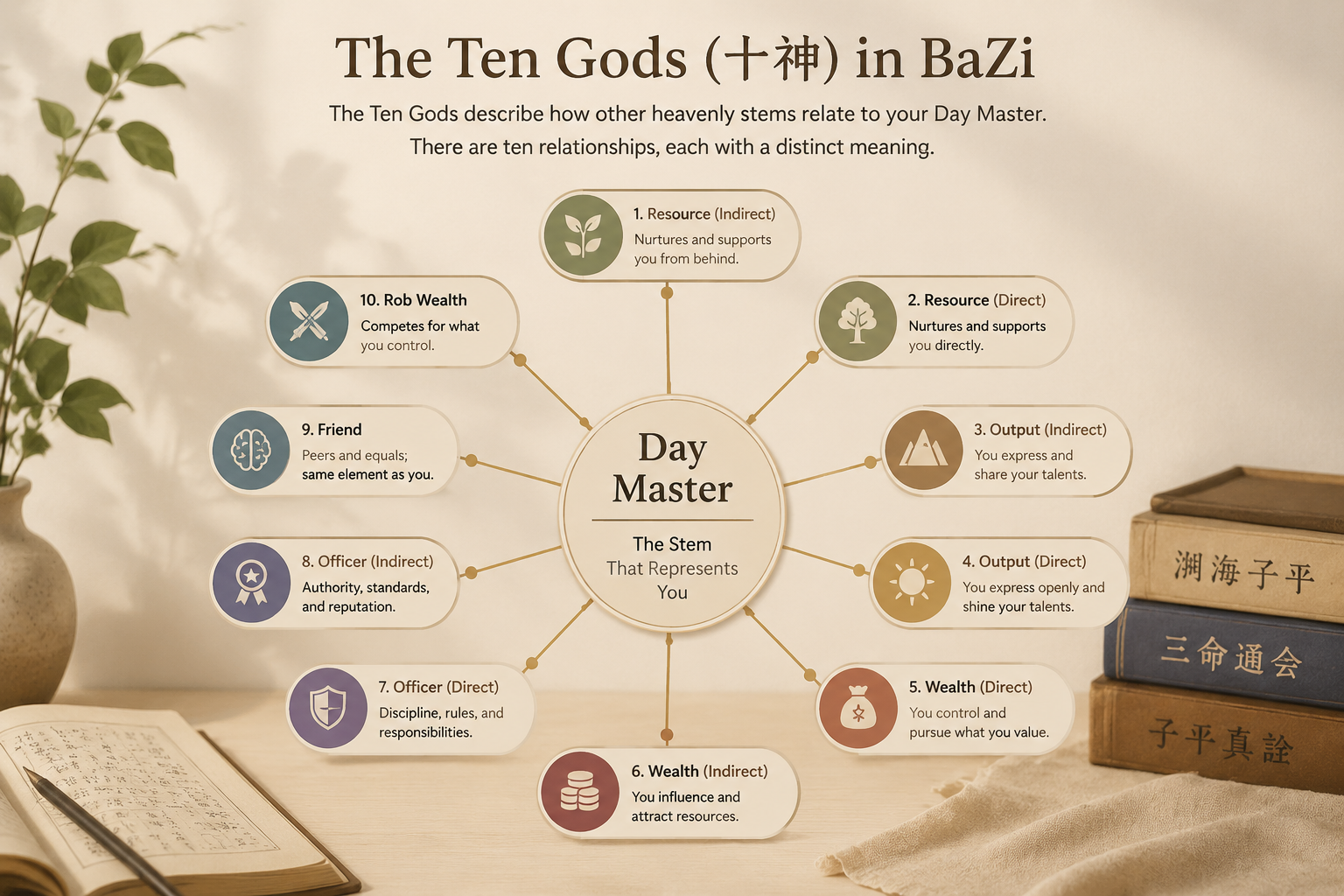
The Ten Gods (十神, Shi Shen) are a foundational framework in BaZi — not deities, but a set of relationships that describe how the Day Master’s element interacts with every other heavenly stem in a chart. This article gives you a method‑driven quick reference: what the Ten Gods are, how to determine them from your Day Master, and a concise table you can use as a daily lookup. While BaZi is a structured cultural reference, it does not guarantee outcomes; it offers a language for reflecting on patterns.
If you haven’t yet pulled your own chart, the Free BaZi chart tool will show your Day Master and all Ten Gods automatically.
What Are the Ten Gods in BaZi?
Every BaZi chart is built from the ten heavenly stems, each carrying an element (Wood, Fire, Earth, Metal, Water) and a polarity (Yang or Yin). The Day Master is the stem that occupies the day pillar — it represents you in the chart. The Ten Gods are the ten possible relationships between the Day Master’s stem and all other stems in the four pillars (year, month, hour) and any hidden stems.
These relationships emerge from the Five Elements cycles. A stem can be:
- Same Element as the Day Master: a companion or peer.
- Produced by the Day Master (output/expression).
- Controlled by the Day Master (wealth).
- Controlling the Day Master (authority/ pressure).
- Producing the Day Master (resource/support).
Add Yin‑Yang polarity and each of these five interactions splits into two distinct Ten Gods, giving the full set of ten. For example, when the Day Master produces a stem, if the output stem has the same polarity it is called Hurting Officer; if opposite, Eating God. This polarity distinction adds nuance to every reading.
How to Find Your Ten Gods
You don’t need to memorise all 100 possible combinations. The process is methodical:
- Get your Day Master — the heavenly stem of the day pillar. You can use a free BaZi chart generator to display it instantly.
- List the stems that appear in your year, month, day (the Day Master itself is its own Friend), and hour pillars. Also include any stems from hidden branches if you want a complete analysis.
- Apply the Ten Gods classification rules based on the element and polarity of each stem relative to the Day Master.
For a Jia (Yang Wood) Day Master, the stem Bing (Yang Fire) is the output element because Wood produces Fire; same polarity, so it is Hurting Officer. In contrast, Ding (Yin Fire) is also output but with opposite polarity, therefore Eating God. Following this logic for every stem yields your Ten Gods landscape.
Ten Gods Quick Reference Table
General Classification Rules
The table below shows how each elemental relationship pairs with polarity to create the Ten Gods. It works for any Day Master stem.
| Relationship | Same Polarity (Yang‑Yang / Yin‑Yin) | Opposite Polarity (Yang‑Yin / Yin‑Yang) |
|---|---|---|
| Same Element | Friend (劫财, Bi Jian) | Rob Wealth (比肩, Jie Cai) |
| Output | Hurting Officer (伤官, Shang Guan) | Eating God (食神, Shi Shen) |
| Wealth | Direct Wealth (正财, Zheng Cai) | Indirect Wealth (偏财, Pian Cai) |
| Officer | 7 Killings (七杀, Qi Sha) | Direct Officer (正官, Zheng Guan) |
| Resource | Indirect Resource (偏印, Pian Yin) | Direct Resource (正印, Zheng Yin) |
Example: Ten Gods for a Jia (Yang Wood) Day Master
Using the rules above, here is the complete mapping for a Jia Day Master. The same approach works for any Day Master — just rotate the five elements accordingly.
| Heavenly Stem | Element & Polarity | Ten God (English) | Ten God (Chinese) |
|---|---|---|---|
| Jia | Yang Wood | Friend | 劫财 (Bi Jian) |
| Yi | Yin Wood | Rob Wealth | 比肩 (Jie Cai) |
| Bing | Yang Fire | Hurting Officer | 伤官 (Shang Guan) |
| Ding | Yin Fire | Eating God | 食神 (Shi Shen) |
| Wu | Yang Earth | Direct Wealth | 正财 (Zheng Cai) |
| Ji | Yin Earth | Indirect Wealth | 偏财 (Pian Cai) |
| Geng | Yang Metal | 7 Killings | 七杀 (Qi Sha) |
| Xin | Yin Metal | Direct Officer | 正官 (Zheng Guan) |
| Ren | Yang Water | Indirect Resource | 偏印 (Pian Yin) |
| Gui | Yin Water | Direct Resource | 正印 (Zheng Yin) |
For your own Day Master, the free BaZi chart tool computes this instantly, so you can spend more time understanding what the patterns suggest and less time on manual lookup.
Interpreting the Ten Gods in Practice
In a BaZi reading, the Ten Gods are not fortune‑telling labels but symbolic themes. They help describe possible tendencies in personality, work style, relationships, and how you respond to opportunities and pressure. For example, a chart with strong Direct Wealth (正财) often points toward a steady, tangible approach to resources, while 7 Killings (七杀) can highlight high‑pressure situations that demand resilience — not a verdict, but a reflective lens.
To build a complete picture, you can read the Ten Gods alongside the underlying Five Elements. Explore our Five Elements wiki for a deeper grounding in the cycles that produce the Ten Gods. Your Day Master profile also influences how each Ten God expresses itself, because a weak Wood Day Master receiving a Resource (Water) carries a different nuance than a strong Wood Day Master.
The Ten Gods also shift over time through the dynamic influence of Luck Pillars. A 10‑year pillar may temporarily bring a Hurting Officer phase, altering the thematic emphasis without being a fixed destiny. Similarly, when comparing two BaZi charts in a relationship, Ten God interactions can offer a framework for understanding dynamics — see our compatibility overview for more on that.
Frequently Asked Questions
What is the difference between Direct Officer and 7 Killings?
Both are stems that control the Day Master (the Officer relationship). Direct Officer (正官) occurs when the controlling stem has opposite polarity to the Day Master; it often symbolizes structured authority, rules, or a disciplined career path. 7 Killings (七杀) occurs with same polarity and typically suggests challenge, competition, or a more forceful form of pressure. In a reading, neither is “good” or “bad” — the context of the whole chart matters.
Why do I have ‘Rob Wealth’ in my chart?
Rob Wealth (比肩) is simply the relationship that appears when a stem of the same element but opposite polarity is present. In BaZi vocabulary it represents peers, siblings, or social networks. Having Rob Wealth does not predict loss; it draws attention to themes around collaboration, competition, or sharing resources. Many charts contain a mix of Friends and Rob Wealth as a natural part of the elemental makeup.
How do the Ten Gods change over Luck Pillars?
Each Luck Pillar has its own heavenly stem, which interacts with your Day Master to produce a Ten God for that decade. For example, if your Day Master is Gui (Yin Water) and a Luck Pillar brings Xin (Yin Metal), that pillar activates Indirect Resource — a period that may emphasise support, learning, or planning. Over a lifetime, these shifts create a rotating emphasis on different aspects, but they do not override the structural foundation laid by your natal chart.
Can the Ten Gods predict my career?
The Ten Gods framework can suggest tendencies — for instance, a prominent Direct Officer combined with a balanced Resource might point toward an affinity for structured organisations. However, BaZi is a cultural reference tool, not a deterministic prediction system. It can enrich self‑reflection and decision‑making, but it should not be treated as a fixed forecast. Real‑world outcomes depend on many factors beyond the chart.
To see your own Ten Gods layout, open your free BaZi chart and explore the relationships. The tool puts the full Ten God structure at your fingertips, making it easier to learn the language of BaZi step by step.
Related reading
Related guide
BaZi Luck Pillars: How the 10-Year Cycles Shape Your Life
A methodical introduction to luck pillars in BaZi: how the 10-year cycles are structured, how to read them with your natal chart, and why they offer an interpretive layer, not a fixed prediction.
Related guide
Ten Gods in BaZi: What Each One Means in Your Chart
A methodical guide to the Ten Gods in BaZi: how they arise from the Day Master, what each represents, and how to read them in context using the Free BaZi chart tool.
Related guide
BaZi Compatibility Reading Boundaries
Learn how BaZi compatibility reading works through the structured method of Day Master interaction, Five Elements, and Ten Gods—with clear boundaries and no promises.