True Solar Time in BaZi: Why Your Birth Location Changes Your Chart
Learn how true solar time adjusts your birth moment for longitude and Earth's orbit, and why a few minutes can change your BaZi hour pillar. Explore the method and Free BaZi tool.
Your BaZi chart—also called the Four Pillars of Destiny—rests on one seemingly simple piece of information: the moment of your birth. Most people record that moment from a clock on the wall. But the clock you trust may be out of step with the sun by enough to change which pillar falls into the hour slot of your chart. True solar time bridges that gap, and that’s why Free BaZi builds it into every chart you create.
In this article you’ll learn what true solar time is, why standard clock time creates a mismatch, how to calculate the adjustment, and—most important—when the shift actually changes a BaZi reading. The article gives you a method, not a mystique, so you can decide whether and how to use the correction.
The Foundation: Time in a BaZi Chart
A BaZi chart has four pillars: year, month, day, and hour. Each pillar consists of a Heavenly Stem and an Earthly Branch. The hour pillar is particularly sensitive because it maps time into twelve two‑hour segments—each associated with a fixed Earthly Branch. For example, 11:00 PM to 12:59 AM is the Zi (Rat) hour, and 11:00 AM to 12:59 PM is the Wu (Horse) hour. The Heavenly Stem for the hour pillar is then derived from the day stem and the hour branch, so both parts shift if the hour block changes.
If the recorded birth time is even a few minutes off, and that pushes the moment across the boundary between two two‑hour blocks, the entire hour pillar may be rewritten. That changes the relationship between the Day Master and the hour’s energies, which plays a significant role in any reading. That’s why precision in birth time matters—but the precision must be solar, not civil.
Clock Time vs. True Solar Time
Civil time is a political and mechanical convenience. Time zones are broad strips of territory that all agree to set their clocks to the same offset from Coordinated Universal Time (UTC). The zone is centered on a specific meridian of longitude; standard time is solar time only along that meridian. Every degree of longitude you travel east or west changes solar noon by four minutes.
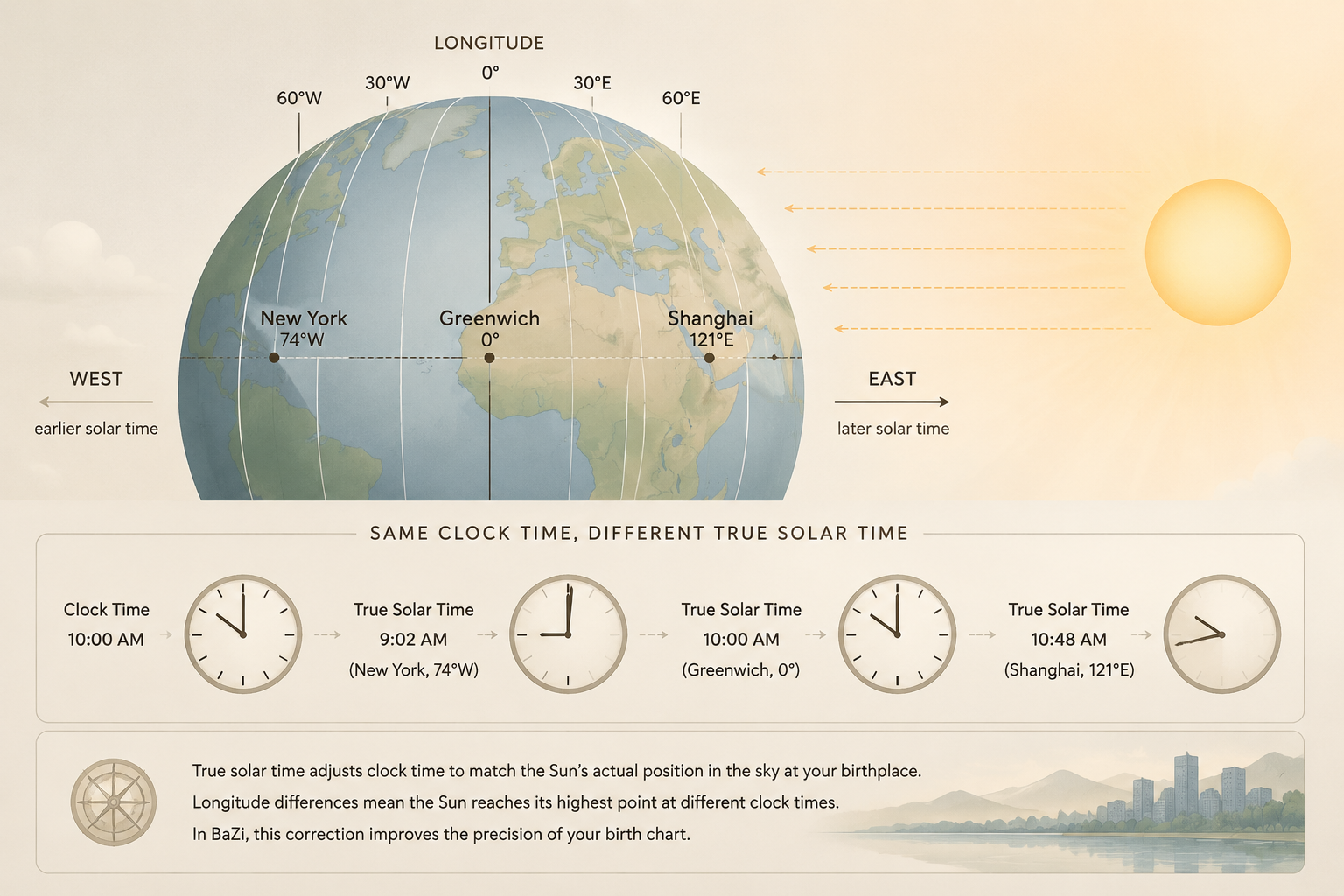
This effect can be dramatic. China, for instance, uses a single time zone (UTC+8) based on the meridian at 120° East. That meridian passes near Hangzhou. But Urumqi, in the far west at about 87.6°E, sits over 32 degrees west of the standard meridian. Solar noon in Urumqi can occur up to two hours later than clock noon. If you were born in Urumqi at 12:30 PM local standard time, the sun might actually indicate a late‑morning hour, not the middle of the day. A BaZi chart built on the clock time could assign an entirely wrong hour pillar.
On top of longitude correction, the Earth’s orbit isn’t a perfect circle, and its axis is tilted. The result is that the apparent solar day isn’t uniform across the year—the sun can run “fast” or “slow” by up to about 16 minutes. This variation is called the Equation of Time (EoT). Only when both the longitude offset and the EoT are applied do you arrive at true solar time, which aligns the celestial positions to the actual position of the sun.[^1]
How to Calculate True Solar Time
You can calculate true solar time manually in three steps, and Free BaZi’s tool does it automatically.
Step 1: Find the longitude of the birth location. The more precise the coordinates, the better.
Step 2: Compute the longitude correction. Determine the reference meridian for the time zone in effect at the date of birth. The standard offset is usually a multiple of 15° from the prime meridian (UTC+8 uses 120°E).
Longitude correction (minutes) = 4 × (local longitude – reference meridian)
If the location is east of the reference meridian, the correction is positive (solar noon occurs earlier); if west, it is negative.
Step 3: Apply the Equation of Time. The EoT varies throughout the year and can be obtained from an astronomical almanac or online source. For example, on February 11, the EoT is approximately −14.3 minutes, meaning the sun is about 14 minutes “slow” relative to a uniform clock. A quick reference table of monthly average values gives sufficient precision for most BaZi uses.
Example: Birth on 15 July in Beijing (longitude 116.4°E). China standard time is UTC+8, reference meridian 120°E.
Longitude difference = 116.4 – 120 = –3.6°
Longitude correction ≈ –14.4 minutes
EoT for mid‑July is about –6 minutes
True solar time ≈ clock time – 20 minutes. If recorded birth time is 12:50 PM, solar time is about 12:30 PM—still within the Wu (Horse) hour, so the hour pillar remains unchanged. But a birth at 12:58 PM could slip into the next two‑hour block.
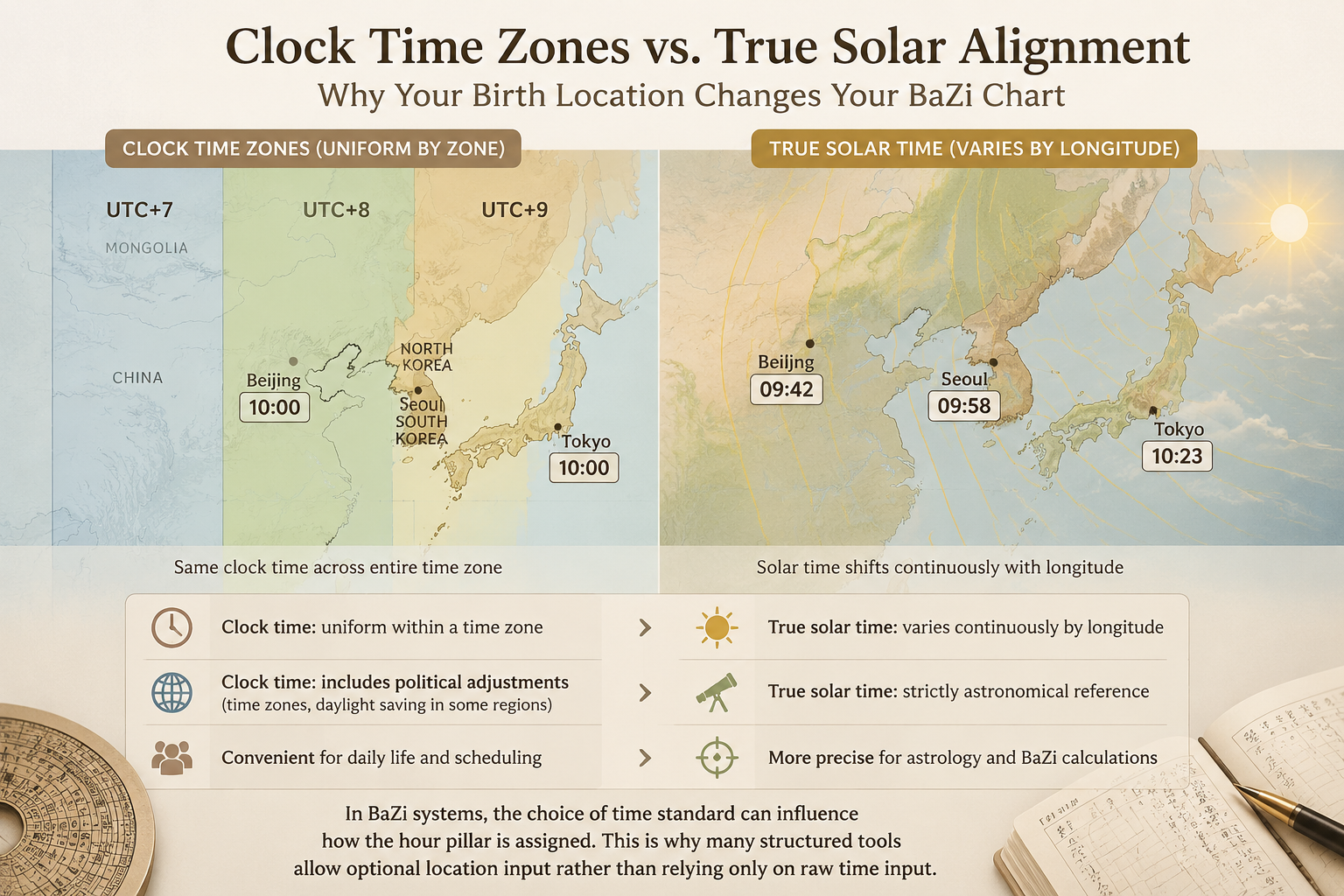
When you use the Free BaZi chart calculator, you don’t have to do the math. Enter the local birth time and the location, and the system applies both longitude and EoT corrections before determining the hour pillar. You can also toggle the true solar time option on or off to compare results.
When True Solar Time Changes a BaZi Chart
A chart changes only when the correction crosses a two‑hour block boundary. The twelve two‑hour segments mean that as little as one minute can be the difference between a Dragon hour and a Snake hour. The most common scenario involves a birth time recorded near the hour margins—for instance, at 12:58 or 1:02 PM.
Take a birth in western China near the Kazakhstan border, longitude 75°E, on a day with a negative EoT. The total correction might shift clock time by over 40 minutes. A recorded 1:05 PM might become 12:23 PM solar, moving from Wei (Goat) hour to Wu (Horse) hour. Since the hour pillar’s Heavenly Stem is derived from the day stem and the hour’s Earthly Branch, a branch change frequently changes the stem too. The entire character of the hour pillar—and therefore the interactions it brings with the Day Master—can be altered.
This matters in practice. The hour pillar represents later life, children, and the way a person’s energy lands in the world. If a reading uses the clock hour instead of the solar hour, the interpretation may assign an energy configuration that never truly occurred. While some schools of BaZi disregard true solar time entirely, many modern practitioners—following the lead of references such as Joey Yap’s Bazi: The Four Pillars of Destiny—consider it an essential precision that respects the original astronomical basis of the Chinese calendar.[^2]
In rare instances, a solar correction can even change the day pillar. This happens if the birth occurred around midnight and the location’s longitude plus EoT pushes the solar time into the previous or next day. However, because the day pillar is usually derived from the local calendar date rather than a fixed UTC offset, Free BaZi treats the day boundary according to the Chinese solar terms, not the civil midnight. A true solar time adjustment only affects the hour pillar by default; you can manually check whether the corrected time crosses a solar day boundary if you wish, but it’s an exceptional case.
Practical Steps to Apply True Solar Time in Free BaZi
- Gather the most accurate birth data you can. The recorded birth time may come from a parent’s memory, a hospital record, or a birth certificate. Note whether daylight saving time (DST) was in effect; the chart tool asks for local time with DST already accounted for—always clarify that.
- Obtain the birth location coordinates. For the most reliable result, use the city name or exact latitude and longitude. Free BaZi’s location picker returns precise coordinates and automatically selects the then‑applicable time zone.
- **Enter the data into the BaZi Chart Calculator.** The tool will display the standard BaZi chart based on the clock time, and below it, a version with true solar time applied. Compare the hour pillar. If they differ, examine what the new pillar introduces: a different earthly branch, a new heavenly stem, and fresh combinations and clashes with the Day Master.
- Interpret with the solar chart. If you are studying the four pillars and the ten Heavenly Stems and twelve Earthly Branches, the solar‑adjusted chart aligns more closely with the environment at the moment of birth. You can then read the hour pillar under the hour pillar guide and see how its qualities shift the overall balance.
- Keep a record. Because true solar time depends on exact location, two people born at the same clock minute in different parts of the same city may have subtly different charts. Saving your data in a free BaZi account lets you revisit and refine.
No tool makes BaZi a prediction machine, but using the right time frame respects the system’s roots in observational astronomy. The Chinese solar terms themselves are defined by the sun’s longitude; true solar time extends that principle to the hour pillar.
Limitations and Cultural Context
True solar time is a refinement, not a guarantee. BaZi reading is a cultural and symbolic practice, not an empirical science. Even with precise astronomical time, the interpretation remains interpretive, influenced by the reader’s school, experience, and the chart’s interplay of elements. Different lineages make different choices: some traditionalists use local standard time, arguing that the birth “event” is recorded by human timekeeping, while others insist on solar time.[^2]
Applying true solar time also demands caution with historical birth records. In many regions, timekeeping was inconsistent before the mid‑20th century, and the birth hour may have been estimated by the sun or by vague intervals. The correction may add artificial precision to an already approximate datum. When in doubt, note the uncertainty and, if possible, confirm the hour pillar with life events before committing to an interpretation.
Moreover, BaZi is not deterministic. It offers a reading framework—a way to reflect on personality, tendencies, and timing cycles. Changing the hour pillar shifts that framework’s vocabulary, but it does not change a person’s fate. Keep claims bounded, and use the method as a lens, not a verdict.
FAQ
Does true solar time always change my BaZi chart?
No. Often the correction is small and does not cross a two‑hour block boundary. The hour pillar remains the same as the clock‑based chart. Only when the total shift pushes the birth moment into a different segment does the pillar change.
Why do some BaZi practitioners ignore true solar time?
Some follow traditional methods that rely on the recorded civil hour, especially where exact birth coordinates are unknown. Others regard the hour pillar as less critical than the day master and may prefer simplicity. It’s a difference of approach, not error.
How accurate is the Equation of Time correction?
The EoT is a well‑established astronomical measure, accurate to within seconds when read from a reliable almanac. For BaZi purposes, using a monthly average or a simple lookup table yields an error of under a minute—well within the two‑hour block tolerance except for boundary births.
Can my birth location change my day master?
Extremely rarely. The Day Master is determined by the day pillar, which is usually taken from the local calendar date. True solar time applied to the hour does not directly alter the day pillar. However, if you apply solar correction to the day boundary as well, a birth very near midnight might shift the day; this is not a standard practice in Free BaZi’s default tool.
Does Free BaZi handle daylight saving time automatically?
No. You must enter the local clock time as it was in effect at birth. If daylight saving was active, include that in the time you input. The tool then adjusts to solar time from that local value.
A More Rooted Reading
True solar time isn’t a complication—it’s a return to the astronomical basis of the calendar that gives BaZi its structure. A few minutes can rewrite the hour pillar, and with it the way you understand the later season of life in your chart. By building the correction into every step, the Free BaZi chart calculator makes that precision effortless.
Explore your solar‑corrected chart, compare it with the clock version, and see how the pillar relationships shift. Then take that reading forward not as a prediction, but as a carefully structured piece of cultural reflection. For deeper dives into each pillar, browse the four pillars guide or the full stems and branches reference.
Nothing here is a promise. It’s a method. True solar time gives your chart its rightful moment under the sun.
[^1]: The US Naval Observatory explains the Equation of Time in detail: https://aa.usno.navy.mil/faq/eqtime
[^2]: Joey Yap, Bazi: The Four Pillars of Destiny, discusses solar correction as standard practice for contemporary BaZi analysis.
Related reading
Related guide
What Is BaZi? A Beginner’s Guide to Four Pillars of Destiny
Learn the fundamentals of BaZi (Four Pillars of Destiny), a structured Chinese reading method that maps your birth data into a chart of eight characters. This guide explains the Five Elements, Day Master, Ten Gods, and Luck Pillars, and shows how to read your own chart with Free BaZi’s tool.
Related guide
Ten Gods in BaZi: What Each One Means in Your Chart
A methodical guide to the Ten Gods in BaZi: how they arise from the Day Master, what each represents, and how to read them in context using the Free BaZi chart tool.
Related guide
BaZi Luck Pillars: How the 10-Year Cycles Shape Your Life
A methodical introduction to luck pillars in BaZi: how the 10-year cycles are structured, how to read them with your natal chart, and why they offer an interpretive layer, not a fixed prediction.