Weak vs. Strong Day Master: How to Tell and Why It Matters
A clear, step-by-step guide to determining whether a BaZi Day Master is strong or weak, why it matters for chart reading, and how to use this reading path without mystique or overpromise.
Day Master strength is one of the first structural assessments in BaZi—it sets the primary reading path. Yet it’s easily misunderstood. This guide explains what a strong or weak Day Master actually means under a transparent, method-driven lens, how to evaluate it using the Five Elements and the chart’s structure, and what that reading direction implies for a person’s natural tendencies. No absolute fortune claims; only a calm reference framework.
Before we begin, if you haven’t yet cast your own chart, open the Free BaZi chart tool and enter your birth details. Seeing your Day Master and the surrounding elements makes the following steps immediately tangible.
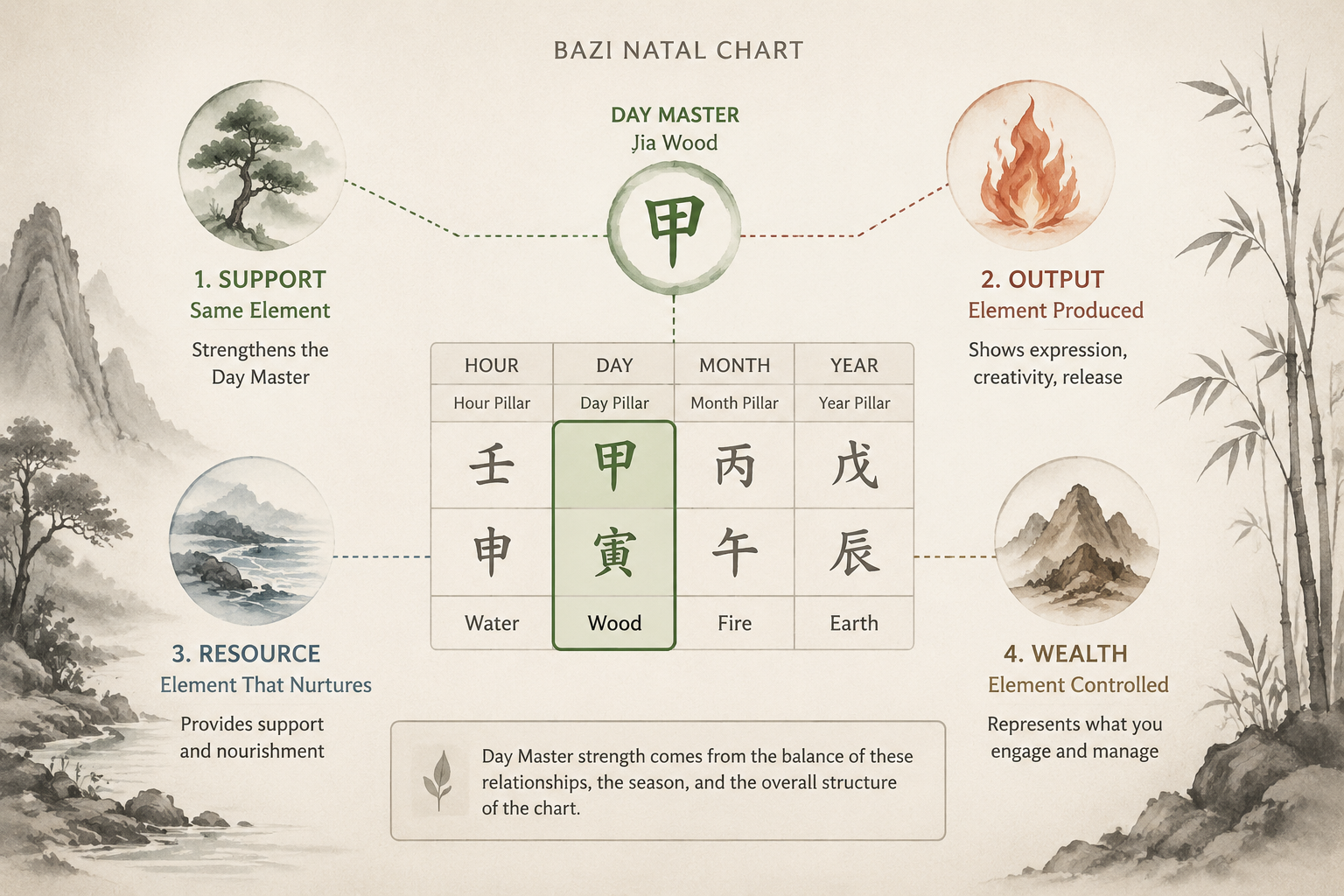
What Does “Strong” or “Weak” Mean for a Day Master?
In BaZi, the Day Master (the Heavenly Stem of the day pillar) represents the person. Strength and weakness are not value judgments; they describe the relative balance of the chart. A strong Day Master has enough supportive elements—friends and resources—to thrive without much outside help. A weak Day Master has fewer direct supports and works more from a posture of careful adaptation.
Strength is evaluated against the month of birth (the Month Branch) and the entire elemental composition. A Day Master born in a month where its element is strongest (prosperous phase) gets a foundational boost. But strength isn’t just about the month; it’s the sum of supportive Stems, Branches, hidden stems, and especially the presence of the same element or the element that produces it. For a deeper look at how the Day Master interacts with the seasons, refer to our guide on the Five Elements cycle.
This evaluation isn’t about deciding if someone is “good” or “bad.” It’s about choosing a reading lens. A strong Day Master reading emphasizes containment, outlet, and control—using resources to manage abundant energy. A weak Day Master reading emphasizes support, nourishment, and alliance—finding the right help to operate effectively. Both are neutral descriptions of chart architecture.
How to Assess Day Master Strength: A Step-by-Step Method
Strength is determined by the presence and quality of three key factors: companions (same element), resource (producing element), and the month’s seasonal influence. Here is a transparent process you can apply directly to any BaZi chart.
Step 1: Identify the Day Master’s Element and the Month
Cast your chart using the free BaZi calculator. Locate your Day Stem—it will be one of the ten Heavenly Stems, which belong to the five elements (Yang Wood, Yin Wood, Yang Fire, etc.). Then note the Month Branch; each branch belongs to an element and a specific phase. For example, a Yin Earth Day Master born in the month of the Dog (戌, Earth) gets seasonal support, while a Yang Metal Day Master born in the month of the Tiger (寅, Wood) faces a weakening season.
Step 2: Count Same-Element Stems and Branches
Look at all four pillars. Count any Heavenly Stem that shares the same element as your Day Master, and any Earthly Branch whose main Qi belongs to that element. Hidden stems within branches also count—especially the main Qi. The Day Master wiki details how each stem behaves under different supports. The more same-element companions, the stronger the Day Master tends to be. For instance, if you are Yang Fire (丙) and there’s another Fire stem or a branch with Fire as its main Qi (like 午 Horse), you have companions.
Step 3: Identify the Resource Element (the Producer)
Each element is produced by another: Wood produces Fire, Fire produces Earth, Earth produces Metal, Metal produces Water, Water produces Wood. Stems and branches carrying the producing element are your resource. If you are Yin Water (癸), Metal is your resource. A chart with several Metal stems or branches feeds Water and increases strength. For a complete reference, see the Ten Gods introduction to recognize the Resource star (Direct and Indirect Resource).
Step 4: Check for Control and Weakening Forces
The element that controls the Day Master (the Officer, the restraining element) and the element the Day Master produces (the Output, the exhausting element) reduce effective strength. A Day Master surrounded by its controlling element—for example, a Fire Day Master with many Water stems—can be weakened considerably, even if there are few companions. Balance isn’t binary; you are looking for the overall weight.
Step 5: Combine and Decide: Strong, Weak, or Balanced
Add up the weight: companions + resource minus heavy controllers and exhausters, with the month’s seasonal boost or penalty. If supportive factors clearly dominate, the Day Master is strong. If restraining and exhausting factors dominate, it’s weak. Sometimes the chart is fairly even—this is a balanced Day Master, which may read as slightly strong or weak depending on the Luck Pillars. Many practitioners assign a “strength grade” but a simple strong/weak classification already gives you a clear reading direction.
Interpreting the Reading: Strong vs. Weak Day Master Paths
Why does this classification matter? Because the entire Ten Gods analysis changes orientation. The same star can represent a positive or challenging influence depending on strength.
For a Strong Day Master
When the Day Master is strong, the reading path focuses on management, expression, and wealth. The chart will read well when it contains elements that guide abundance outward: Output stars (to express talent), Wealth stars (to direct energy into tangible results), and Officer stars (to instill discipline). A strong chart without these outlets may feel stuck or overbearing. The method isn’t about “needing” certain elements, but about noticing what structural flows exist.
For a Weak Day Master
When the Day Master is weak, the reading path highlights support and nourishment. Here the favorable stars are typically Companions and Resources—friends, peers, mentors, and self-cultivation. Output and Wealth can become draining if they are overrepresented. The focus is on building a stable foundation before expressing outward. Again, it’s not a prediction but a map of which energies align more naturally.
Practical Context
These distinctions are used in cultural life-reading contexts to discuss career orientation, relationship dynamics, and decision-making styles. A strong Day Master reading might open conversations about leadership and channeling drive; a weak Day Master reading about building supportive networks and pacing oneself. In our Ten Gods tool guide, you’ll find how each star manifests differently across strength categories.
Common Misunderstandings and Limitations
Strength assessment is method, not destiny. Avoid these pitfalls:
- “Weak means bad, strong means good.” No—both are just structural states. Many people with weak Day Masters live robust, influential lives. The chart only indicates how a person naturally processes the world.
- Strength alone defines the person. Day Master strength is one layer. The interplay of all Eight Characters, Luck Pillars, and the configuration of the chart adds immense nuance.
- A strong Day Master must be balanced by the luck pillars. While luck pillars shift emphasis, the natal chart’s implications don’t flip overnight; they evolve.
- This is a predictive formula. It isn’t. It’s a cultural reading framework with roots in Chinese natural philosophy. Use it for reflection, not certainty.
If you want to explore how your strength interacts with daily cycles, the Huangli almanac offers a reference for the day’s elemental environment.
Frequently Asked Questions
How do I quickly check if my Day Master is strong?
Start with the month: is your Day Master’s element in its prosperous season? Then count stems and branches of the same element and the producing element. The free BaZi chart tool highlights the Day Master automatically and shows elemental counts, making this evaluation much faster.
Can a weak Day Master still have a good life path?
Absolutely. Strength only directs the reading lens, not the quality of life. A weak Day Master with supportive Resource stars or helpful Companions in the luck pillars often reflects a person who builds meaningful alliances and relies on steady growth—no better or worse than a strong Day Master’s trajectory.
Does the strength change over time?
The natal Day Master strength is fixed, but the Luck Pillars modify how that strength expresses. A weak Day Master entering a supportive Resource-decade may find it easier to learn, grow, or gain help, while a strong Day Master entering a Wealth-decade might experience more direction for excess energy. This is dynamic context, not a change of the core strength.
What if my chart looks very balanced?
Balanced charts can be read from either direction, and many practitioners look at the first Luck Pillar to tip the scale. Even then, the reading remains structural; you are simply observing which path feels more harmonious to pursue. There’s no requirement to force a strong or weak label if the chart genuinely resists it.
Do I need to calculate hidden stems to know strength?
For a precise reading, yes—hidden stems inside the Earthly Branches often carry significant resource or companion elements that tip the balance. However, a preliminary strength check using the main stems and branch Qi will already point you in the right direction.
Related reading
Related guide
Ten Gods in BaZi: What Each One Means in Your Chart
A methodical guide to the Ten Gods in BaZi: how they arise from the Day Master, what each represents, and how to read them in context using the Free BaZi chart tool.
Related guide
BaZi Luck Pillars: How the 10-Year Cycles Shape Your Life
A methodical introduction to luck pillars in BaZi: how the 10-year cycles are structured, how to read them with your natal chart, and why they offer an interpretive layer, not a fixed prediction.
Related guide
Ten Gods Quick Reference Table: A BaZi Reference Guide
A clear quick reference table for the Ten Gods in BaZi, explaining how to identify them from your Day Master and providing a practical lookup for every heavenly stem.