What Is BaZi? A Beginner's Guide to Four Pillars of Destiny
Learn what BaZi is, how it works, and how to get a free chart. Discover your Day Master, five elements, and luck cycles in this beginner's guide.
BaZi (八字), also known as the Four Pillars of Destiny, is an ancient Chinese system that analyzes the year, month, day, and hour of a person's birth to reveal patterns in personality, strengths, and life cycles. It is based on the interaction of Heavenly Stems and Earthly Branches, with the Day Master (日主) representing the self. Unlike fortune-telling, BaZi is used as a tool for self-reflection and understanding one's inherent tendencies.
How BaZi Works: The Four Pillars
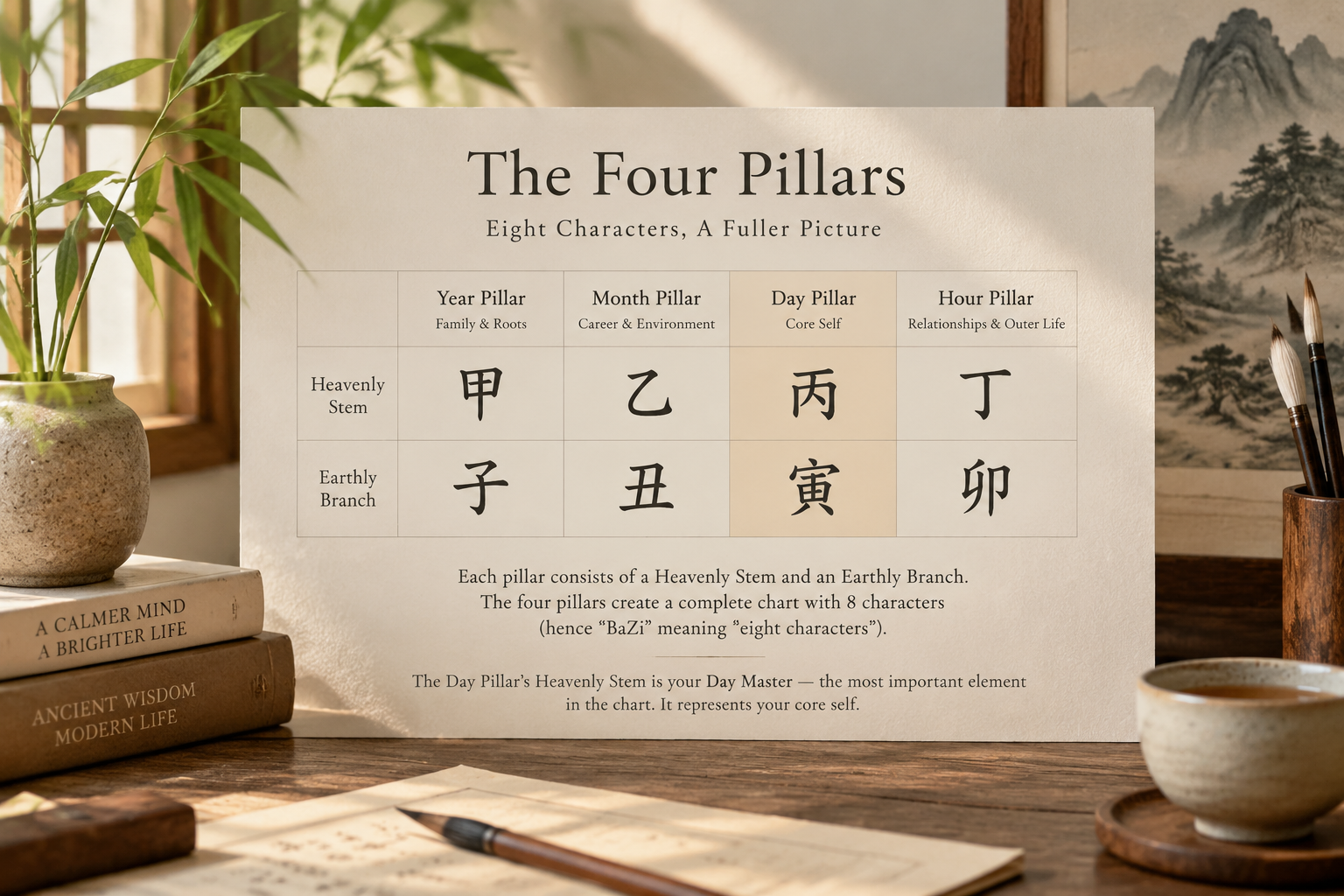
Each pillar consists of a Heavenly Stem and an Earthly Branch. The four pillars together create a complete chart with 8 characters (hence "BaZi" meaning "eight characters").
| Pillar | Year | Month | Day | Hour |
|---|---|---|---|---|
| Heavenly Stem | 甲, 乙, 丙, etc. | ... | ... | ... |
| Earthly Branch | 子, 丑, 寅, etc. | ... | ... | ... |
The Day Pillar's Heavenly Stem is your Day Master — the most important element in the chart. It represents your core self. The other pillars reveal influences from your family, career, relationships, and outer life.
The Day Master and Five Elements
Your Day Master belongs to one of the Five Elements (五行): Wood, Fire, Earth, Metal, or Water. Each element has yin and yang variations. The balance of these elements in your chart indicates strengths and weaknesses. For example, a Wood Day Master may be creative and flexible, but if there is too much Wood, it can lead to rigidity. The Free BaZi Calculator automatically shows your element distribution.
Ten Gods and Relationships
Ten Gods (十神) are derived from the interactions between the Day Master and other stems/branches. They represent different life aspects: direct wealth, indirect wealth, direct officer, indirect officer, etc. Each Ten God suggests how you relate to money, authority, resources, and peers. Understanding these helps interpret your chart without mystification.
For a deeper dive, see the Day Master wiki page and the Five Elements wiki page.
Luck Cycles and Annual Influence
BaZi includes Luck Pillars (大运) that shift every 10 years, describing major life phases. Additionally, each year's Annual Pillar interacts with your natal chart. This is not a fixed prediction but a lens to see favorable or challenging periods. For instance, a year with your favorable element may support career growth, while a conflicting year may require extra caution.
How to Get Your BaZi Chart
Using the Free BaZi Calculator, you can generate a chart in seconds:
- Go to free-bazi.com.
- Enter your birth date and birth time (use exact time if known; if unknown, leave blank for a default).
- Enter your birth location — the calculator uses true solar time for accuracy.
- Select your gender (required for luck cycle calculations).
- Click Get My BaZi Chart.
Your chart will display the Four Pillars, Day Master, Five Elements balance, Ten Gods, and current luck cycles. For a detailed walkthrough, check out How to Use the Free BaZi Calculator.
Common Misunderstandings About BaZi
- BaZi does not guarantee specific events. It suggests tendencies, not certainties. Your choices and environment also matter.
- Exact birth time improves accuracy, but even without it, the day pillar provides valuable insight.
- BaZi is not a religion — it is a system of observation, similar to personality frameworks like Myers-Briggs.
- The chart is not fixed fate — luck cycles and personal growth can change how energies manifest.
FAQ
Do I need an exact birth time?
If your birth time is unknown, the calculator defaults to 12:00 noon. The day pillar remains accurate, but the hour pillar (which affects certain details) is omitted. For best results, try to obtain your time from a birth certificate.
Can BaZi predict the future?
BaZi describes potential patterns, not fixed outcomes. It is most useful for understanding yourself and timing favorable opportunities. Always combine insights with your own judgment.
What is the difference between BaZi and Western astrology?
Western astrology uses planets and zodiac signs based on the solar calendar. BaZi uses the Chinese lunar calendar, stems, and branches. Both offer self-reflection frameworks, but their methods and interpretations differ.
How accurate is BaZi?
Accuracy depends on correct birth data and the interpreter's experience. As a tool, it provides a structured perspective; its value lies in how you apply the insights to your life.
Ready to explore your own BaZi chart? Try the Free BaZi Calculator to get started.
Related reading
Related guide
What Is a BaZi Chart? A Beginner's Guide to the Four Pillars
Learn what a BaZi chart is, how the Four Pillars work, what the Day Master means, and how to read your chart with a clear, methodology-based approach.
Related guide
2027 Zodiac Forecast: A Structured Guide to the Year of the Fire Goat
Learn what the 2027 zodiac forecast actually measures, how the Ding Wei year pillar interacts with your chart, and how to read the Year of the Goat without mystical claims.
Related guide
What Is BaZi? A Beginner’s Guide to Four Pillars of Destiny
Learn the fundamentals of BaZi (Four Pillars of Destiny), a structured Chinese reading method that maps your birth data into a chart of eight characters. This guide explains the Five Elements, Day Master, Ten Gods, and Luck Pillars, and shows how to read your own chart with Free BaZi’s tool.