What Is a BaZi Chart? A Beginner's Guide to the Four Pillars
Learn what a BaZi chart is, how the Four Pillars work, what the Day Master means, and how to read your chart with a clear, methodology-based approach.
A BaZi chart can look like an ancient riddle: eight Chinese characters arranged in four neat columns, each tied to an element, a hidden story, and a set of interpretations. If you have ever opened a BaZi report or heard someone say, “What is your Day Master?”, you have already met the basic unit of this system. Keep reading for a grounded, method-driven overview of what a BaZi chart actually is, how it is structured, and how to make sense of it as a cultural reference and self-reflection tool—not as a mystical guarantee.
The Cultural Roots of BaZi
BaZi (八字) literally means “Eight Characters” in Chinese. You will also hear it called the Four Pillars of Destiny, a name that can sound more fixed than the method actually is. The system developed in Chinese calendrical tradition, where time was divided into cycles of ten Heavenly Stems and twelve Earthly Branches. When paired, these two cycles form a sixty-year repeating loop. The same pairing is used for days, hours, and years, creating a reliable chronological grid for farmers, historians, and astrologers alike.
BaZi grew from earlier forms of Chinese time-based cosmology and was gradually shaped into the structured reading method found in late imperial-era texts. It is not a single science but a layered cultural system that has been interpreted differently over the centuries. In modern practice, many people use it as a way to think about temperament, patterns, and life rhythm. Because the method is both culturally rich and internally elaborate, it is best understood as a symbolic language rather than a factual prediction engine. A BaZi chart does not “sent a verdict”; it offers a Map of relations that invites you to examine with intention.
The Structure of a BaZi Chart
Every BaZi chart is built from two core units:
- Heavenly Stems (十天干) – ten characters with yin/yang and Five Element attributes.
- Earthly Branches (十二地支) – twelve characters associated with the Chinese zodiac, animal signs, elements, and a hidden set of stems.
A chart displays four time-based pillars: Year, Month, Day, and Hour. Each pillar has one Heavenly Stem placed above one Earthly Branch. Because there are four pillars and each contains two characters, you get exactly eight characters—the BaZi you see in the name.
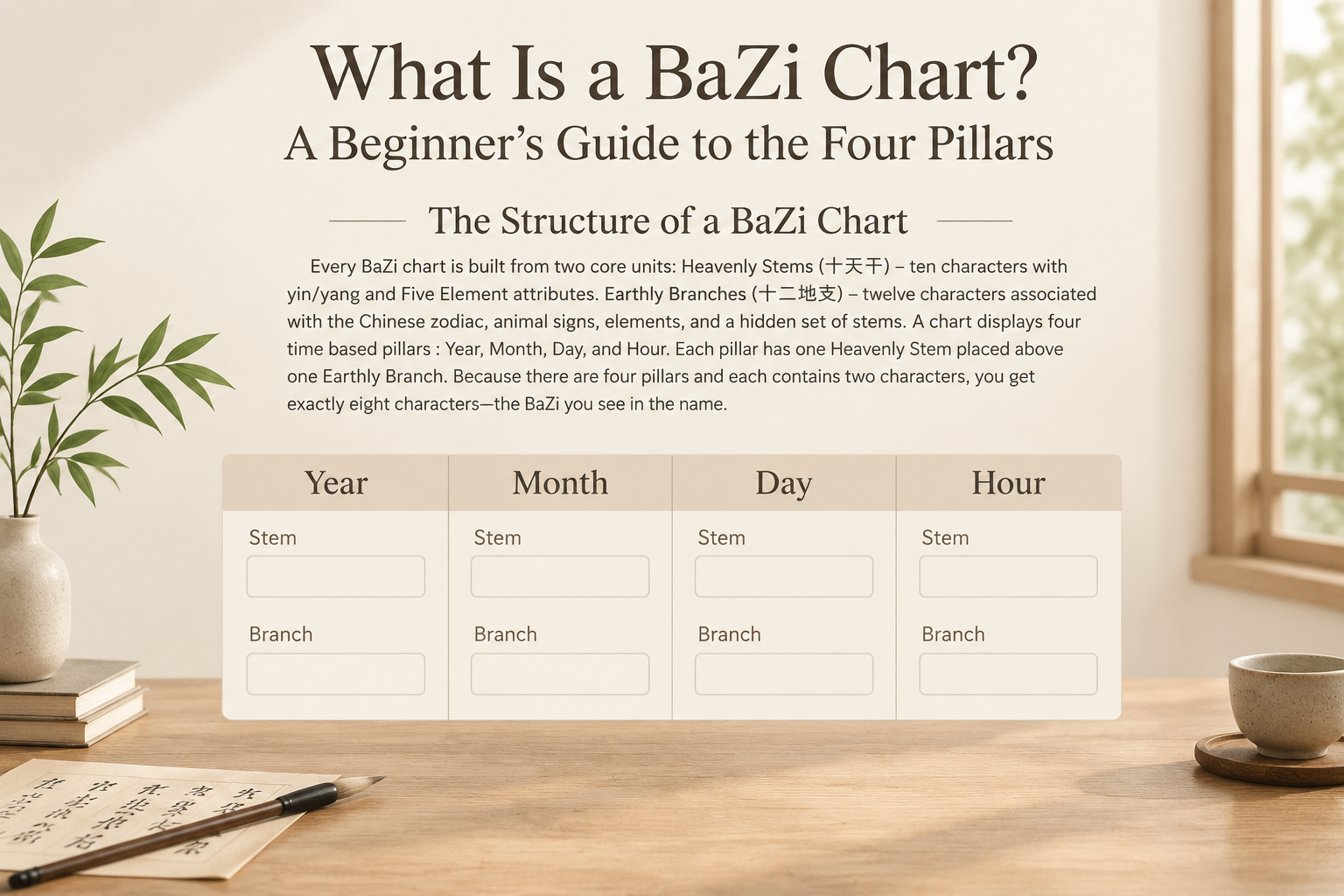
The Year Pillar refers to the Chinese solar year (not necessarily the January 1 calendar year). The Month Pillar points to the solar term month. The Day Pillar marks the day, and the Hour Pillar marks the two-hour Chinese time block. The day pillar has special importance in traditional BaZi reading, because its Heavenly Stem is called the Day Master, or the reference point for the entire chart.
Pillar | Domain | Core question it answers
--- | --- | ---
Year | Family background, youth | What inherited environment do I begin with?
Month | Parents, career season, early climate | In what season of life does this story unfold?
Day | Self, partner, inner core | How do I understand my own center?
Hour | Children, late years | How do I move toward completion?
This table is a simplification, but it gives you a mental structure before diving into stems, branches, and elements. Once you know where to look, you can read a chart as a conversation between these four time layers.
The Day Master: Your Reading Center
In most BaZi schools, the Day Master is the starting point for analysis. It is the Heavenly Stem of the Day Pillar, representing the self assumed by the chart. If your Day Master is a certain element, the other stems and branches are interpreted in relation to it.
For example:
- A Jia Wood Day Master is Yang Wood: tree-like, upright, growth-oriented.
- A Yi Wood Day Master is Yin Wood: grass-like, flexible, adaptable.
- A Bing Fire Day Master is Yang Fire: radiant, quick, expressive.
Reading from the Day Master outward allows the chart to work as a relational map. Your element is not a fixed “type” in the way Western astrology offers rising signs; it is more like a center of gravity. But here is a common misconception: having a Wood Day Master does not mean you “are wood” in a simple physical sense. Instead, wood is the lens through which you interpret the other seven characters.
A good chart reader will not say “You are a wood person, so you should always be flexible.” They will look at how much water, fire, earth, metal, and wood appears around your Day Master, in what season it sits, and which relationships are highlighted. That context is what makes BaZi both complex and intellectually interesting.
The Five Elements: Relationship Logic
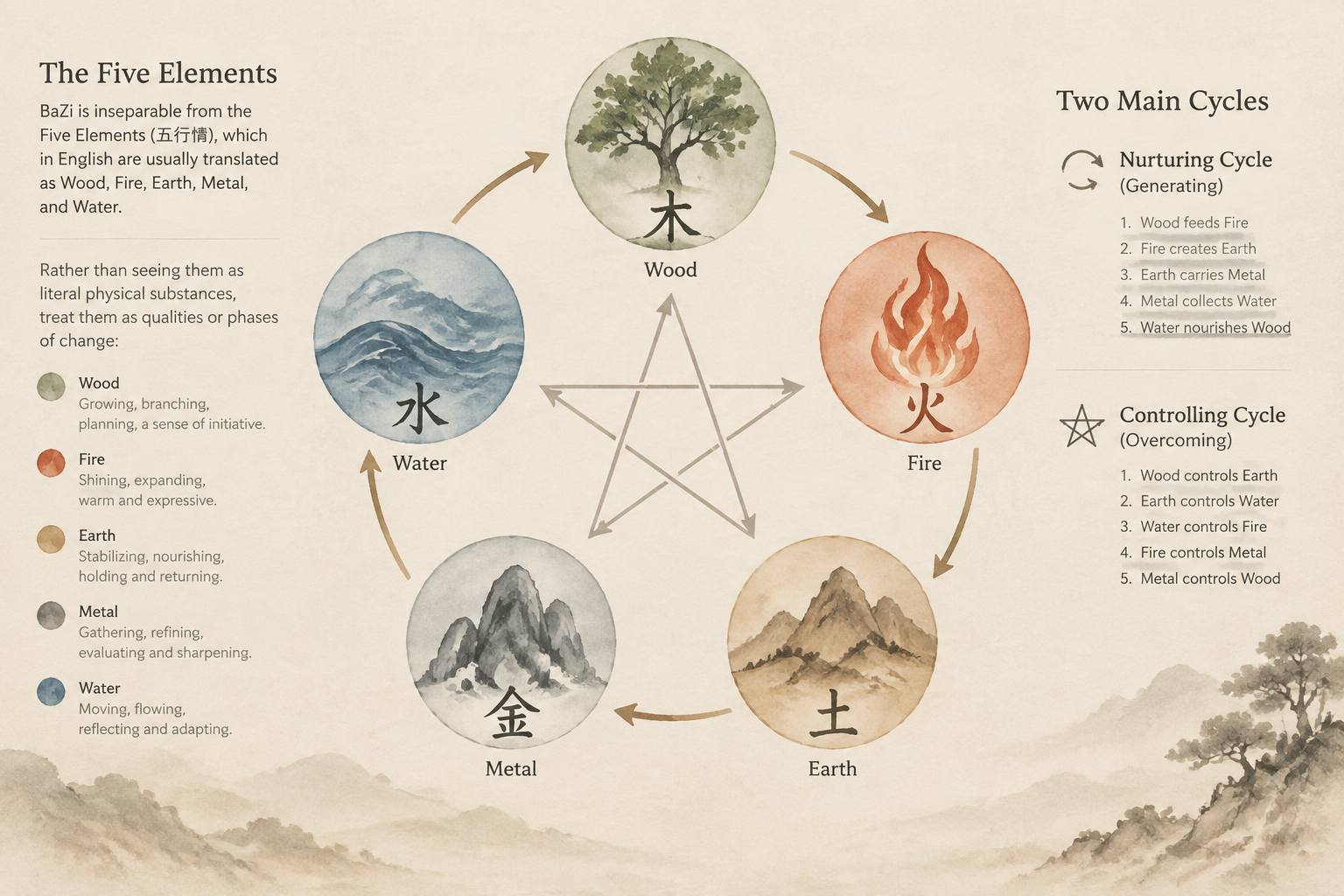
BaZi is inseparable from the Five Elements (五行情), which in English are usually translated as Wood, Fire, Earth, Metal, and Water. Rather than seeing them as literal physical substances, treat them as qualities or phases of change:
- Wood – growing, branching, planning, a sense of initiative
- Fire – shining, expanding, warm and expressive
- Earth – stabilizing, nourishing, holding and returning
- Metal – gathering, refining, evaluating and sharpening
- Water – moving, flowing, reflecting and adapting
The Five Elements interact through two main cycles:
- Nurturing cycle (generating): Wood feeds Fire, Fire creates Earth, Earth carries Metal, Metal collects Water, Water nourishes Wood.
- Controlling cycle (overcoming): Wood breaks into Earth, Earth dams Water, Water quenches Fire, Fire melts Metal, Metal cuts Wood.
In BaZi reading, these cycles are not judgments. “Metal controls Wood” does not mean Metal destroys Wood in daily life; it signals a regulating, pruning, or structuring influence. A chart with too much Fire may not mean your life is full of drama; rather, the reading might ask what kind of water, earth, or metal is present to balance, guide, or contain that Fire. Every element has both creative and restraining functions, so there is no universally “bad” or “good” element in isolation.
The Ten Gods: Roles in the Telling
The Ten Gods (十神) are one of BaZi’s more specialized systems. They take the Day Master’s element and binary polarity (yin/yang), then convert each other stem in the chart into a role label. These labels include concepts like:
- Resource – support, protection, learning or inner wisdom
- Output – expression, creativity, direct action
- Wealth – resources you value, charisma, earning ability (interpreted in a reflective way)
- Officer – self-discipline, boundaries, external expectation
- Companion – rivalry, cooperation, equal standing between same element peers
Each Ten God gives you a vocabulary for reading a person’s inner management style rather than a fixed life event. For example, a strong “Resource” character might describe someone who seeks knowledge and reassurance before acting. But no one wants a chart that only shows one role forever: the goal of good BaZi reading is to observe how these roles cooperate, suppress, or invite each other through the Five Elements.
You can see how different systems overlap: the Day Master uses the Five Elements, the pillar chart uses the sexagenary pairing, and the Ten Gods layer a social role-system on top. If that feels like a lot, remember that even a single reading step is meaningful. You can start by simply identifying your Day Master, then notice which elements appear strongly in your Four Pillars.
How to Read a BaZi Chart Step by Step
The practical path is more useful than memorizing all symbolism at once. Use these steps as a calm first pass.
1. Gather your birth data
Write down your birth date, both the exact hour if possible and the approximate place. BaZi is time-sensitive and often uses Chinese solar terms, not just your Gregorian calendar. The month pillar can change when the sun enters a new solar term, so a slight hour difference can put you in another hour pillar. No need to worry about rare precision if you do not have your birth time; you can still get a valid structural reading, though some readers would pair it as the “month and hour uncertainty.” This is why reliable calendars matter.
2. Convert the date into Heavenly Stems and Earthly Branches
A BaZi chart generator, like the Free BaZi BaZi chart tool on this site, will perform the conversion for you. It uses a consistent Chinese solar-time calendar and display the four pillars in a clean table. This route is best if you are just starting, because manual calculation can easily introduce errors for Gregorian dates.
3. Find your Day Master
Look at the Heavenly Stem in the Day column. If your Day Stem is “Ding”, your Day Master is Yin Fire. If it is “Ren”, your Day Master is Yang Water. Write this element and polarity in a phrase: “My Day Master belongs to Yin Metal,” for example.
4. Notice the season
Find the Month Branch. It is the “climate” of your chart. A Metal Day Master born in spring, when Wood and Fire are strong, will feel different in the reading than a Metal Day Master born in autumn. Season matters because month is the only pillar that indicates energy at its peak in the natural cycle.
5. Look at stems you see in each pillar
Scan the other three Heavenly Stems. Are they supporting your Day Master? Are they dominant in a different element? Track what is repeated. You might find you have many Wood or Water stems. That repetition is a pattern worth exploring, but do not draw quick conclusions about your character. Use the chart as a provocation: “Why does this repetitive element appear so strongly in my relational map?”
6. Optionally, compare with Ten Gods
If you are comfortable with the first five steps, notice which Ten Gods appear near the Day Master. The strongest Ten Gods often describe themes in your style of motivation, expression, and cooperation. A BaZi tool with “Fate” or “Ten Gods” display will color the characters and group them for you, which helps you see patterns at a glance.
The entire process should be descriptive, not decisive. Even a relatively extreme chart leaves plenty of room for environment, choice, and personal growth. After a reading, free yourself from “good/bad” labels and simply note the chart’s core tension: one element that appears strongly and one that barely appears, or a supportive relationship between your Day Master and the Month condition. That tension can serve as an entry point for self-reflection.
What a BaZi Chart Cannot Do
Even with a perfect chart, a BaZi chart cannot do any of the following:
- Tell you exactly when to change jobs
- Guarantee that a certain person is “the right one” for you
- Replace medical, financial, professional, or personal judgment
- Provide a single unchanging life plot
BaZi is often misunderstood as a system that determines your fate the moment you are born. In practice, Chinese cosmology has never treated a person as wholly static. The environment changes, you grow, and the chart is only one lens. Many modern practitioners describe BaZi as a way to recognize patterns in how you react to the world. If that recognition leads to better choices, the chart has served its purpose. But if the chart makes you act against your own common sense, it is being overused.
Also keep in mind that BaZi is a cultural reference. It is meaningful inside Chinese cultural traditions, and many people enjoy it as a method of self-understanding. But you do not need to believe in its determinism to benefit from its vocabulary. You can be curious about your Day Master and still decide your career by market research, your relationships by direct conversation, and your health by a qualified professional.
Common Terms You Will See on Free BaZi
As you explore the Free BaZi chart generator, you will meet some recurring labels:
- Four Pillars: the Year, Month, Day, Hour columns.
- Day Master: the Heavenly Stem of the Day Pillar, used as the chart’s reference point.
- Five Elements: Wood, Fire, Earth, Metal, Water, with generating and controlling relationships.
- Ten Gods: role labels built from the Day Master and the other stems.
- Luck Pillar: a later layer that divides the life path into time periods, usually using a 10-year cycle. It is optional for a first reading.
- Huangli: the Chinese almanac route on the site that shows auspicious time choices and traditional daily prompts. You can look up your Chinese date and solar term in the Huangli calendar.
Understanding these terms is the difference between looking at a colorful grid and having a conversation with the chart.
Frequently Asked Questions
What is BaZi chart exactly?
A BaZi chart is a snapshot of time at your birth, represented by four pillars of eight Chinese characters. Each character combines a Heavenly Stem and Earthly Branch and carries symbolic meaning related to elements, season, and role. It is used for cultural reflection and structured interpretation, not as a science-based prediction of life events.
What does “Eight Characters” mean in BaZi?
“Eight Characters” refers to the eight Chinese symbols in a chart: two for each of the four pillars. The Year, Month, Day, and Hour each produce a Heavenly Stem and an Earthly Branch, adding up to eight symbols in total. That is why the system is called BaZi.
What is the best way to read my BaZi chart as a beginner?
Start with the Day Master. Find which of the Five Elements it is, which be consider the month climate, and then note repeated elements around it. Leave finer details like Ten Gods and Luck Pillars for a second pass. Use a BaZi chart tool to generate the characters for you, so you can focus on interpretational thinking.
Are Five Elements in BaZi the same as Wu Xing used in Chinese medicine?
They share the same Chinese Five Element system, but medical applications and BaZi interpretation are two different contexts. A Chinese medicine practitioner reads the body’s balance from symptoms and pulse, while a BaZi chart reads elements from time-based symbols. Do not apply a BaZi diagnosis directly to health issues.
Can BaZi chart predict my future exactly?
No. BaZi offers no exact predictions. A good interpretation is a map of possibilities, not a guaranteed chain of events. The chart is limited to the symbols and your birth parameters; it cannot see your free choices, complex social contexts, or unexpected life events. Use it for insight, reflection, and conversation, not as an oracle.
Begin with an Honest First Reading
If you have just learned what a BaZi chart is, you are already ahead of the person who only expects a one-sentence fortune. The beauty of BaZi is not in its mysteriousness but in its structured pattern language. You can generate a chart, locate your Day Master, and discover that your own chart mirrors a set of themes you want to think about in your next journaling session.
The Free BaZi chart generator gives you the Four Pillars, Ten Gods, and Five Elements in one calm, self-explanatory page. It does not present destiny as fixed and does not push you to “change fate”. Instead, it lets you observe your time-based pattern with a clear head.
Ready to begin? Open the BaZi chart tool to see your own Four Pillars, or check the Huangli calendar to understand the Lunar date context behind your chart. Look for the Day Master, notice where you feel metaphor and resonance, and decide for yourself what the chart has to say.
Related reading
Related guide
What Is BaZi? A Beginner's Guide to Four Pillars of Destiny
Learn what BaZi is, how it works, and how to get a free chart. Discover your Day Master, five elements, and luck cycles in this beginner's guide.
Related guide
2027 Zodiac Forecast: A Structured Guide to the Year of the Fire Goat
Learn what the 2027 zodiac forecast actually measures, how the Ding Wei year pillar interacts with your chart, and how to read the Year of the Goat without mystical claims.