Twelve Earthly Branches — Quick Reference Table
A clear and practical reference to the 12 Earthly Branches used in BaZi. Includes a complete table with animals, elements, hidden stems, and their role in chart reading.
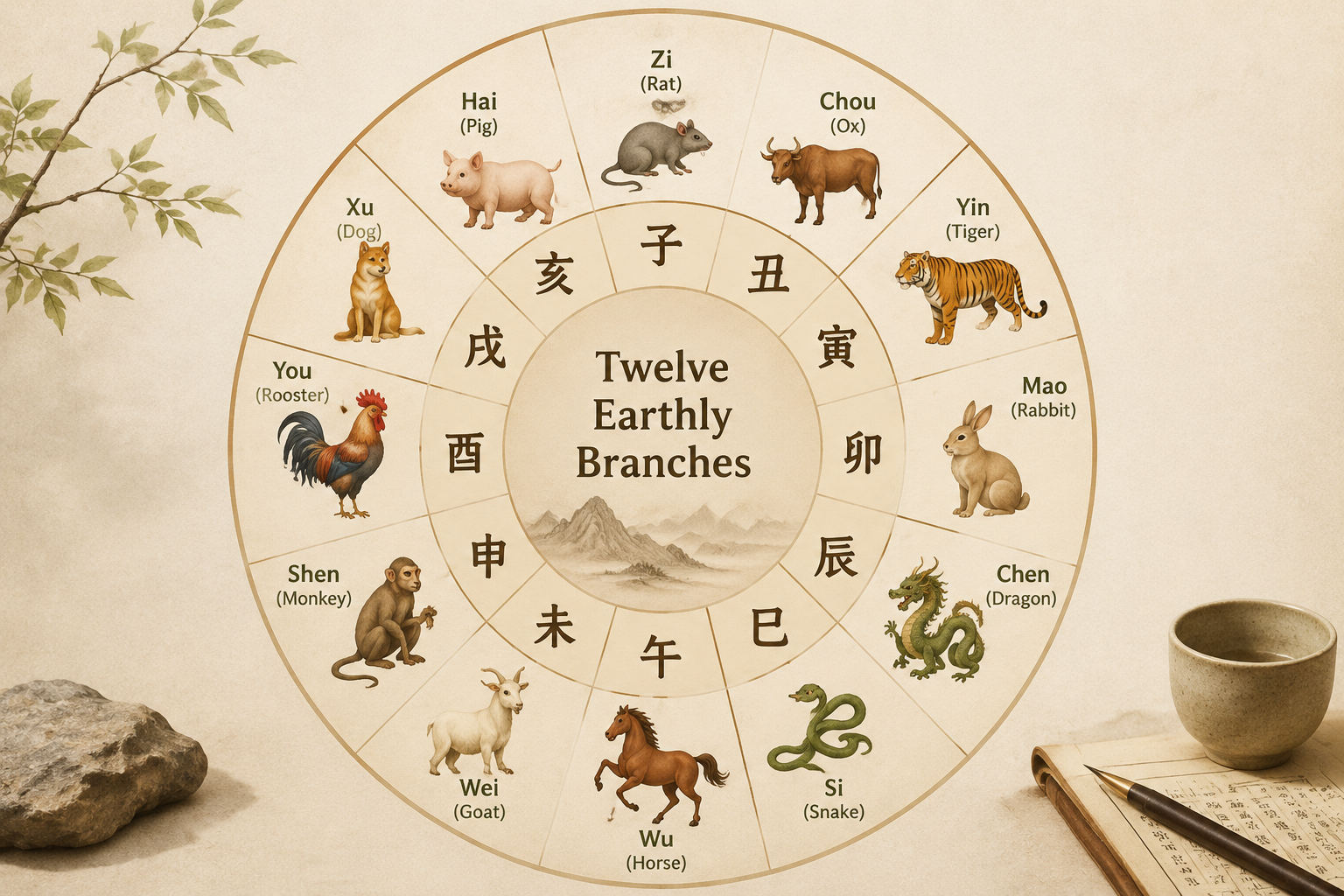
In BaZi, the Four Pillars of Destiny are built from ten Heavenly Stems and twelve Earthly Branches. While stems deliver the day-to-day energy signature, the branches anchor each pillar in time, direction, and elemental quality. This article provides a complete reference table along with a reading framework—so you can understand what each branch signals when you look at your own free BaZi chart.
What Are the Twelve Earthly Branches?
The twelve Earthly Branches form the earth‑based half of the sexagenary cycle that underpins Chinese calendrics and BaZi. They are frequently called “animal signs” because each branch is paired with a creature from the Chinese zodiac, but they carry much more than a name: a branch also encodes a yin or yang polarity, a fixed element, a seasonal phase, and a set of hidden Heavenly Stems.
In a chart, the Earthly Branch appears in each of the four pillars—year, month, day, and hour. Together with the corresponding Heavenly Stem, the branch defines that pillar’s character. The branch’s animal, element, and hidden stems become threads that the reader can follow, much like reading a natural landscape rather than predicting a single outcome.
The Quick Reference Table
The table below lists every branch with its core attributes. Use it as you would a map legend while learning to read a chart.
| Branch | Animal | Yin / Yang | Element | Season | Hidden Stems |
|---|---|---|---|---|---|
| 子 (Zǐ) | Rat | Yang | Water | Winter | 癸 (Guǐ) |
| 丑 (Chǒu) | Ox | Yin | Earth | Winter | 己 (Jǐ), 癸 (Guǐ), 辛 (Xīn) |
| 寅 (Yín) | Tiger | Yang | Wood | Spring | 甲 (Jiǎ), 丙 (Bǐng), 戊 (Wù) |
| 卯 (Mǎo) | Rabbit | Yin | Wood | Spring | 乙 (Yǐ) |
| 辰 (Chén) | Dragon | Yang | Earth | Spring | 戊 (Wù), 乙 (Yǐ), 癸 (Guǐ) |
| 巳 (Sì) | Snake | Yin | Fire | Summer | 丙 (Bǐng), 庚 (Gēng), 戊 (Wù) |
| 午 (Wǔ) | Horse | Yang | Fire | Summer | 丁 (Dīng), 己 (Jǐ) |
| 未 (Wèi) | Goat | Yin | Earth | Summer | 己 (Jǐ), 丁 (Dīng), 乙 (Yǐ) |
| 申 (Shēn) | Monkey | Yang | Metal | Autumn | 庚 (Gēng), 壬 (Rén), 戊 (Wù) |
| 酉 (Yǒu) | Rooster | Yin | Metal | Autumn | 辛 (Xīn) |
| 戌 (Xū) | Dog | Yang | Earth | Autumn | 戊 (Wù), 辛 (Xīn), 丁 (Dīng) |
| 亥 (Hài) | Pig | Yin | Water | Winter | 壬 (Rén), 甲 (Jiǎ) |
How to Read the Branch Table
Each column gives you a distinct lens for interpretation — start with two or three facets and layer them as you grow comfortable.
Animal and Polarity
The animal sign is the most visible memory hook. Zi, the Rat, is yin in character but yang in its active phase; Mao, the Rabbit, is fully yin wood. Polarity adds a rhythm to the chart, hinting at whether the energy tends to express outwardly or quietly consolidate.
Element and Season
The branch’s element is drawn from the season it governs, following the cycle of the Five Elements. Yin (Tiger) and Mao (Rabbit) belong to spring and carry wood energy—expansion and new growth. Si (Snake) and Wu (Horse) are summer fire, marking warmth, visibility, and drive. Recognizing the seasonal element helps you assess whether a pillar feels seasonally “at home” or out of its depth.
Hidden Stems — the Inner Layer
Inside every branch lie one, two, or three hidden Heavenly Stems. These stems are latent qualities that can surface under the influence of a Luck Pillar or an annual cycle. For example, Yin contains the dominant Yang Wood (Jia), the secondary Fire (Bing), and the tertiary Earth (Wu). This means a Yin branch can, in certain configurations, additionally express initiative (Jia wood), warmth (Bing fire), and stability (Wu earth). Hidden stems are not hidden predictions — they are a map of potentials that a chart reader uses to see which energies are stocked and which are called into action.
Why the Branches Matter in BaZi Analysis
Anchoring the Chart Structure
A BaZi chart is read from the Day Stem outward, but the branches frame the whole picture. The month branch sets the seasonal tone; the year branch carries the generational theme; the hour branch often relates to personal expression and later life. When you review your chart side by side with this table, you can quickly gauge which branches are present and what elemental textures they introduce.
Interaction with the Ten Gods
The branches don’t act alone. When the Heavenly Stem of a pillar combines with the branch’s dominant hidden stem, the Ten Gods emerge — the ten relationship types that shape the reading of career, resources, influence, and output. A branch like Si (Snake) with hidden Geng Metal can, through the right stem meeting, activate the Output Star or the Influence Star, shifting the narrative of a pillar.
Luck Pillars and Timing
Branches also reappear in the 10‑year Luck Pillar cycles. Each Luck Pillar comes with its own stem‑branch pair, and its branch interacts with the branches already in your natal chart. By checking the branch’s element and hidden stems in this table, you can contextualize a cycle without treating it as a guaranteed outcome — the branches simply describe the weather of that period. Read more about how these cycles are constructed in our Luck Pillars article.
Daily and Annual Reference with the Huangli
Beyond the natal chart, branches are the bones of the Chinese calendar. The Huangli (traditional calendar) lists the branch for every day, and choosing an auspicious day often starts with noting which branch is in charge. Our Huangli tool shows the daily branch and its clashes, helping you align activities with the daily branch’s character.
Frequently Asked Questions
What are the 12 Earthly Branches?
The twelve Earthly Branches are the earth‑based components of the sexagenary cycle used in BaZi to represent time segments: a 2‑hour period, a month, a year, and a direction. They are Zi, Chou, Yin, Mao, Chen, Si, Wu, Wei, Shen, You, Xu, and Hai. Each one carries an animal sign, a Five Element, yin/yang polarity, and a set of hidden Heavenly Stems.
How do I use this reference table when reading my BaZi chart?
After you generate your free BaZi chart, each pillar will show its earthly branch. Cross‑reference the branch with the table to check its animal, element, and hidden stems. For instance, the month branch gives insights into your career orientation and innate elemental affinity.
What are hidden stems and why are they important?
Hidden stems are the Heavenly Stems stored inside a branch. They represent latent energies that can emerge during specific life phases or annual cycles. They add complexity to a reading by revealing secondary qualities — such as communication skills or cautiousness — beyond the branch’s surface element.
How do the Branches relate to the Five Elements?
Each branch’s element is determined by its season, following the Five Elements cycle. Yin and Mao are wood (spring), Si and Wu are fire (summer), Shen and You are metal (autumn), Hai and Zi are water (winter), while the earth branches — Chou, Chen, Wei, Xu — sit at the transitions between seasons. Elements define how branches interact: generating, controlling, or clashing.
Where can I check my own BaZi chart for free?
You can compute your complete Four Pillars, including all branch placements, with our free BaZi chart tool. It instantly displays the animal signs, hidden stems, and the Day Master so you can start exploring the branches in your own chart.
This reference table is meant to be a calm starting point, not a crystal ball. Use it side by side with your chart, observe which branches appear, and see what themes naturally arise. If you’re ready to step further, the Day Master article explains how the central stem interacts with the branch layer, and the Ten Gods overview shows you how the stems and branches combine to create the narrative palette of your BaZi.
Related reading
Related guide
Ten Heavenly Stems Table — Quick Reference & Guide
A clear reference table for the ten heavenly stems (Tian Gan), including elements, polarity, and practical use in BaZi chart reading. Structured method with no fortune-telling.
Related guide
Free BaZi Calculator: How to Read Your Four Pillars Chart
Learn to interpret your BaZi (Four Pillars of Destiny) chart step by step using the free BaZi calculator. Understand Day Master, Five Elements, Ten Gods, and Luck Pillars for a structured cultural reading.
Related guide
How to Read a BaZi Chart Step by Step
A clear, method-driven guide to reading a BaZi chart. Learn to identify the Four Pillars, Day Master, Five Elements, and Ten Gods—step by step.