How to Read a BaZi Chart Step by Step
A clear, method-driven guide to reading a BaZi chart. Learn to identify the Four Pillars, Day Master, Five Elements, and Ten Gods—step by step.
A BaZi chart (Four Pillars of Destiny) is a structured arrangement of eight characters that maps a birth moment onto the Chinese calendar system. It does not predict a fixed future, but it does provide a rich cultural reference for understanding a person’s temperament, strengths, and interaction with time cycles.
This guide walks through the reading method step by step, using clear definitions and real examples instead of mysterious claims. By the end, you will know how to approach any BaZi chart with a logical framework—and where to look next.
If you want to follow along with your own chart, you can generate one instantly using the Free BaZi Chart.
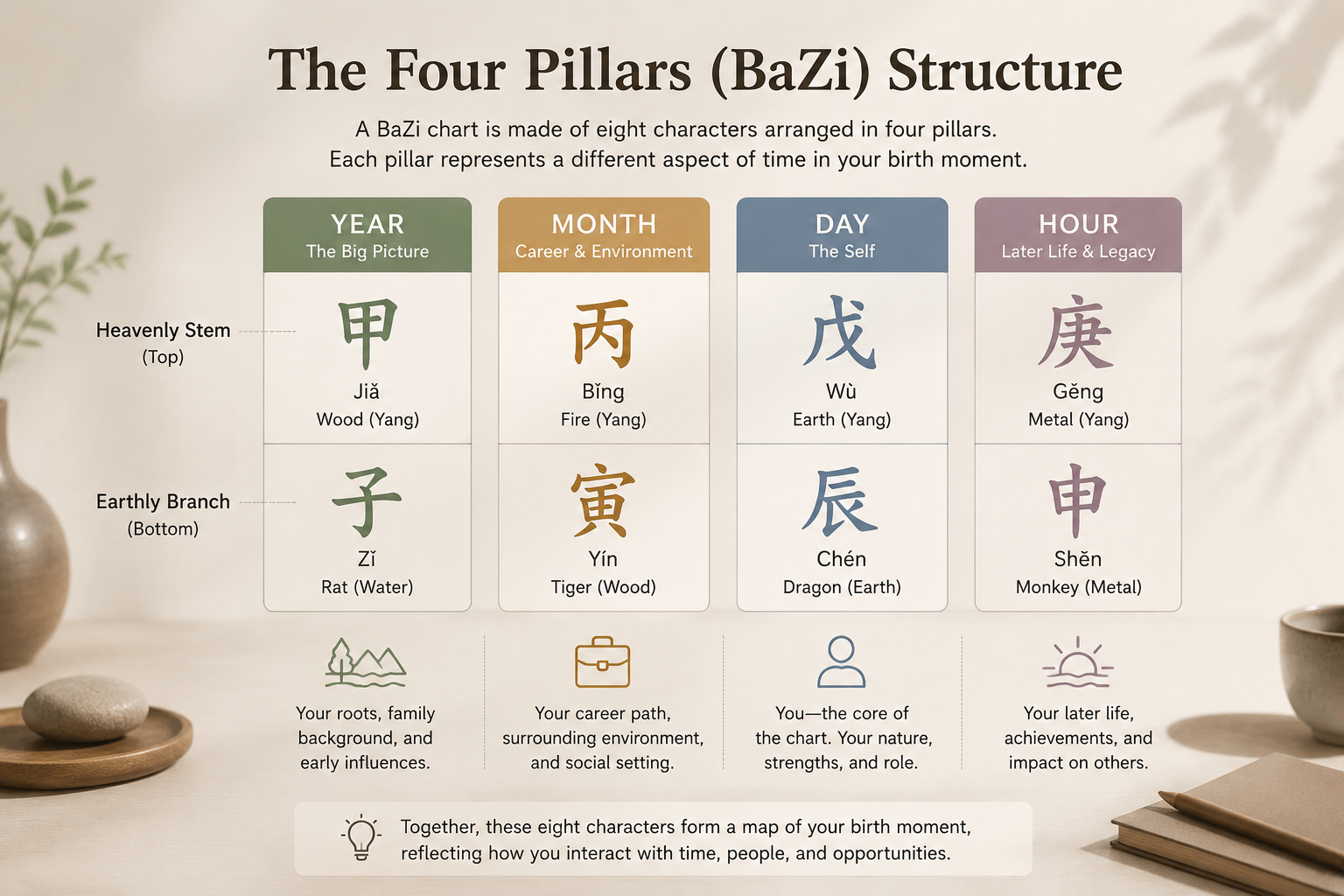
Step 1: Understand the Four Pillars Structure
Every BaZi chart is built from four pillars, each representing a time unit:
- Year Pillar
- Month Pillar
- Day Pillar
- Hour Pillar
Each pillar holds two characters: a Heavenly Stem (top) and an Earthly Branch (bottom). Because there are four pillars with two characters each, we get eight characters—BaZi literally means “Eight Characters.”
The stems and branches are drawn from the sexagenary cycle, a 60-term system that combines 10 Heavenly Stems (甲 Jia, 乙 Yi, 丙 Bing, 丁 Ding, 戊 Wu, 己 Ji, 庚 Geng, 辛 Xin, 壬 Ren, 癸 Gui) and 12 Earthly Branches (子 Zi, 丑 Chou, 寅 Yin, 卯 Mao, 辰 Chen, 巳 Si, 午 Wu, 未 Wei, 申 Shen, 酉 You, 戌 Xu, 亥 Hai). Each stem and branch carries an elemental property (Wood, Fire, Earth, Metal, Water) and a Yin or Yang polarity. The Year Pillar reflects broad generational trends, the Month Pillar marks the season of birth, the Day Pillar holds the self, and the Hour Pillar shows later life and inner thoughts.
Before you interpret anything, orient yourself with these four pillars. Simply identifying the characters and their elements gives you the chart’s raw material.
Step 2: Identify Your Day Master
The Heavenly Stem of the Day Pillar is called the Day Master. It represents the person being read—the self.
For example, if your Day Pillar is 甲申 (Jia Shen), the Day Master is 甲 (Jia), a Yang Wood stem. The Day Master’s element determines the baseline relationship with every other character in the chart.
There are ten possible Day Masters, each with well-documented cultural profiles. A Jia Wood Day Master is often described as straightforward and growth-oriented, while a Xin Metal Day Master tends toward precision and refinement. These profiles are not fixed personality types but reference points that gain nuance from the full chart. You can explore your Day Master further in the Day Master Characteristics article.
Once you have the Day Master, you know the core energy you will use to read all other stems in the chart.
Step 3: Assess the Five Elements Balance
Every stem and branch has an elemental designation. Tally how often Wood, Fire, Earth, Metal, and Water appear across all eight characters. Some may appear frequently, others may be absent.
A chart with many Fire stems and few Water characters shows a Fire-dominant configuration. The Day Master’s element matters here: a Fire Day Master in a Fiery chart may be quite strong, while a Water Day Master in the same chart may feel unsupported.
Balance analysis is not about correcting missing elements; it is about understanding where energy is concentrated. A chart heavy in Metal may indicate a person who operates with structure and principle, while a Wood-heavy chart often suggests creativity and expansion. The Five Elements in BaZi page explains these relationships in more detail.
The Free BaZi tool automatically counts and displays the elemental composition, so you can skip the manual tally and focus on reading the pattern.
Step 4: Interpret the Ten Gods
The Ten Gods are not deities—they are relationship descriptors that compare each Heavenly Stem to the Day Master. Based on the Day Master’s element, every other stem becomes a Friend, Resource, Output, Influence, or Wealth.
For a Jia Wood Day Master:
- Another Jia Wood stem is a Friend (same element, same polarity)
- Yi Wood is a Friend (same element, different polarity)
- Bing Fire is an Output (Day Master produces Fire)
- Ding Fire is an Output
- Wu Earth is Wealth (Day Master controls Earth)
- Ji Earth is Wealth
- Geng Metal is Influence (Metal controls Wood)
- Xin Metal is Influence
- Ren Water is Resource (Water produces Wood)
- Gui Water is Resource
These categories highlight different life areas: Friends point to peers and competition; Resources relate to support and knowledge; Outputs suggest expression and creativity; Influences indicate authority and challenge; Wealth reflects assets and control. Again, these are reading patterns, not fixed destinies. A chart with strong Wealth structures, for instance, may indicate someone who naturally attracts resources or focuses on value, but context always matters.
For a complete breakdown, see Ten Gods Explained.
Step 5: Factor in Luck Pillars and Current Cycles
A static BaZi chart is only half the picture. The second dimension is time, represented by Luck Pillars (10-year periods) and annual cycles.
Luck Pillars begin from the birth chart and are derived using the gender of the person and the stem of the year pillar. Each pillar covers roughly one decade, and the stems and branches that enter during that period interact with the natal chart. A resource-heavy Luck Pillar may bring educational or support-oriented themes; a wealth-heavy Luck Pillar may highlight financial movement.
Annual influences come from the current year’s stem and branch. The Huangli Calendar shows daily and annual combinations that interact with both the natal chart and the Luck Pillar. When the annual branch clashes with a chart branch, there is a temporary shift in energy that is worth noting, not fearing.
To learn how these periods are calculated and read, visit Luck Pillars and Life Cycles.
FAQ
How accurate is a BaZi chart reading?
A reading’s value depends on the reader’s understanding of the method and the sincerity of the questions asked. BaZi provides a cultural reference framework, not a guaranteed prediction. Charts are best used for self-reflection, timing awareness, and exploring patterns rather than absolute forecasting.
What if I don’t know my exact birth time?
The Hour Pillar changes every two hours, so an incorrect hour may shift the chart’s details but often leaves the broader structure intact. Many readers begin with the three pillars they have and note the Hour Pillar as uncertain. When time is completely unknown, some use noon as a placeholder, but always treat the interpretation of the Hour Pillar as tentative.
Can I read my own chart without memorizing all the stems and branches?
Yes. Tools like the Free BaZi Chart automatically generate the stems, branches, elements, and Ten Gods. You can focus on understanding the patterns in front of you rather than manual lookup. Over time, you will naturally remember the key relationships.
Is the BaZi chart connected to feng shui or other systems?
BaZi is a sister study to feng shui under the umbrella of Chinese metaphysics. They share the same Five Elements language, but BaZi reads a person’s energy blueprint while feng shui reads an environment’s energy. Many practitioners use BaZi to tailor feng shui recommendations, but a chart stands alone as a complete reading method.
Reading a BaZi chart is a skill that grows with practice. Start with your own chart on the Free BaZi Chart, note the Day Master, check the element balance, and identify the Ten Gods. Move on to your Luck Pillars when the static chart feels familiar.
The method is transparent, the patterns are cultural, and the insights are yours to explore.
Related reading
Related guide
Ten Heavenly Stems Table — Quick Reference & Guide
A clear reference table for the ten heavenly stems (Tian Gan), including elements, polarity, and practical use in BaZi chart reading. Structured method with no fortune-telling.
Related guide
Free BaZi Calculator: How to Read Your Four Pillars Chart
Learn to interpret your BaZi (Four Pillars of Destiny) chart step by step using the free BaZi calculator. Understand Day Master, Five Elements, Ten Gods, and Luck Pillars for a structured cultural reading.
Related guide
Five Elements Balance in BaZi: How to Read Your Chart's Strengths
Learn how to read the five elements balance in your BaZi chart. Understand strengths, imbalances, and the interplay of Day Master and Ten Gods for a clearer self-reading.