What Your BaZi Day Master Meaning Reveals About You
Discover what your BaZi Day Master means and how this core element shapes your reading. A restrained, method-driven guide to the Day Master's role in a Four Pillars chart.
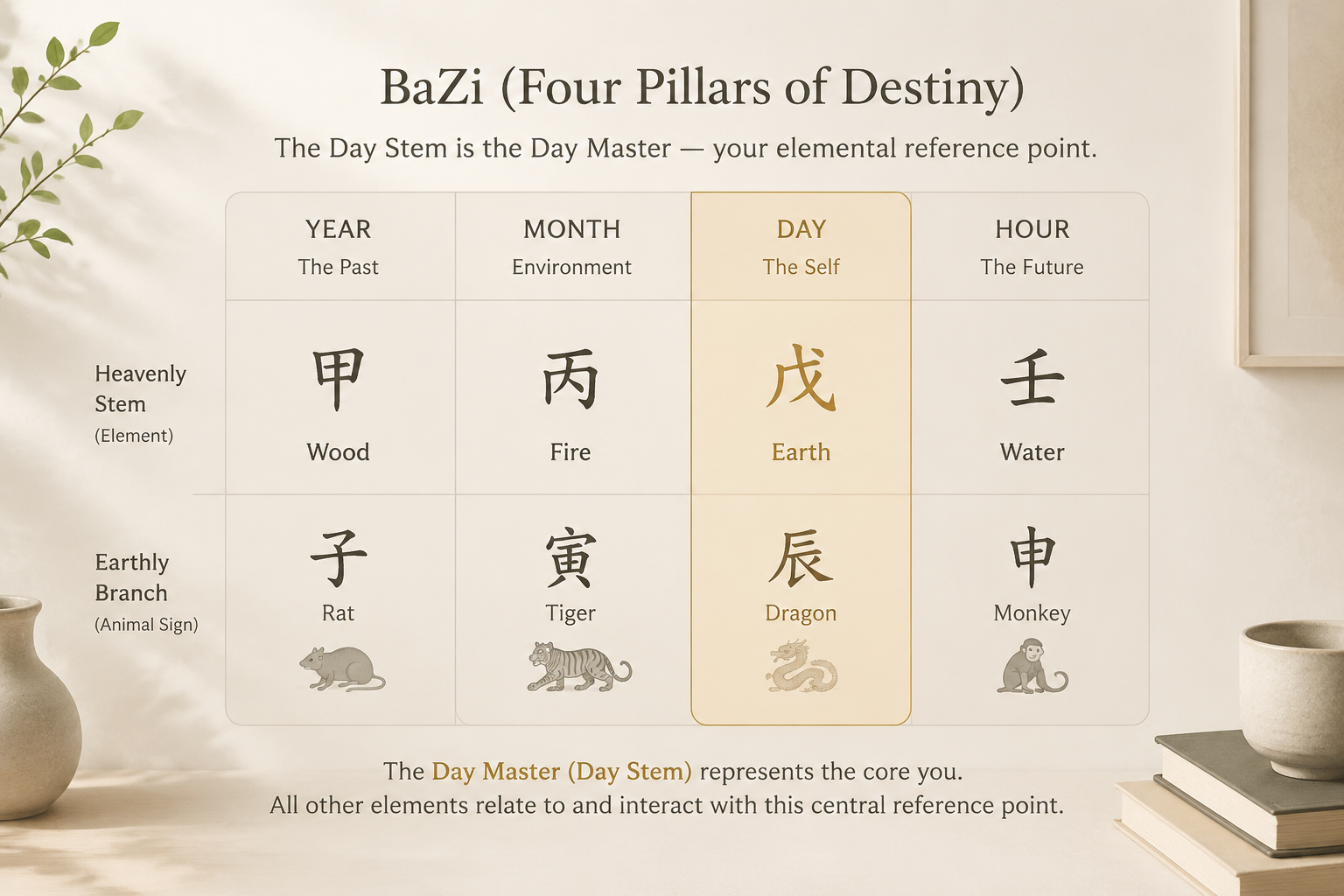
In a BaZi (Four Pillars of Destiny) chart, every pillar carries a Heavenly Stem and an Earthly Branch. Among the four Stems, one stands out as the central reference point: the Day Stem, commonly called the Day Master. It represents the self — not your full personality, but the elemental lens through which you process the world. This article explains what the Day Master reveals, walks you through the ten possible Day Masters, and shows how to place this single reference point into a larger, structured reading. Everything here treats BaZi as a cultural reference method; it is not a tool for guaranteed prediction or fortune-telling.
How BaZi Uses the Day Master to Read a Chart
The BaZi chart is built from a person’s birth year, month, day, and hour, translated into two characters per pillar. The upper character of the Day Pillar — the Day Stem — becomes the Day Master. This single Stem belongs to one of the Five Elements (Wood, Fire, Earth, Metal, Water) and carries a yin or yang polarity.
Everything else in the chart — the other Stems, the Earthly Branches, hidden stems, and even the ten-year Luck Pillars — is read in relation to the Day Master. The system does not assess the chart in isolation; it asks: How do the surrounding elements interact with this central stem? Those interactions are categorized through the Ten Gods (十神), which describe relationships such as Resource, Output, Power, Wealth, and Companion. So the Day Master isn’t a personality label; it’s the fixed point of a relational map.
This relational logic is why understanding your Day Master is the first meaningful step in any BaZi reading. Without it, you cannot interpret the Ten Gods, gauge elemental strength, or evaluate the flow of a Luck Pillar.
The Ten Day Masters and Their Elemental Signatures
There are exactly ten Day Masters, corresponding to the ten Heavenly Stems. Each one combines an element with a yin or yang character, giving it a distinct behavioural flavour. Below are short readings that describe tendencies often associated with each configuration. These are observational patterns, not fixed destinies.
- Jia (甲) — Yang Wood
Jia Wood is often compared to a tall tree: sturdy, principled, and growth-oriented. People with Jia as their Day Master frequently lean toward leadership, straightforwardness, and a desire to build something lasting. They may resist bending to external pressure.
- Yi (乙) — Yin Wood
Yi Wood resembles grass or a vine — flexible, adaptive, and diplomatic. This configuration commonly shows a preference for indirect approaches, persuasion rather than force, and an ability to weave through obstacles.
- Bing (丙) — Yang Fire
Bing Fire is the sun: radiant, enthusiastic, and openly expressive. Those with Bing as Day Master often display warmth, generosity, and a desire to be seen and appreciated. Their energy can be inspiring but may also burn out if not managed.
- Ding (丁) — Yin Fire
Ding Fire is a candle flame or a star — focused, intense, and inwardly passionate. This Day Master often signals a refined, analytical mind that works best in concentrated bursts. The light is quieter but deeply penetrating.
- Wu (戊) — Yang Earth
Wu Earth is a mountain or a large boulder: solid, reliable, and protective. People with this Day Master tend to be grounded, patient, and supportive. They often act as stabilisers in relationships and projects.
- Ji (己) — Yin Earth
Ji Earth is fertile soil, nurturing and resourceful. This configuration commonly reflects an accommodating, detail-oriented nature. Individuals may excel at cultivating ideas or people, preferring steady development over dramatic leaps.
- Geng (庚) — Yang Metal
Geng Metal is an axe or a sword — sharp, decisive, and driven by justice. This Day Master frequently manifests as a straightforward, action-oriented disposition, valuing clarity and results. The edge can be cutting if not tempered.
- Xin (辛) — Yin Metal
Xin Metal is jewellery or a fine tool: refined, meticulous, and aesthetically sensitive. Those with Xin as Day Master often exhibit high standards, precision, and a taste for quality. They may guard their inner world carefully.
- Ren (壬) — Yang Water
Ren Water is the ocean, vast and free-flowing. This Day Master tends toward broad thinking, adaptability, and strong intuition. The personality often welcomes change and can handle complexity, but may struggle with containment.
- Gui (癸) — Yin Water
Gui Water is rain, mist, or a quiet stream: subtle, perceptive, and inward. This configuration usually suggests a reflective, sensitive nature that operates below the surface. Creativity and empathy are common themes.
Each Day Master reading gains nuance when you examine the full chart. A Jia Wood surrounded by strong Water (Resource) behaves differently from a Jia Wood under heavy Metal (Control). The Day Master gives you the starting note, not the entire melody.
How to Find Your Day Master Using Free BaZi
You don’t need to memorise stem-and-branch tables. The fastest way to identify your Day Master is to use the Free BaZi chart tool. Enter a birth date, time, and gender, and the calculator will plot a complete Four Pillars chart. The Day Stem is displayed prominently — labelled “Day Master” in the output — along with the elemental and polarity information.
For an accurate Day Master, the time of birth matters because the Day Pillar changes at a specific juncture each day. If you’re unsure of the exact hour, the tool still gives a reading; just note that finer details like the Hour Pillar may shift.
Once you have your Day Master, you can begin exploring the Ten Gods section of the chart and see how each Stem interacts with your self-element. If you want to go deeper, our Five Elements primer explains the productive and controlling cycles that shape those interactions.
Reading Beyond the Day Master: Interactions and Context
A Day Master only makes sense inside a complete chart. Two people born with the same Day Stem can display quite different tendencies because the surrounding Stems, Branches, and Luck Pillars modify the expression. The reading path follows a few logical layers:
- Elemental strength — The Day Master’s element may be strong, weak, or balanced depending on the season of birth and the presence of supporting or controlling Stems. A weak Wood Day Master in a dry Metal season will lean toward different strategies than a robust Wood Day Master in spring, when Wood prospers.
- Ten Gods distribution — Each Stem and hidden stem relates to the Day Master via an Output, Wealth, Power, Resource, or Companion relationship. These describe areas of natural focus: a chart rich in Output often reflects creative expression; one dominated by Power may indicate discipline or stress, depending on context.
- Luck Pillars — The ten-year cycles introduce new celestial Stems that temporarily emphasise certain relationships, shifting the flavour of a period. They don’t “change” the Day Master, but they colour experience.
Because of this interplay, no single Day Master trait should be read in isolation. The Ten Gods deep dive offers a fuller vocabulary for those relationships, and the BaZi compatibility lens looks at how two charts’ Day Masters interact.
Common Misconceptions About Day Master Readings
- The Day Master is not your whole personality. It’s a reference point for an elemental reading. Real human character involves upbringing, choice, and context.
- The Day Master cannot “fix” your life. BaZi is a cultural framework, not a remedial prescription. No result guarantees career, relationship, or health outcomes.
- A single Day Master description won’t capture complexity. Two Jia Wood Day Masters can live very differently depending on the other seven characters and their environment.
- The Day Master does not change with the lunar year. Unlike some zodiac systems that shift annually, your BaZi chart remains fixed from birth. Time cycles act upon the chart; they don’t alter its core.
Understanding these limits protects you from over-interpretation. Use the Day Master as a lens to explore patterns, not as a label to reduce a person.
FAQ
What does my BaZi Day Master actually mean?
Your BaZi Day Master is the Heavenly Stem of the day you were born. It represents your core elemental self within the chart and serves as the fixed point around which all other Stems and Branches are evaluated. Think of it not as a personality type, but as an elemental anchor that helps you make sense of the relational map produced by the Ten Gods.
Can my Day Master change over time?
No. The Day Master is derived from your fixed birth data and remains constant throughout your life. What changes are the Luck Pillars and annual influences that interact with your Day Master, which can create the impression of shifting tendencies without altering the underlying self-stem.
How does the Day Master relate to the Five Elements?
Every Day Master belongs to one of the Five Elements — Wood, Fire, Earth, Metal, or Water — in either yin or yang form. This elemental quality then interacts with every other element in the chart through the productive (engendering) and controlling (restraining) cycles, forming the foundation for the Ten Gods classification.
Is the Day Master the same as my zodiac animal?
No. The Day Master is a Heavenly Stem and element, while the zodiac animal is the Earthly Branch of your year of birth (or any pillar). However, the Day Pillar’s Branch does correspond to a zodiac animal, which can add another layer of insight when read alongside the Day Master.
Where can I calculate my Day Master for free?
Use the Free BaZi chart calculator. Enter your birth date, time, and gender. The tool instantly produces a full chart, highlights your Day Master, and shows the Ten Gods distribution — all without requiring registration. For date selection questions, the Huangli calendar can also help you verify traditional calendar details.
Explore your chart, start with the Day Master, and let the relationships teach you the rest.
Related reading
Related guide
Free BaZi Calculator: How to Read Your Four Pillars Chart
Learn to interpret your BaZi (Four Pillars of Destiny) chart step by step using the free BaZi calculator. Understand Day Master, Five Elements, Ten Gods, and Luck Pillars for a structured cultural reading.
Related guide
Five Elements Balance in BaZi: How to Read Your Chart's Strengths
Learn how to read the five elements balance in your BaZi chart. Understand strengths, imbalances, and the interplay of Day Master and Ten Gods for a clearer self-reading.
Related guide
Ten Gods in BaZi: What Each One Means in Your Chart
A methodical guide to the Ten Gods in BaZi: how they arise from the Day Master, what each represents, and how to read them in context using the Free BaZi chart tool.