The Four Pillars Explained: Year, Month, Day & Hour in BaZi
Understand the Four Pillars in BaZi—Year, Month, Day, Hour—and how they form the foundation of a chart reading. A clear, method-driven guide to the building blocks of Bazi.
A BaZi chart, sometimes called the Four Pillars of Destiny, is built on eight simple characters—two for each of four time pillars. These pillars correspond to your year, month, day, and hour of birth. While the chart may look like an abstract grid of Chinese characters at first, each position carries a specific meaning in the reading method. This article walks you through the structure of the Four Pillars, what each one represents, and how they work together as a cultural reference for self-observation—not a guaranteed prediction.
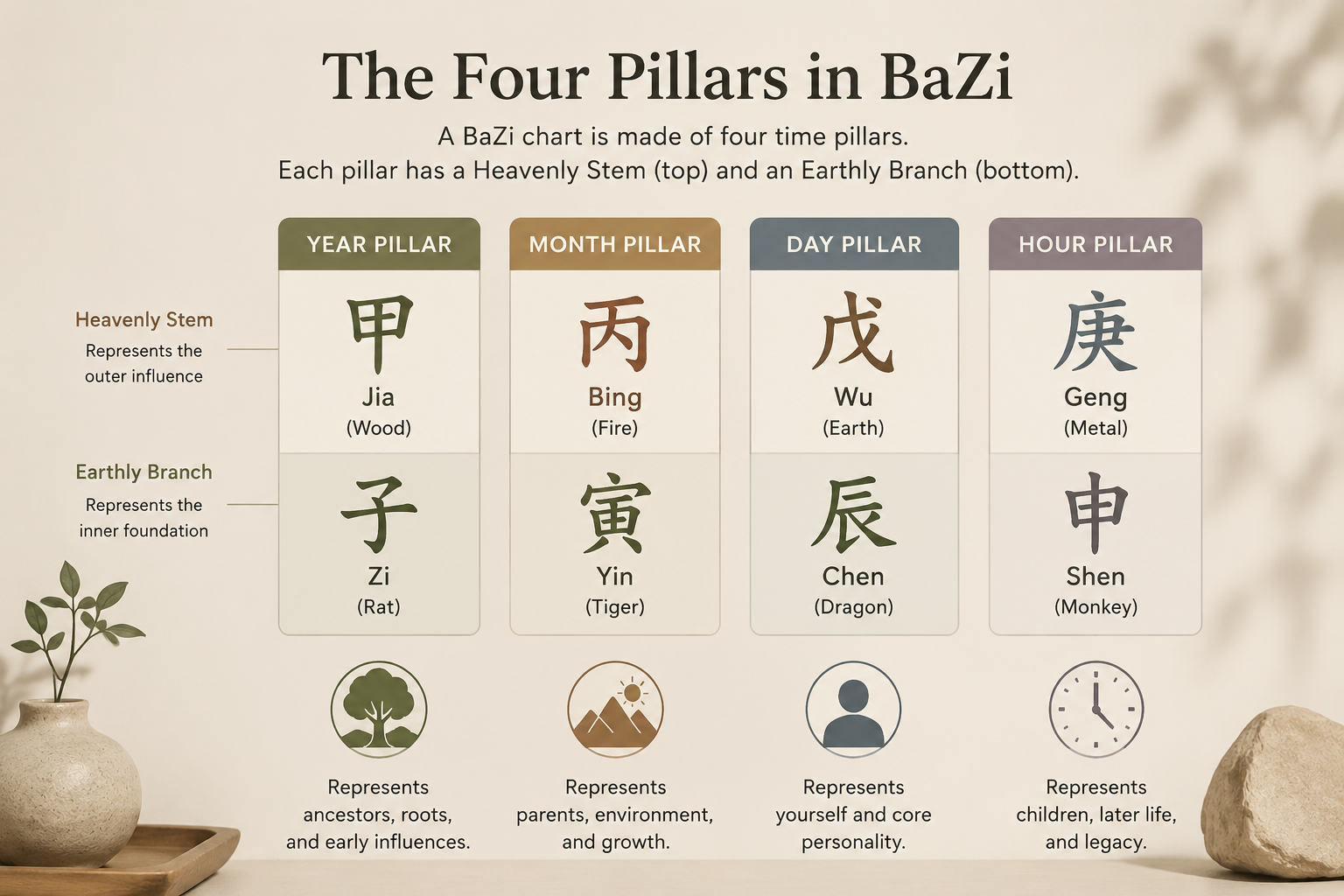
Before diving into the individual pillars, it helps to see the whole. A BaZi chart is arranged into four columns, each with a top character (the Heavenly Stem) and a bottom character (the Earthly Branch). The columns—from left to right—are the Year, Month, Day, and Hour pillars. When you generate your own chart using the Free BaZi chart tool, you will see exactly this layout, with your personal stems and branches filled in.
Understanding the Four Pillars Structure
The Four Pillars are a way of encoding time into qualitative elements. Instead of simply recording a clock reading, BaZi organizes your birth moment into a system of Heavenly Stems (the ten cosmic energies) and Earthly Branches (the twelve terrestrial phases). Each Stem–Branch pair forms a pillar that describes a distinct domain of life. Together, they offer a balanced view: the outer self (Year), the inner emotional climate (Month), the core self (Day), and the private mind (Hour).
The method draws on the principles of the Five Elements—Wood, Fire, Earth, Metal, and Water—and the relationships among them. A pillar is never read in isolation; its meaning emerges from how its elements interact with the others. Throughout this explanation, we will refer back to this web of relationships.
Year Pillar – The Outer Self and Generational Influences
The Year Pillar is the leftmost column in your chart. It is derived from the year of birth according to the Chinese solar calendar. This pillar often points to the environment you were born into, your family background, and the qualities that others notice first—your social facade. It can also reflect the influence of grandparents or ancestors.
In reading practice, the Year Pillar is examined for:
- Outward personality: How you present yourself in larger social contexts.
- Generational patterns: Inherited strengths or challenges passed down through family.
- Early life: The general atmosphere of your childhood years.
For example, a Year Stem that is the same element as your Day Master (your core self character) might suggest that your outward persona aligns closely with your inner nature. A contrasting element could indicate that you wear a mask in public. These are interpretive starting points, not fixed truths; they become meaningful only when checked against your lived experience.
Month Pillar – The Season of Your Inner World
The Month Pillar represents the month of birth, and it is one of the most influential pillars in the chart because it defines the season. Each month in the solar calendar carries a dominant element—spring is Wood, summer is Fire, autumn is Metal, and winter is Water, with Earth connecting the transitions. This pillar reveals your emotional climate, your approach to work, and the values you hold in your career and public roles.
Key aspects of the Month Pillar include:
- Emotional baseline: The mood and inner weather you often return to.
- Career and mission: How you engage with professional life and sense of purpose.
- Relationship to parents: In traditional readings, the Month Pillar is linked to the mother or nurturing figures.
Because of its seasonal strength, the element of the Month Branch heavily influences the entire chart’s balance. If you want to understand why certain Ten Gods appear strongly in your life, check the season: a Fire month will strengthen Fire and Earth elements, while it may weaken Metal or Water. The Month Pillar acts as the thermostat that sets the energetic temperature.
Day Pillar – The Self and the Day Master
The Day Pillar is the central anchor of the entire chart. Its Heavenly Stem is called the Day Master, and it represents you: your core character, your essential strengths, and your way of being in the world. This one character becomes the reference point for interpreting all other stems and branches.
When you begin reading a BaZi chart, you always start with the Day Master. You identify its element (one of the five) and its polarity (Yin or Yang). Then you analyze how the other seven characters relate to it—supporting, controlling, draining, or balancing. This relational analysis is what gives the Day Master its depth.
The Day Pillar also includes the Earthly Branch, which represents your partner or spouse and your intimate relationships. So the Day Pillar covers:
- Core identity: Your fundamental nature, decision-making style, and values.
- Marriage and partnership: The quality you seek and bring into close unions.
- Personal constitution: Resilience, health predispositions (as a cultural observation).
For a detailed understanding, you can explore your Day Master element and its common traits. But remember: the Day Master is only one dot in a larger constellation. Its strength and expression are shaped by the season, the other pillars, and the dynamic flow of the entire chart.
Hour Pillar – The Inner Mind and Later Life
The Hour Pillar is the rightmost column, corresponding to the two-hour interval of birth. This pillar is often the most mysterious because it represents the internal, private realm: your thoughts, dreams, aspirations, and hidden drives. It also points toward later stages of life—legacy, what you create for the future, and your relationship with children.
Readings of the Hour Pillar focus on:
- Inner world: The thoughts and feelings you may not share openly.
- Potential and ambitions: What you aim for, even if not yet realized.
- Later years: How your energy may shift as you age, and what you leave behind.
Because the Hour Pillar can reveal deep-seated patterns, it is sometimes used to reflect latent talents or challenges. A balanced Hour element might indicate a person who can turn inner ideas into tangible results. An extreme element here might suggest intense internal pressure that needs a healthy outlet. As always, these are interpretive lenses, not deterministic labels.
How the Four Pillars Interact
A meaningful reading does not look at pillars in isolation. The method uses several layers of analysis:
- Stem–Branch dynamics within each pillar: The Heavenly Stem and Earthly Branch always have a relationship—they may combine, clash, harm, or support each other. This inner pillar dynamic describes how the external and internal aspects of that life area get along.
- Pillar‑to‑pillar interactions: Characters from different pillars can form special combinations, clashes, or sequences. For example, a Year Branch that combines with a Month Branch might modify the seasonal influence.
- The Ten Gods framework: Once you know your Day Master, each other Stem and Branch is translated into a “god”—like the Direct Resource, Indirect Wealth, Hurting Officer, etc. This reveals a functional, role-based reading of every character. The Ten Gods guide explains these roles in detail.
- The Luck Pillars: Over time, the chart enters different ten‑year cycles called Luck Pillars. These are external influences that interact with the natal Four Pillars to suggest shifting themes. You can read about how Luck Pillars work in our Luck Pillars overview.
By layering these interactions, you build a nuanced picture. A chart is not a static verdict; it is a set of conditions and potentials. The reading path invites you to reflect on how these patterns resonate with your actual life, rather than predict an immutable fate.
Frequently Asked Questions
What does each pillar represent in BaZi?
The Year Pillar relates to outer personality and ancestry; the Month Pillar describes your inner emotional world and career orientation; the Day Pillar holds your core self (Day Master) and partnership; the Hour Pillar reveals your private mind and later-life direction. Each pillar is a composite of a Heavenly Stem and Earthly Branch that carries qualitative meaning within the cultural tradition.
How do I find my Day Master?
Once you enter your birth details into a BaZi calculator—such as the Free BaZi chart tool—the Day Stem of your chart is your Day Master. Its element (Wood, Fire, Earth, Metal, or Water) and polarity (Yin or Yang) become the reference for all further interpretation. You can then explore common traits associated with that Day Master type, while remembering that the full chart context is essential.
Can the Four Pillars predict my future?
No. BaZi is a structured cultural reference system, not a predictive science. The pillars describe relational dynamics and elemental qualities at the moment of birth, which some traditions use to reflect on life themes. Any reading should be taken as one perspective among many, and never as a guarantee of specific events. The method is best used for self‑observation and personal reflection, not for claiming certainty about the future.
Why is the Month Pillar so important?
The Month Pillar sets the seasonal strength of the chart. The dominant element of the birth month heavily influences the balance among all five elements, which in turn affects the strength of the Day Master and the expression of other characters. Many classical commentaries emphasize the Month Branch as a key factor in determining chart structure.
Do the Four Pillars change over time?
The natal Four Pillars remain fixed, but your reading can change when you consider Luck Pillars—ten‑year cycles that overlay new energies onto your chart. Additionally, annual cycles (current year’s stems and branches) interact with the natal pillars, offering another layer of cultural commentary. However, the original birth pillars do not change; they are a constant reference.
Learning to read a BaZi chart begins with understanding the Four Pillars as a time map. When you see the Year, Month, Day, and Hour as distinct voices—outer, inner, self, and hidden—you can start to hear the larger conversation that a chart contains. Use this knowledge as a tool for perspective, not a script for life.
Related reading
Related guide
2027 Love Horoscope as a BaZi Reflection Guide
Use the 2027 Ding Wei Fire Goat year as a structured BaZi reflection tool for relationship insights. Explore how the year’s energies interact with your Day Master, Ten Gods, and personal chart—without predictions, only cultural pattern awareness.
Related guide
Ten Gods in BaZi: What Each One Means in Your Chart
A methodical guide to the Ten Gods in BaZi: how they arise from the Day Master, what each represents, and how to read them in context using the Free BaZi chart tool.
Related guide
BaZi Career and Wealth Reading Boundaries | Free BaZi
Understand how BaZi charts map career and wealth indicators through Ten Gods, Day Master, and Luck Pillars—clear method, cultural reference, and realistic boundaries.