2027 BaZi Forecast: A Cultural Reference Guide
Explore the 2027 BaZi year through the lens of the Ding Wei pillar. A calm, method‑driven guide to reading the Fire Goat year using Day Master, Ten Gods, and Five Elements — with no fortune‑telling.
In the traditional BaZi calendar, 2027 is the year of Ding Wei (丁未), the Fire Goat. This guide offers a structured, method‑first look at the 2027 annual pillar — not as a personal fortune, but as a cultural reference for people who use BaZi as a tool for reflection, habit awareness, or intellectual curiosity. If you already have your own free BaZi chart, you can follow the reading path below and see how the generic year theme interacts with your personal configuration.
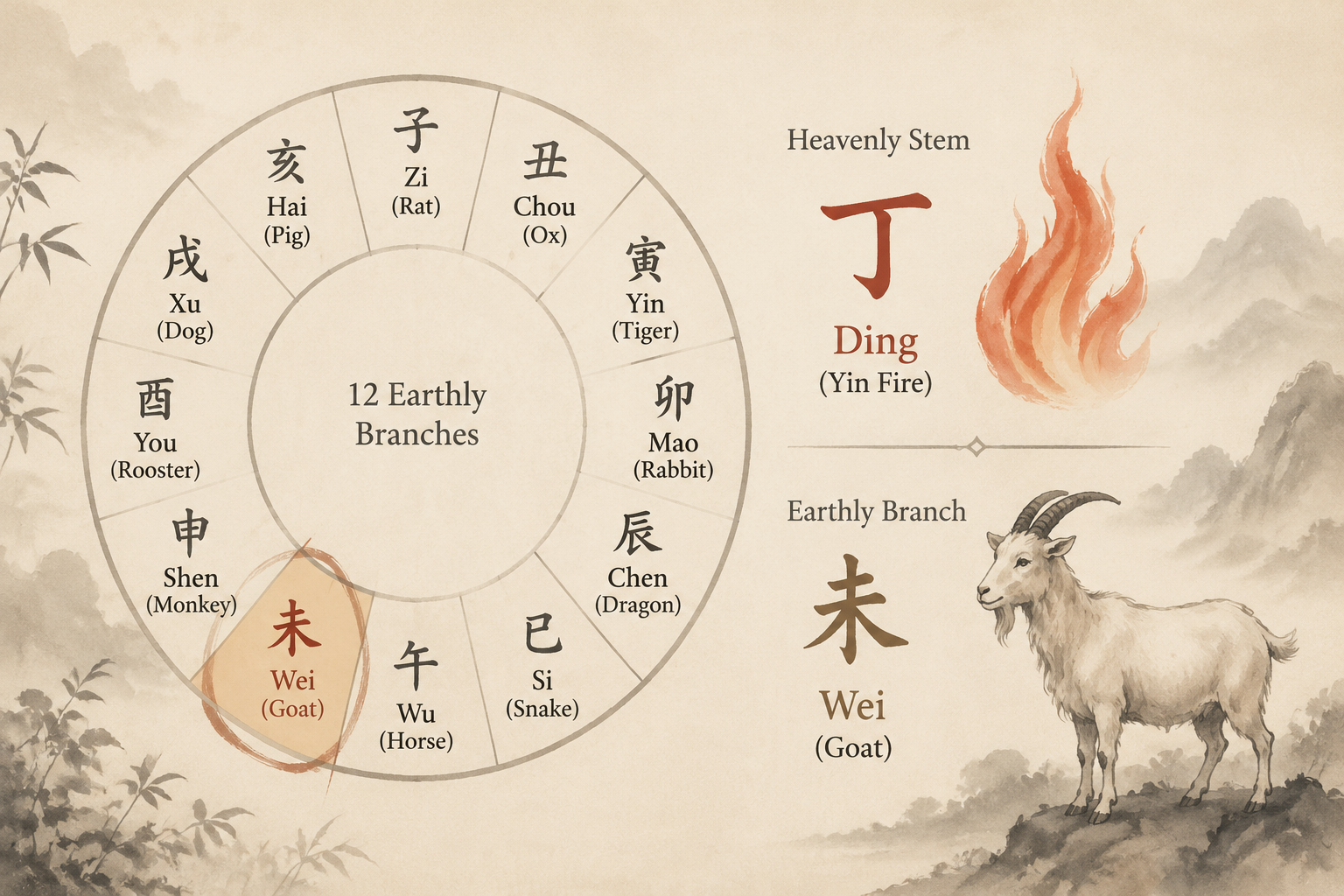
The 2027 Year Pillar: Ding Wei (Fire Goat)
A BaZi year is defined by a Heavenly Stem and an Earthly Branch. In 2027, the stem is Ding 丁 (Yin Fire) and the branch is Wei 未 (Goat). The pillar begins on the 立春 Lìchūn (Start of Spring) solar term, which falls on 3 or 4 February 2027, and runs until the next Lìchūn in early February 2028.
Ding Fire is often described as a candle flame, a hearth fire, or soft sunlight — it illuminates rather than scorches. Wei, the Goat, is a pure Yin Earth branch. Its hidden stems are:
- Ji 己 (Yin Earth) – the dominant qi
- Ding 丁 (Yin Fire)
- Yi 乙 (Yin Wood)
The branch carries a quiet, fertile quality: earth that nourishes, shelters, and sometimes over‑protects. Together, Ding Wei suggests a year where cultivated energy, steady warmth, and subtle refinement are favoured over raw drive. However, any general description is only background colour — the personal chart determines the real texture.
For readers interested in the mechanics, Wei has notable interactions:
- It forms a Six‑Combination with Wu 午 (Horse) to produce Fire.
- It is in a Three‑Harmony Earth frame with Hai 亥 (Pig) and Mao 卯 (Rabbit).
- It is in Clash with Chou 丑 (Ox).
These structural facts become meaningful only when they touch personal pillars or the Luck Pillar.
The Five Elements in 2027
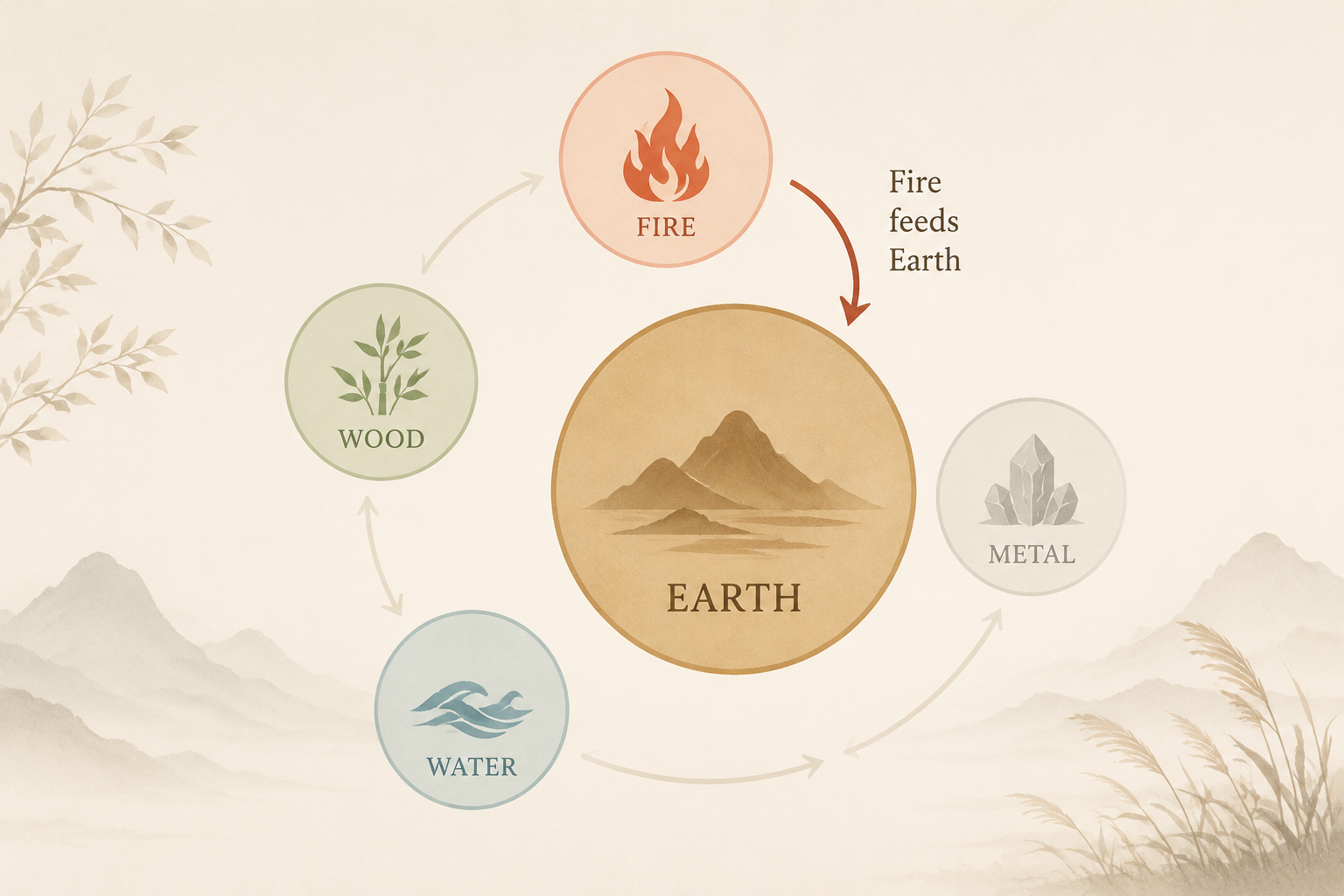
In the Five Elements cycle, Ding Fire sits on top of Wei Earth. Fire is the mother of Earth, so the surface reading is one of generating and nourishing: Fire’s warmth feeds Earth’s productivity. But because Ding is small and Wei is heavy Yin Earth, the imagery is often a lamp resting on a clay table — not a raging bonfire.
The elemental balance in the pillar:
- Fire – present but restrained
- Earth – the strongest note; both the branch and its dominant hidden stem are Earth
- Wood – a hidden shoot (Yi Wood) inside Wei, providing a quiet growth current
- Metal and Water – absent at the surface, so their roles in a personal chart become critical
If your chart lacks Metal or Water, the year’s Earth and Fire will amplify the feeling of groundedness but may also slow momentum. If your chart already holds abundant Earth, the year adds more weight — beneficial or overwhelming, depending on your Day Master’s affinity. Nothing in this is inherently good or bad; it’s simply an invitation to look at your chart’s elemental profile through a single annual filter.
Reading Your BaZi Chart in 2027
The quickest way to contextualise the Ding Wei year is to overlay the Year Pillar onto your personal BaZi chart and check three layers:
- Day Master: which of the Ten Heavenly Stems governs your day pillar?
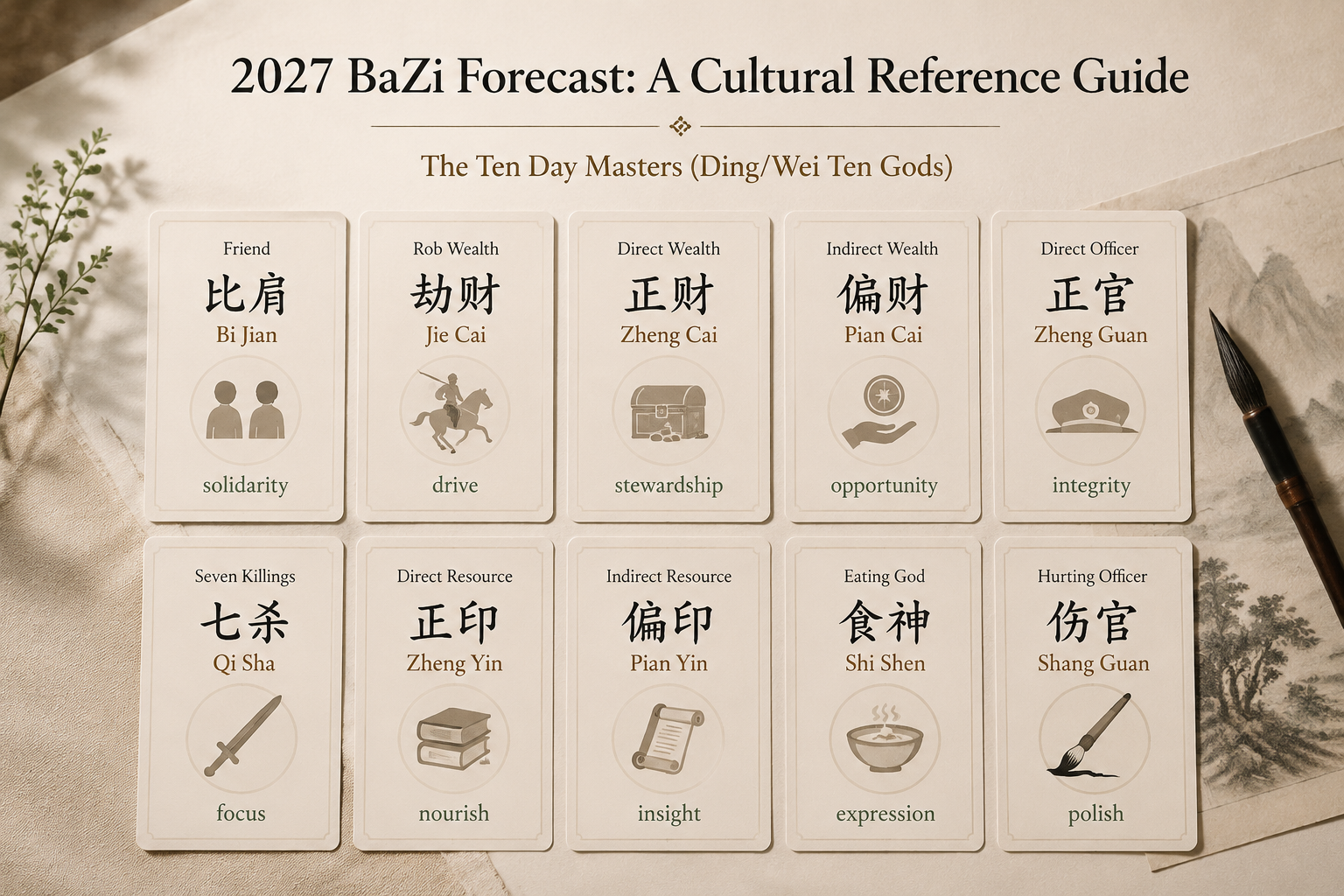
- Ten Gods: what relationship does the annual stem Ding create with your Day Master?
- Branch interactions: does Wei combine, clash, harm, or punish any of your earthly branches (especially the year, month, and day branches)?
You can get your full chart instantly with the Free BaZi chart tool. Once you see the chart, identify your Day Master in the “Day” column.
Day Master Interactions with Ding Wei
Each Day Master experiences the annual stem and branch differently. Below is a cultural reading of those encounters, meant as a starting point for your own observation.
Yang Wood (甲 Jia)
- Ding is the Hurting Officer (Shang Guan) – a star of expression, skill, and restlessness.
- Wei contains Ji (Indirect Wealth), Ding (Hurting Officer), Yi (Companion). The year may highlight creative output, resourceful thinking, and peer dynamics.
Yin Wood (乙 Yi)
- Ding is the Eating God (Shi Shen) – enjoyment, talent, and slow cultivation.
- Wei is Yi’s Burial stage (庫), and the hidden Yi repeats the Day Master. Reflections on self‑worth, nourishment, and practical creativity come into focus.
Yang Fire (丙 Bing)
- Ding is the Rob Wealth (Jie Cai) – shared effort, competitiveness, even visibility through others.
- Wei brings Yin Earth (Hurting Officer) that can moderate the Fire. A year of checking impulses through deliberate craft.
Yin Fire (丁 Ding)
- Ding is the Companion (Bi Jian) – self‑assertion, individuality, or overload.
- Wei is the Day Master’s own storage; the hidden Ding reinforces identity. The tone is quiet self‑definition rather than external change.
Yang Earth (戊 Wu)
- Ding is the Direct Seal (Zheng Yin) – learning, support, introspection.
- Wei is Yang Earth’s tomb, and the hidden Ji is Companion. Intellectual deepening and boundary‑setting often surface.
Yin Earth (己 Ji)
- Ding is the Indirect Seal (Pian Yin) – unconventional ideas, sudden insights.
- Wei is a strong root, since Ji dominates the hidden stems. A year of anchoring imaginative work in daily structure.
Yang Metal (庚 Geng)
- Ding is the Direct Officer (Zheng Guan) – discipline, responsibility, reputation.
- Wei contains Ji (Indirect Seal) and Ding (Direct Officer). Professional refinement and balancing authority with creativity become prominent themes.
Yin Metal (辛 Xin)
- Ding is the 7‑Killings (Qi Sha) – pressure, focus, breakthrough.
- Wei is Yin Metal’s grave; the hidden Ding is the 7‑Killings star itself. The year can feel like a drill — demanding precision and growth.
Yang Water (壬 Ren)
- Ding is the Indirect Wealth (Pian Cai) – opportunity, risk, lateral income.
- Wei contains Ji (Direct Officer) and Ding (Indirect Wealth). A year of managing resources and taking calculated chances.
Yin Water (癸 Gui)
- Ding is the Direct Wealth (Zheng Cai) – steady income, value awareness, practical effort.
- Wei carries Ji (7‑Killings) and Yi (Eating God). The mix often translates into disciplined creativity for material stability.
These Ten God frames do not predict events; they simply describe the archetypal relationship between you and the arriving energy. The actual experience is shaped by your Luck Pillar, the birth season, and the full chart’s balance.
Luck Pillars and the Annual Influence
A BaZi reading always pairs the year with the active 10‑year Luck Pillar (大運). The Luck Pillar colours how you meet the annual energy. For example, if you are in a Luck Pillar dominated by Water, the 2027 Earth may feel like a dam — and whether that means productive focus or frustration depends on your Day Master’s need for Water. If your Luck Pillar already carries strong Earth or Fire, the Ding Wei year amplifies an existing climate.
Without consulting your Luck Pillar, the annual reading remains generic and incomplete. The Free BaZi chart automatically displays your current pillar; you can find it beneath the natal stems and branches. A careful observer looks at the interaction between the luck stem/branch and the year stem/branch as an additional layer.
Practical Tips for Using the 2027 Cultural Reference
- Start with your chart: generate it on Free BaZi, then note the Day Master and the four earthly branches.
- Check for direct contacts: if your chart contains Chou 丑 (Ox), note the Wei‑Chou clash; if it has Wu 午 (Horse), Wei‑Wu may combine. These contacts highlight areas of heightened activity, not disaster.
- Use the Ten Gods as a lens: think, “When Ding Fire arrives as my Hurting Officer, what do I normally do when I feel creatively restless?” The framework is observational, not deterministic.
- Keep a light journal: many BaZi enthusiasts simply note which Ten God themes feel relevant each month; over time, patterns appear without magic thinking.
Frequently Asked Questions
Does the 2027 BaZi forecast affect everyone the same way?
No. The year pillar is a universal background; your personal chart turns that background into a unique experience. Two people born on different days will meet Ding Wei through different Ten Gods and branch contacts.
When does the Fire Goat year start?
In traditional BaZi, the year begins at the Lìchūn solar term, which occurs around 3‑4 February 2027. This differs from the Chinese Lunar New Year, which often falls earlier.
Can I use my Day Master alone to understand 2027?
The Day Master is the starting point, but a meaningful reading also considers the Earthly Branches, the Luck Pillar, and the strength of the elements in your chart. A heavy‑Earth Day Master responds differently to a Wei year than a thin‑Earth Day Master.
What if my chart has a lot of Earth already?
The Ding Wei pillar adds Earth. Whether that feels supportive or overwhelming depends on your Day Master’s relationship to Earth. For Yin Fire (Ding) or Yin Water (Gui), that extra Earth may bring grounding; for Yang Wood (Jia), it might feel like resistance. The tool is meant to ask questions, not give final answers.
Is the BaZi year the same as the zodiac animal year?
In daily public culture, 2027 is the Year of the Goat. BaZi uses the same animal (Wei), but it adds the Heavenly Stem and treats the pillar as a technical unit rather than a personality label. The Goat traits in popular zodiac are not part of a BaZi reading unless you intentionally import them as an extra layer.
Continue Your Reading
If you’d like to explore how the Ding Wei pillar lands on your personal chart, create your free BaZi chart. For deeper looks at the ideas mentioned here, see:
These guides follow the same restraint and curiosity that inform this 2027 reference — built not to predict the future, but to offer a clearer way to see the present.