How to Compare Two BaZi Charts Without Overreading the Result
How to compare two BaZi charts systematically without overreading. Our method uses Day Master, Five Elements, Ten Gods, and Luck Pillars for a balanced cultural reading.
Comparing two BaZi charts can be a natural next step after you’ve started using the Free BaZi chart tool. Whether you’re curious about a friendship, a working relationship, or any kind of interpersonal dynamic, placing two charts side by side often feels like discovering a hidden layer of meaning. But the moment you start drawing conclusions — "this pairing will never work" or "this is a perfect match" — you’ve already strayed from what a structured BaZi reading can usefully offer.
This article outlines a restrained method for bazi chart comparison. It is built around the cultural concepts of Day Master, Five Elements, Ten Gods, and Luck Pillars, and it prioritises clarity over drama. By the end, you’ll have a repeatable sequence that helps you notice patterns without turning them into fixed prophecies.
The Purpose of Chart Comparison in BaZi
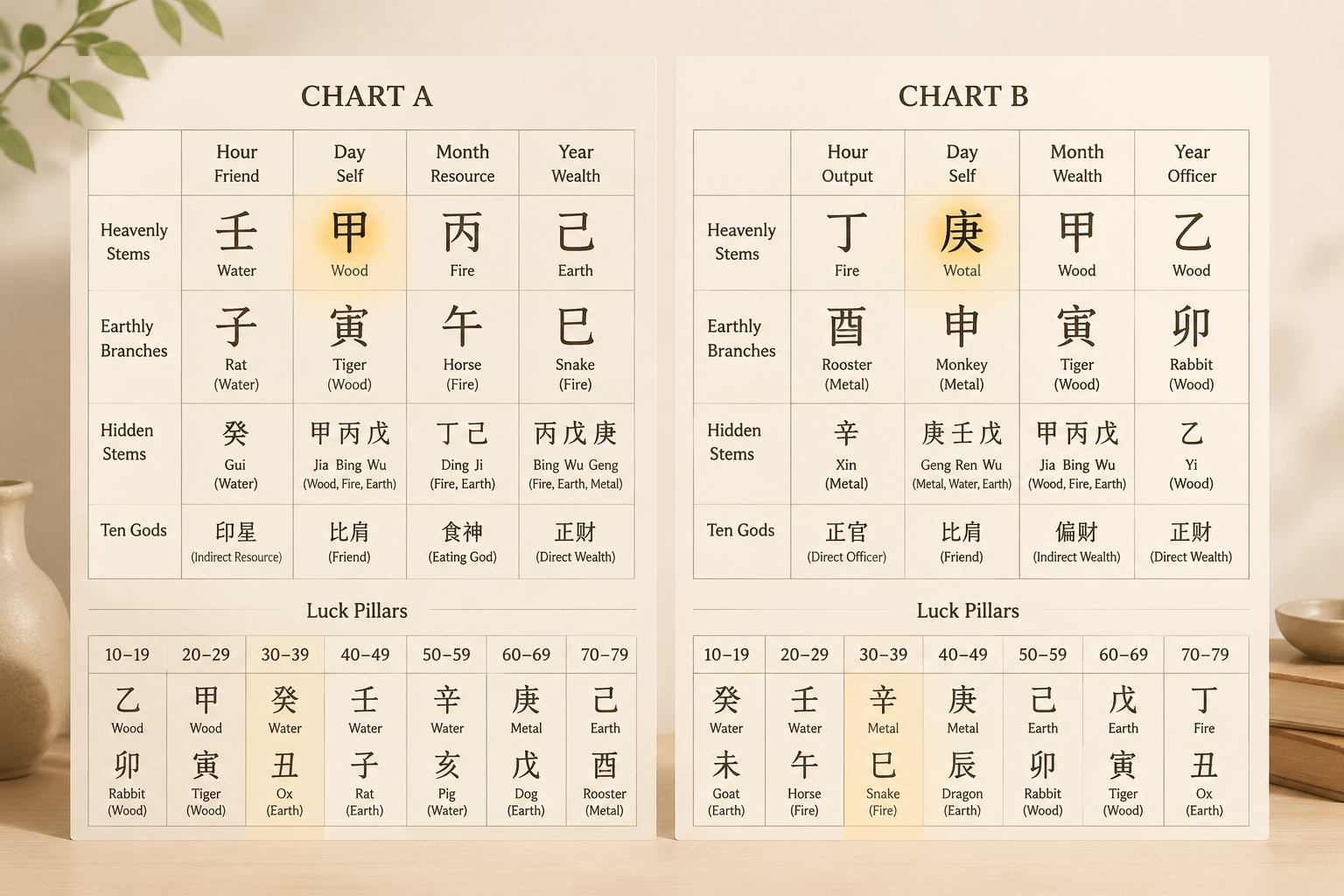
BaZi, often called the Four Pillars of Destiny, is a structured reading system rooted in Chinese metaphysics. It maps a person’s birth year, month, day, and hour into Heavenly Stems and Earthly Branches, and from those derive the Day Master, the Five Element balance, and the Ten Gods. The system is descriptive, not prescriptive.
When you compare two charts, you aren’t searching for a cosmic verdict. You’re looking for tendencies that can help both individuals understand how their natural energies interact. Perhaps you notice that one person’s chart is heavy with Metal while the other’s is dominated by Wood — that can point to a dynamic where one often takes the lead and the other may feel pushed. Used lightly, that insight opens a conversation; used rigidly, it becomes an accusation.
The goal of chart comparison, as we frame it at Free BaZi, is to expand your reading vocabulary, not to make binary decisions.
What the Charts Tell You — and What They Don’t
A BaZi chart is a snapshot of celestial influences at the moment of birth. Through the Day Master, you see the person’s core elemental self. The Five Elements distribution suggests natural strengths and tensions. The Ten Gods reveal relationships like Resource (support), Officer (discipline), or Output (expression). Luck Pillars add a time dimension, showing the shifting backdrop over 10‑year phases.
What the charts tell you: thematic tendencies, potential resonances or frictions between someone’s core element and another’s, and periods when both people might experience parallel pressures or supportive flows.
What the charts cannot tell you: whether two people will stay together, trust each other, or achieve joint success. Human connection depends on communication, values, shared history, and countless other factors outside the chart. A BaZi comparison can be a reflective mirror, not a crystal ball.
A Step‑by‑Step Method for Bazi Chart Comparison
The following six steps create a boundary for a careful reading. Move through them in order, and pause if you find yourself reaching for interpretations that go far beyond what’s visible.
1. Lay Out Both Charts Side by Side
Generate both charts using the Free BaZi tool. Look at the full structure—Heavenly Stems in the top row, Earthly Branches in the bottom row, and any hidden stems. Resist the urge to zoom into just one pillar. The overall composition matters.
2. Identify the Day Masters First
The Day Master is the central reference point. Compare the two Day Master elements using the Five Element cycles:
- Production (feeding): e.g., Wood feeds Fire, Fire feeds Earth. A producing relationship often feels supportive.
- Control (restraining): e.g., Metal controls Wood, Water controls Fire. This can manifest as a mentoring or challenging dynamic.
- Same element: two people share a core elemental quality, which can feel familiar or competitive depending on the whole chart.
Avoid layering too much meaning on this single observation. A Metal Day Master and a Wood Day Master don’t automatically signal conflict; they indicate a tendency toward a particular energetic exchange.
3. Compare Element Balance and Structure
Go beyond the Day Master and examine the five elements across each chart. Is one chart mostly Fire and Earth while the other is mostly Water and Metal? Where one chart has a missing element, the other may supply it. That can create a sense of complementarity, but it’s a tendency, not a guarantee of harmony.
Also note the overall structure: a very strong element can dominate, while a weak element may struggle to assert itself. If both charts show extremes, the interaction might amplify those dynamics, but again, the reading stays at the level of “interesting to notice.”
4. Examine the Ten Gods Interactions
Ten Gods are defined relative to the Day Master, so comparing them directly between charts isn’t like lining up two columns. However, you can observe the general Ten God “climate” of each chart.
For example, one chart may have many Resource stars, suggesting a reflective, knowledge-absorbing style. The other may have prominent Output stars, indicating expressiveness. The combination often highlights a potential exchange: one person provides stability while the other brings fresh ideas. But framing those observations as “you are the Resource type” can easily become reductive. Use the Ten Gods to enrich your understanding of possible communication styles, not to label personalities.
5. Check Luck Pillar Overlaps (Current Phases)
Each person moves through 10‑year Luck Pillars. Look at which pillar both are in now. If one is in a pillar that clashes with their own Day Master (an intense, changeable period) and the other is in a stable, harmonious pillar, their inner rhythms may be out of sync for a while. That isn’t a crisis; it’s a rhythm mismatch you can note and move on from.
If both are in pillars that support their Day Master, you might observe a period when both feel strengthened, which can make the relationship feel smoother. Keep the observation simple.
6. Look for Complementary or Clashing Patterns — and Know When to Stop
After the first five steps, you’ll have a short list of patterns: the Day Master relationship, element interplay, Ten God themes, and current Luck Pillar timing. That’s usually enough. If you find yourself digging into hidden stems, earthly branch combinations, or hypothetical future phases just to “prove” something, you’re overreading.
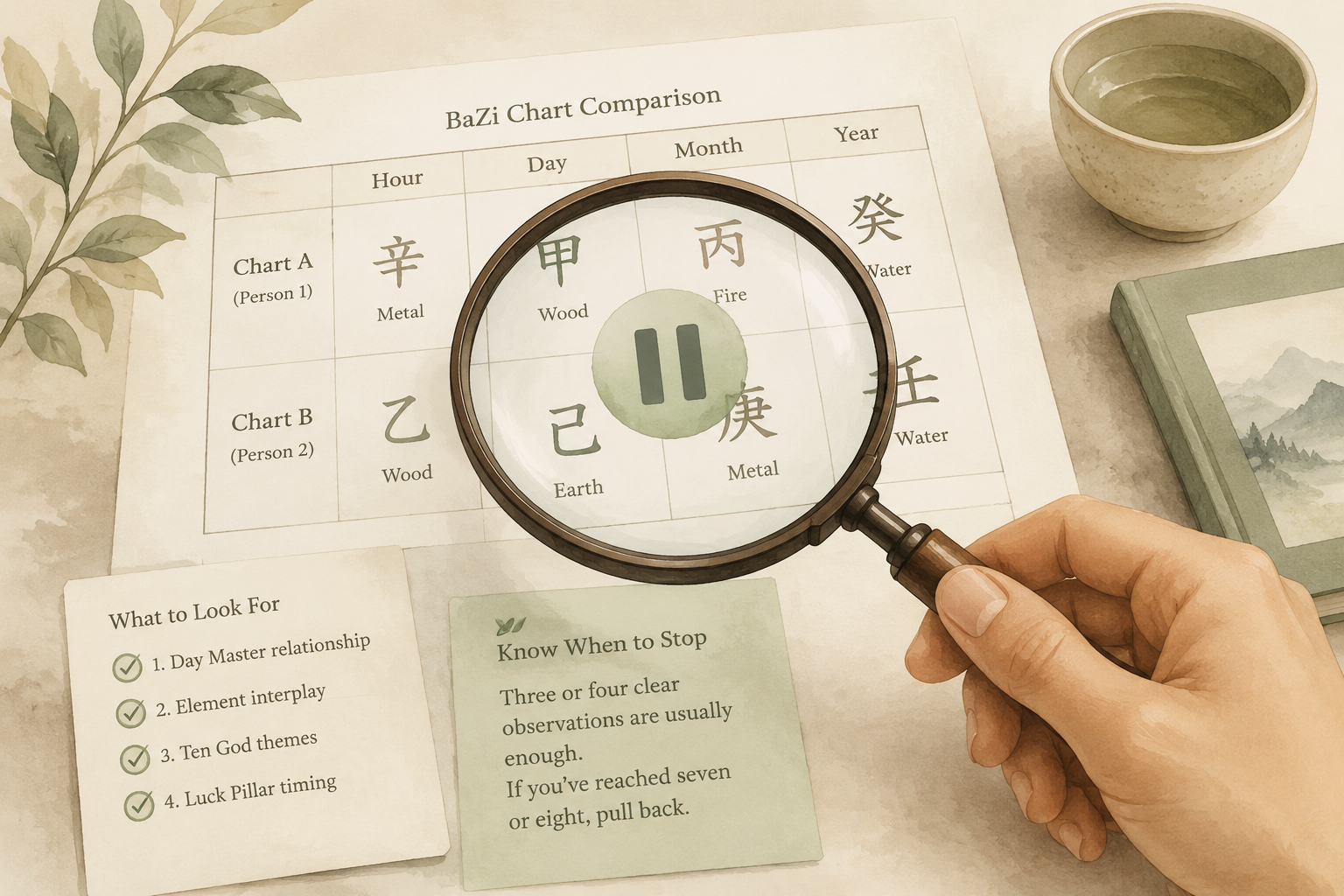
A healthy chart comparison yields maybe three or four modest observations. If you’ve reached seven or eight, pull back.
Common Traps That Lead to Overreading
Even with a method, certain mental habits can push a reading into overstatement. Watch out for these:
- Focusing on a single clash. A clash between two Earthly Branches can feel dramatic, but a clash in BaZi indicates friction, not disaster. Life is full of friction.
- Ignoring the fluidity of real relationships. The charts are static, but people grow and adapt. A difficult elemental pairing can be managed with awareness.
- Assuming complementary elements guarantee ease. A “production” relationship can sometimes feel smothering, not supportive. A “control” relationship can be growth‑oriented. Context matters.
- Treating BaZi as deterministic rather than descriptive. Every chart shows a weather pattern, not a fixed destiny. Comparison is a tool for reflection, not a rulebook.
When in doubt, return to the Day Master and the biggest elemental picture. Simplify, don’t amplify.
A Calibrated Example: Two Chart Walkthrough
Imagine you have two charts open:
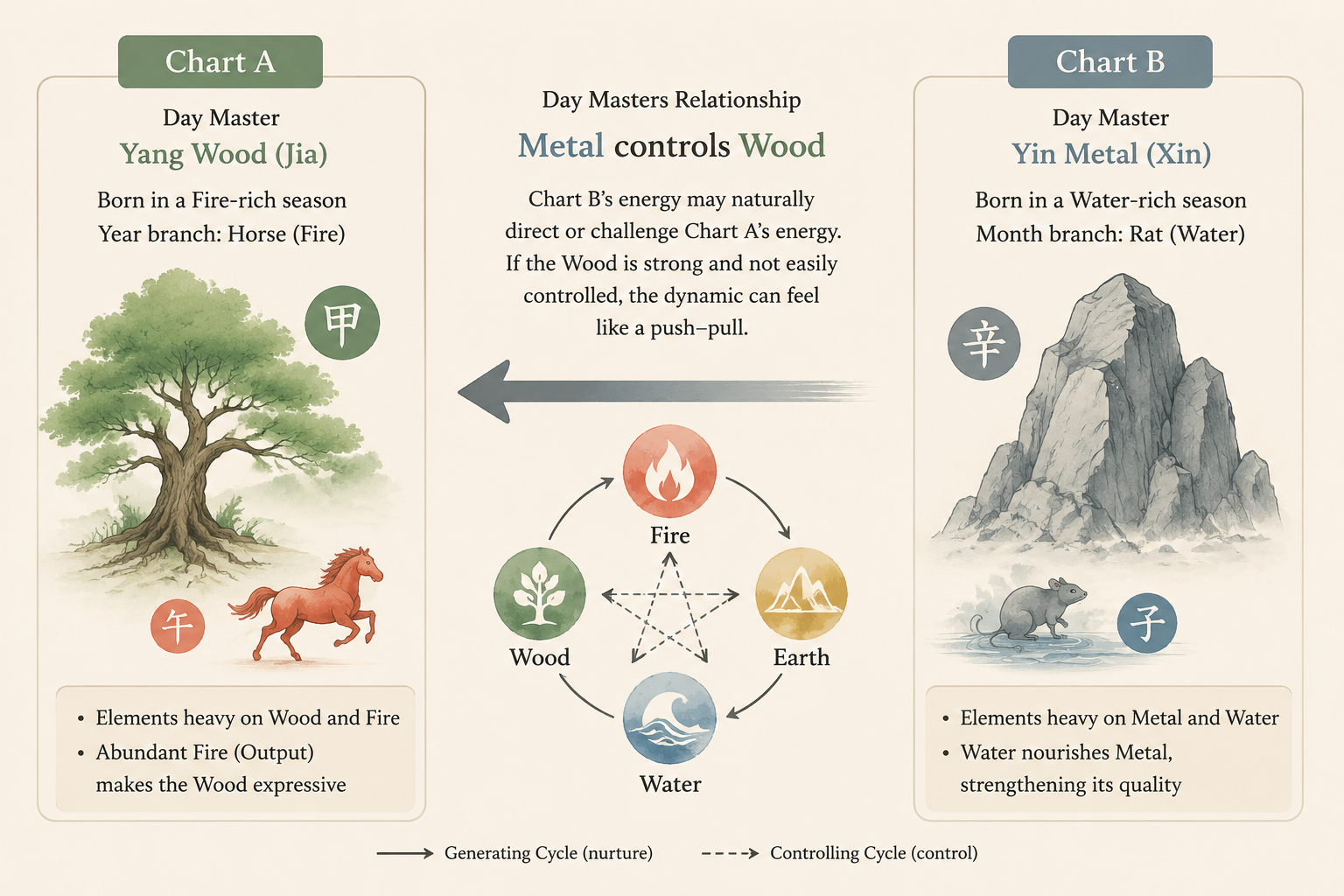
- Chart A: Day Master Yang Wood (Jia), born in a Fire‑rich season, with the Horse branch (Fire) in the year pillar. Elements are heavy on Wood and Fire.
- Chart B: Day Master Yin Metal (Xin) , born in a Water‑rich season, with the Rat branch (Water) in the month. Elements are heavy on Metal and Water.
Step‑by‑step:
- Day Masters: Wood (Jia) and Metal (Xin) sit in a control relationship; Metal controls Wood. In everyday terms, Chart B’s energy may naturally direct or challenge Chart A’s energy. If the Wood is strong and not easily controlled, the dynamic can feel like a push‑pull.
- Element balance: Chart A has abundant Fire (Output), making the Wood expressive and active. Chart B has abundant Water (Resource), giving the Metal a reflective, nourishing backdrop. Water actually supports Wood, so there’s an indirect supportive current—Water feeds Wood, even though the primary Day Master relationship is control.
- Ten Gods flavour: Chart A is full of Output stars, so it tends toward creativity and communication. Chart B features Resource stars, so it tends toward thoughtfulness and structure. This pairing often looks like a lively speaker with a careful listener; it can work well if both honour each other’s tempo.
- Luck Pillars: Suppose Chart A has just entered a 10‑year pillar of Wood (self‑strengthening) while Chart B is deep in a Metal pillar (self‑power). Both are in strengthening phases—they may be focused on their own development. Patience might be needed because neither is naturally yielding at this time.
From these four observations, you might reflect: “There is a natural tension between a directing influence and a strong, creative force. Yet there’s also hidden support through Water. Right now, both are in self‑building cycles, which can create a bit of distance. The comparison doesn’t say ‘workable’ or ‘unworkable’—it just highlights areas to pay attention to.”
That’s a restrained reading. It doesn’t overpromise, and it leaves room for the actual people to fill in the blanks.
FAQ
Can BaZi chart comparison predict relationship success?
No. A BaZi comparison highlights energetic tendencies and possible friction or harmony points. Real‑world relationship success depends on communication, shared values, and effort.
What is the most important factor when comparing two charts?
The Day Master relationship and the overall Five Element balance give the clearest signal. After that, the Ten Gods and Luck Pillar timing can add useful shading. But the simplest reading is usually the most reliable.
How many parameters should I consider before overreading?
If you’ve examined more than five or six distinct aspects and still feel the need to dig deeper, you’re likely overreading. A healthy comparison arrives at a small handful of observations.
Is my BaZi chart doomed if it clashes with my partner’s?
Not at all. Clashes in BaZi indicate dynamic tension—something that can be understood and navigated. Many effective partnerships contain clashes that become productive forces once both people are aware of them.
Can I compare my chart with a business partner’s chart?
Yes, using the same method. Focus on complementary skills (e.g., one chart strong in Resource, the other strong in Output), potential stress points (Day Master control relationships), and whether current Luck Pillars support cooperation or individual growth.
A Sane Approach to Using BaZi Comparison
A BaZi chart comparison works best when it stays light and curious. It can help you notice why certain dynamics feel a certain way, but it doesn’t hold the final word. The next time you’re tempted to overread, remember the method: lay out the charts, note a few observations, and then let the real conversation begin.
Ready to apply these steps? Open the Free BaZi tool, generate the charts you want to compare, and walk through each point above at your own pace.