2027 Feng Shui Forecast: Scope and Cultural Context
Understand what a 2027 Feng Shui forecast is, its cultural roots, and how Flying Stars, annual afflictions, and the Fire Goat year shape a tradition of spatial tuning—not a guarantee of luck.
Every winter, as the lunar calendar turns, a quiet tradition unfolds across Chinese‑speaking households and even in Western design circles: the publication of the annual Feng Shui forecast. For the year 2027—the Ding Wei year, also known as the Fire Goat—the charts, numbers, and directions will once again suggest where to place a metal object, which corner needs a little quiet, and which entrance might welcome warmer currents. But what is a Feng Shui forecast, really? How should a modern reader approach it, and what separates a thoughtful cultural practice from a promise of guaranteed luck?
This article unpacks the scope of a 2027 Feng Shui forecast. It explains the classical frameworks, the limits of what a spatial energy map can offer, and the way Feng Shui can complement a personal BaZi chart rather than replace careful, everyday decisions.
What Is a Feng Shui Forecast?
A Feng Shui forecast is an annual spatial assessment rooted in the Chinese calendar cycles. Unlike a personal fortune‑telling session, it does not read an individual’s destiny. Instead, it maps the changing energy signature of time onto physical space—your home, office, or even a single room—using timeless formulas such as the Flying Stars (Xuan Kong Fei Xing) and the 24 Mountains.
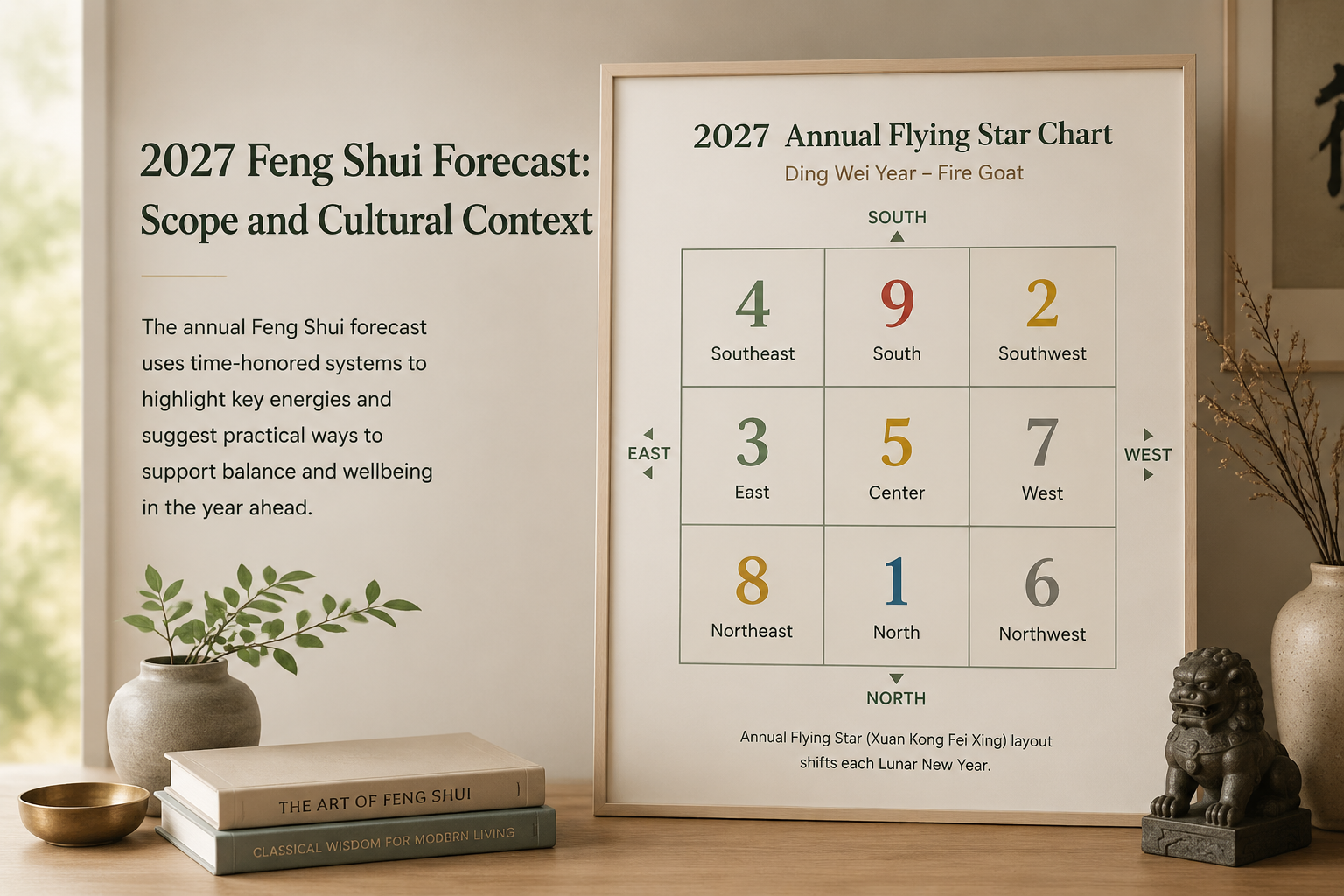
For 2027, the central forecast will assign each of the eight compass directions (plus the center) a combination of a “star number,” an element, and a set of influences. For example, the annual Flying Star 5, often associated with obstacles when unchecked, will move to a specific sector, while the 8 Star of prosperity settles into another. The idea is not that a room suddenly becomes dangerous or magical; rather, the annual chart invites a conversation between your environment and the temporary energy template of the year.
It helps to think of a Feng Shui forecast as a seasonal almanac for space—comparable in cultural spirit to a farmer’s guide knowing when the soil shifts or a sailor noting the trade winds. The advice is preventive and tuning‑based: soften a sharp corner, use a color to harmonize an element, keep a certain area quieter during construction months. None of it demands belief in supernatural forces; it is an applied cultural system that encodes centuries of observation about human comfort, orientation, and the rhythms of nature.
The Cultural Roots of Feng Shui Forecasting
Feng Shui, literally “wind and water,” is not a monolithic system but a lineage of site‑reading practices developed over more than two thousand years. Annual forecasting as we see it today draws primarily from the Compass School (Liqi Pai), which integrates the Chinese lunisolar calendar, the Five Elements (Wu Xing), and the trigrams of the I Ching. The role of time was always present—dynasties moved capitals based on cosmic cycles—but the popularization of annual home‑level forecasts is relatively modern, accelerated by almanacs like the Tong Shu (通書) and, more recently, by digital media.
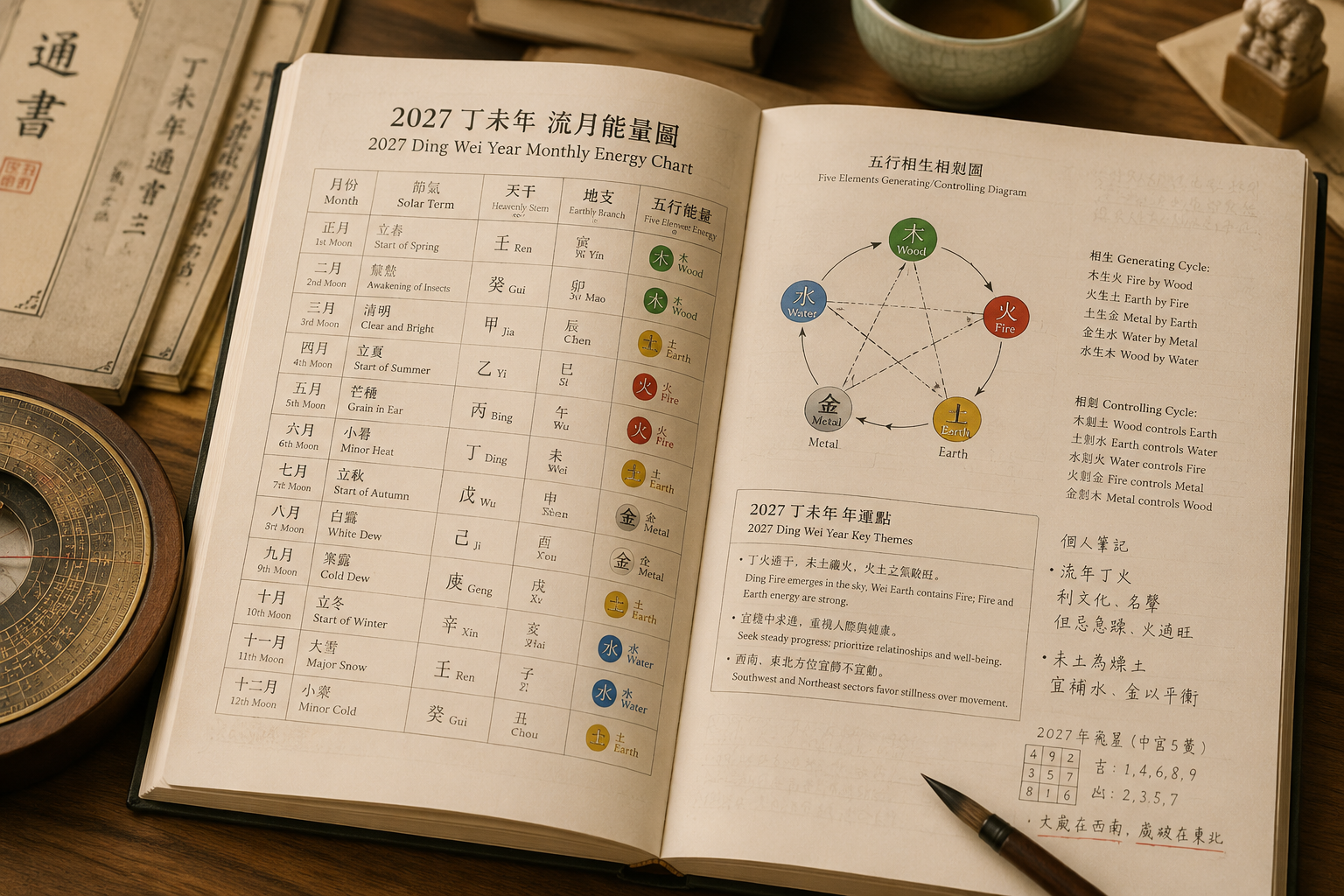
The Ding Wei (Fire Goat) year of 2027 sits within the 60‑year sexagenary cycle. The Heavenly Stem Ding is Yin Fire, like a candle flame, while the Earthly Branch Wei is the Goat, carrying the hidden stems of Yin Earth, Yin Wood, and Yin Fire. In classical Feng Shui, the Stem‑Branch pair influences not only the annual Flying Star center but also the tone of the year: Fire over Earth suggests a need for grounding—a year where nourishment and stability matter more than flashy activation. Forecasts often emphasize managing fire‑related sectors and reinforcing earth‑strengthening adjustments, all within the context of an impersonal, calendric rhythm.
This is not fortune‑telling; it is a context. Just as a Buddhist monastery arranges its calendar around the seasons, a Feng Shui forecast offers a template for timed adjustments. The moment we mistake it for a personal promise, we step outside the cultural system’s intended use.
Key Components of a 2027 Feng Shui Forecast
When a practitioner or an online tool publishes a “2027 Feng Shui forecast,” what exactly is inside? Typically, you’ll see several layers, each with its own logic page.
The Annual Flying Stars
The heart of the forecast is the annual Flying Star chart—a 3×3 grid mapping the Luo Shu numbers onto the eight directions. In 2027, the central palace will host Star 2 (Earth), a number often linked to health and relationship care, while other stars rotate around it. A forecast will describe the character of each sector, for instance:
- Northwest: Star 3 (Wood) may bring vitality but also argumentative energy if left unbalanced. A small amount of red or fire element is often suggested to temper excess Wood.
- Southeast: Star 7 (Metal) might indicate a risk of conflict or theft chi. Traditional advice often recommends a quiet, still usage of that area rather than loud, active functions.
- South: Star 8 (Earth), the current prosperity star, could be used for a home office or a main living space, with gentle activation through earth tones or stable shapes.
These descriptions are not deterministic. They are a framework. The advice “place a metal object in the northwest” is not a magic talisman; it is an elemental adjustment—a way to dialogue with the symbolic language of the system. A Day Master reading from your personal BaZi chart might add nuance, showing whether Metal itself is favorable for you in 2027.
The Three Killings and the Grand Duke
Beyond the Flying Stars, a Feng Shui forecast includes annual directional afflictions. The Tai Sui (Grand Duke Jupiter) sits at 15° Wei (the Goat’s mountain, roughly Southwest‑by‑West) in 2027, and tradition advises not to face it directly during long periods of work nor to disturb the ground there with renovations. The Three Killings (San Sha) will likely occupy the South, given the formula that ties it to the Earthly Branch. The Year Breaker (Sui Po) opposes Tai Sui, landing in the Ox direction (Northeast‑by‑North).
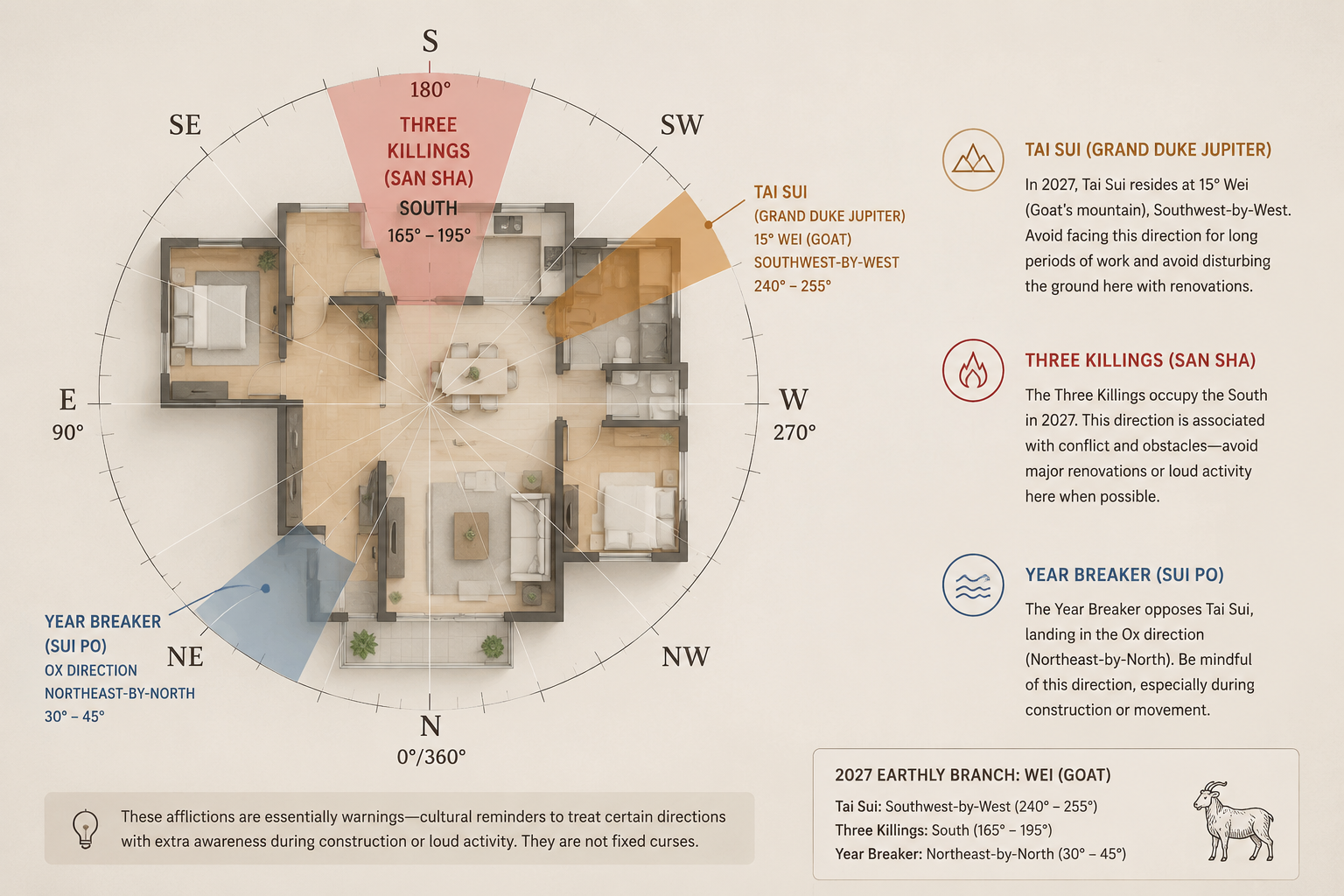
These afflictions are essentially warnings—cultural reminders to treat certain directions with extra awareness during construction or loud activity. They are not fixed curses; they represent areas where the annual chi is considered unstable. For a household with an unavoidable renovation in the South in 2027, a practitioner might suggest selecting auspicious dates through a Huangli calendar to time the work respectfully.
Sector‑by‑Sector Adjustments
Most forecasts will provide a practical table: direction, star combination, element, recommended colors, objects to add or avoid. These adjustments range from simple decor changes (add a ceramic object in the center to steady the earth chi) to lifestyle tips (use the East with its 9 Fire star for morning reading, as Fire supports illumination and mental clarity). The advice is intended to be light, seasonal, and reversible. It does not require a full‑scale renovation; a carefully placed crystal, a change in lighting temperature, or even just being mindful of clutter in a particular corner counts as engaging the forecast.
How Feng Shui Complements BaZi and Other Chinese Metaphysics
Confusing Feng Shui with personal destiny analysis is a common misstep. BaZi (Four Pillars of Destiny) and Feng Shui are sister systems within Chinese metaphysics, but they answer different questions. BaZi reads a person’s birth chart to describe their elemental makeup, innate capacities, and timing cycles (the Luck Pillars and annual influences via the Day Master). Feng Shui reads the environment to harmonize with a given time slice. Neither replaces the other.
For 2027, a person with a strong Yang Wood Day Master might find that the Fire Goat year brings creative expression, but also potential burnout. While the BaZi will advise on career pacing and relationship timing, the Feng Shui forecast adds a spatial layer: perhaps the wealth‑related star (8) drops into a sector that already contains a personal auspicious direction from the individual’s Ming Gua. When the two maps overlay, the advice becomes more concrete: use this desk orientation, activate this corner with a small water feature, sleep with your head toward a certain direction. This synergy is why many Chinese families consult both their BaZi chart and the annual Feng Shui forecast at the start of a new year.
The key is to keep expectations grounded. A 2027 Feng Shui forecast is not going to “make you rich” or “protect you from all illness.” It can, however, nudge your spatial habits in a direction that aligns with a thoughtful, culturally rich way of engaging the calendar. In that sense, it functions much like the Japanese practice of seasonal cleaning or the Ayurvedic adjustment of diet with the seasons—an intentional, rhythmic dialogue with time and space.
How to Read a 2027 Feng Shui Forecast Responsibly
Given the popularity of clickbait‑style “lucky corner” posts, a responsible reader benefits from a few filters.
- Prioritize source transparency. A good forecast will explain which school of Feng Shui it uses (Flying Stars, Eight Mansions, etc.), not just drop a list of “cures.” It will clarify that the advice is symbolic and environmental, not personal‑destiny‑altering.
- Separate spatial advice from life‑event promises. If a forecast says “Hang a wind chime to activate romance in 2027,” read it as “The southeast sector is influenced by a combination that symbolically relates to communication and connection; gentle sound may remind you to pay attention to relationships.” The mechanism is about attention and atmosphere, not supernatural intervention.
- Use it alongside your personal chart. Your own BaZi will tell you whether the year’s Wood or Fire energy is helpful or challenging on a personal level. A tailored approach might lead you to place more emphasis on the sector that aligns with your favorable element. For example, if Water is your Useful God, you might focus on the North sector where the annual Star 1 (Water) settles in 2027. That is the art of merging personal and environmental timing.
- Keep adjustments light. The best Feng Shui adjustments are subtle—a color accent, a rearrangement of furniture, a temporary screen. If a recommendation feels drastic or fear‑based, it’s likely a misreading of the cultural intent.
If you’re new to these systems, beginning with your own BaZi Day Master is an excellent first step. Knowing your elemental personality gives you a stable anchor before you layer on the seasonal shifts.
FAQ
What is a Feng Shui forecast, and is it the same as a personal horoscope?
No. A Feng Shui forecast maps annual energy in physical directions, offering spatial advice for homes and offices. A personal horoscope or BaZi chart reads individual destiny from birth data. They are complementary but distinct.
Does the 2027 Fire Goat year mean fire energy will be stronger everywhere?
Not exactly. The Heavenly Stem Ding Fire influences the year’s character, but the actual energy in a given room comes from the interaction of annual stars, the building’s permanent chart, and the surrounding landform. A Feng Shui forecast translates this into directional recommendations—not a simple blanket of “fire.”
Can I ignore the annual afflictions if I don’t believe in them?
From a cultural tradition standpoint, the afflictions are reminders to treat certain directions with care during risky activities like construction. Many families observe them as a matter of custom. Whether you believe in qi, the practice often aligns with common‑sense safety: don’t disturb earth under unstable conditions, and keep high‑activity areas clear.
How can I combine my BaZi chart with the 2027 Feng Shui forecast?
Start by identifying your Day Master and favorable elements. Then, look at the 2027 Flying Star chart: place yourself in sectors where the star element supports your Useful God, or use personal auspicious directions from your Eight Mansions profile. Our free BaZi chart tool can help you get your elemental map quickly.
Is the 2027 Feng Shui forecast only for Chinese culture?
The system originated in China but is now used globally. Its principles of aligning human activity with natural cycles are universal in spirit, though the language is culturally specific. Respectful engagement means learning the framework, not cherry‑picking symbols.
If you’d like to see how the year’s elemental rhythm interacts with your own chart, try our **free BaZi calculator today**—it takes less than a minute to reveal your Day Master, element distribution, and current Luck Pillar. From there, you can layer on a 2027 spatial plan with a clear, personal foundation.