2027 Liunian (Annual Pillar): How to Read the Ding Wei Year in Your BaZi Chart
The 2027 annual pillar (Liunian) is the Ding Wei year in BaZi. Learn what it means, how to compare it with your Day Master and natal pillars, and how to read it with Free BaZi tools.
If you have seen a BaZi chart, you know that a person's birth time can be organized into four pillars: year, month, day, and hour. Each pillar carries one Heavenly Stem and one Earthly Branch. In 2027, the Chinese calendar year pillar is Ding Wei (丁未). In BaZi reading, that year pillar is often called 2027 八字流年. The phrase can sound like a prediction, but in a structured BaZi method it is better understood as a reading path: a set of symbolic relationships that can be compared with your natal chart. This guide explains the method, gives you a step-by-step way to read the 2027 year for your own chart, and keeps the whole process transparent and non-deterministic.
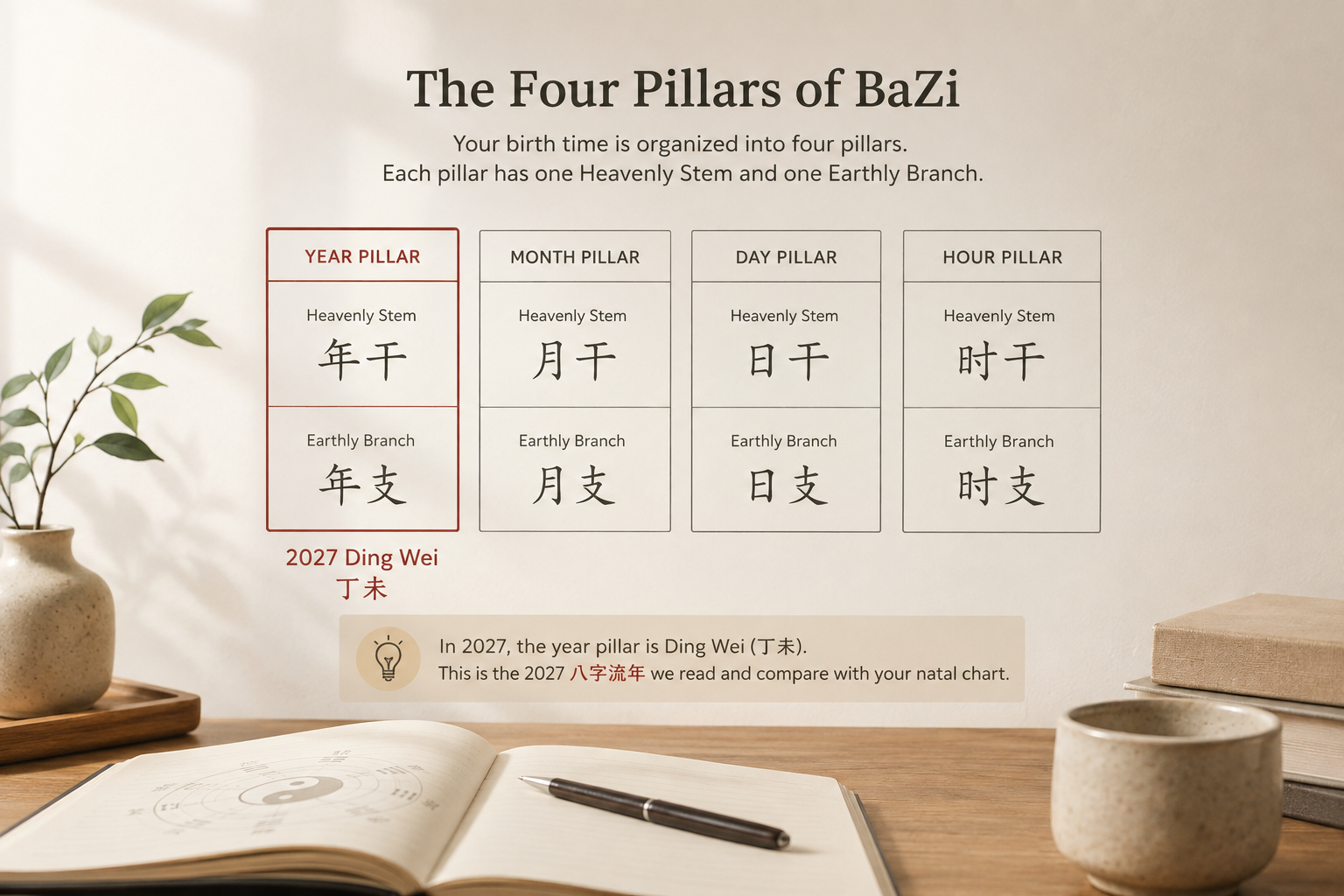
What Does 2027 八字流年 Mean in BaZi?
The term 流年 means "flowing year." In BaZi, it is the pillar that governs the current year in the Chinese solar calendar. Unlike the popular zodiac sign for a year, the BaZi year pillar is used for structural comparison, not as a one-line horoscope. The 2027 pillar is Ding Wei: Ding is a yin fire Heavenly Stem, and Wei is a yin earth Earthly Branch associated with the Goat.
BaZi works with five elements and their relationships. The annual pillar does not exist in isolation. It interacts with the four pillars of a person's birth chart, especially the Day Master, which represents the core self in this reading system. Therefore, 2027 八字流年 is not a universal statement about what will happen to everyone. It is a lens that produces different observations depending on the rest of the chart.
This is an important boundary: BaZi is a cultural reference and a structured reading method, not a guaranteed predictive system. The value of reading a year pillar is in the themes, tensions, and tendencies it reveals for reflection, not in fatalistic statements.
The 2027 Year Pillar: Ding Wei (丁未)
Let us look closely at the 2027 year pillar itself.
Ding is yin fire. In the Five Elements cycle, fire is warm, expressive, and transforming. Yin fire is often described as a lamp or candle flame rather than a wildfire. It can be steady, illuminating, and sensitive to the environment around it. In a year pillar, Ding may point to themes like visible effort, communication, cultural work, or careful observation.
Wei is yin earth. In the Chinese zodiac, Wei is the Goat. As an Earthly Branch, Wei is also a container of hidden stems. The Wei branch contains Ji Earth, Ding Fire, and Yi Wood. This means the Ding Wei year is not simply "fire plus earth." It carries a small internal ecosystem: moist earth for growing things, quiet fire for warmth, and flexible wood for movement. In Five Elements terms, fire generates earth, so the Ding Wei year has a natural flow from inspiration to practical form.
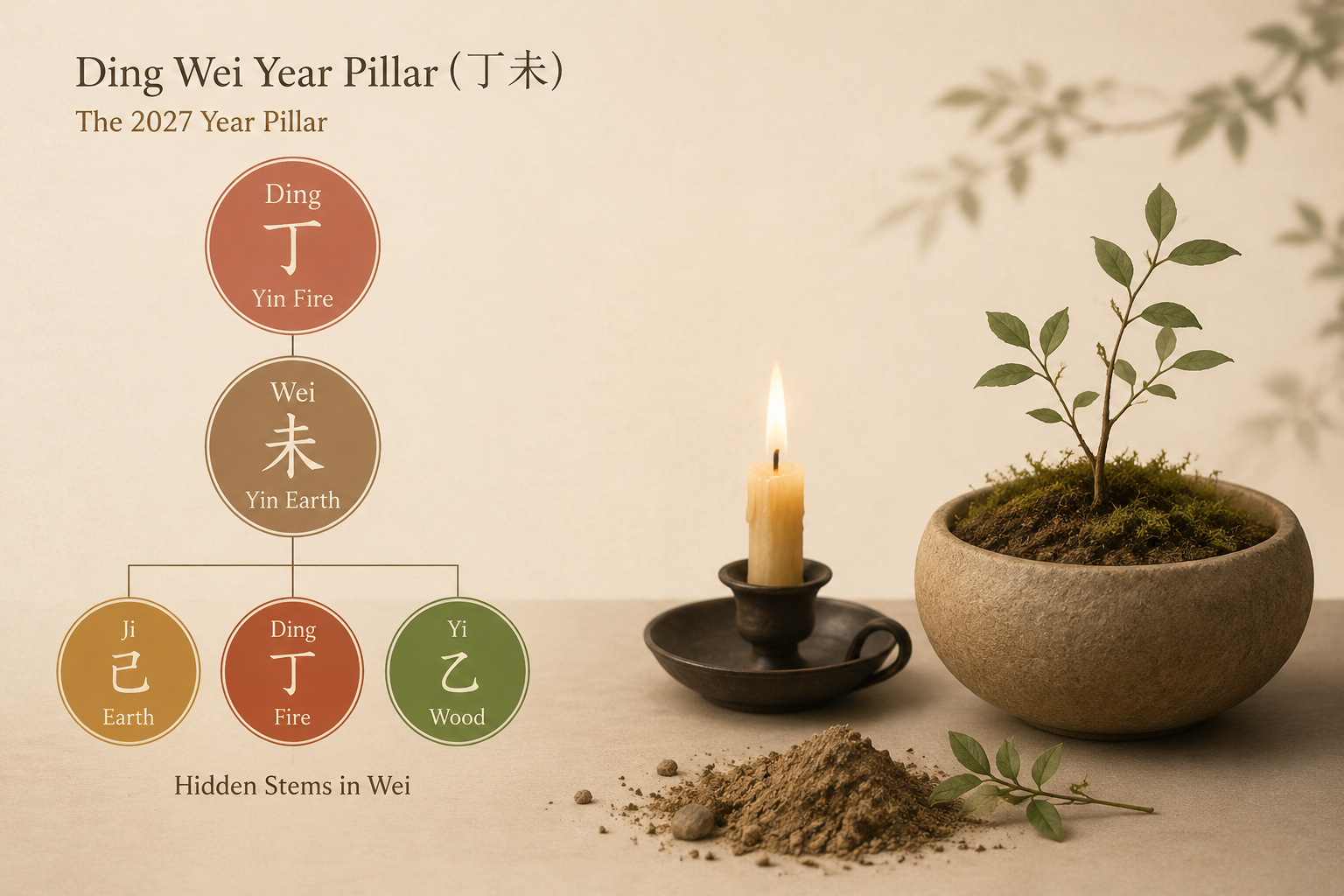
Different BaZi schools may emphasize different parts of the branch, but for a general 2027 八字流年 reading, the main image is one of contained warmth moving toward grounded expression. If that sounds abstract, it is because BaZi is symbolic. The method works by comparing symbols, not by claiming that every Goat year is identical.
How to Read 2027 八字流年 in Your Own Chart
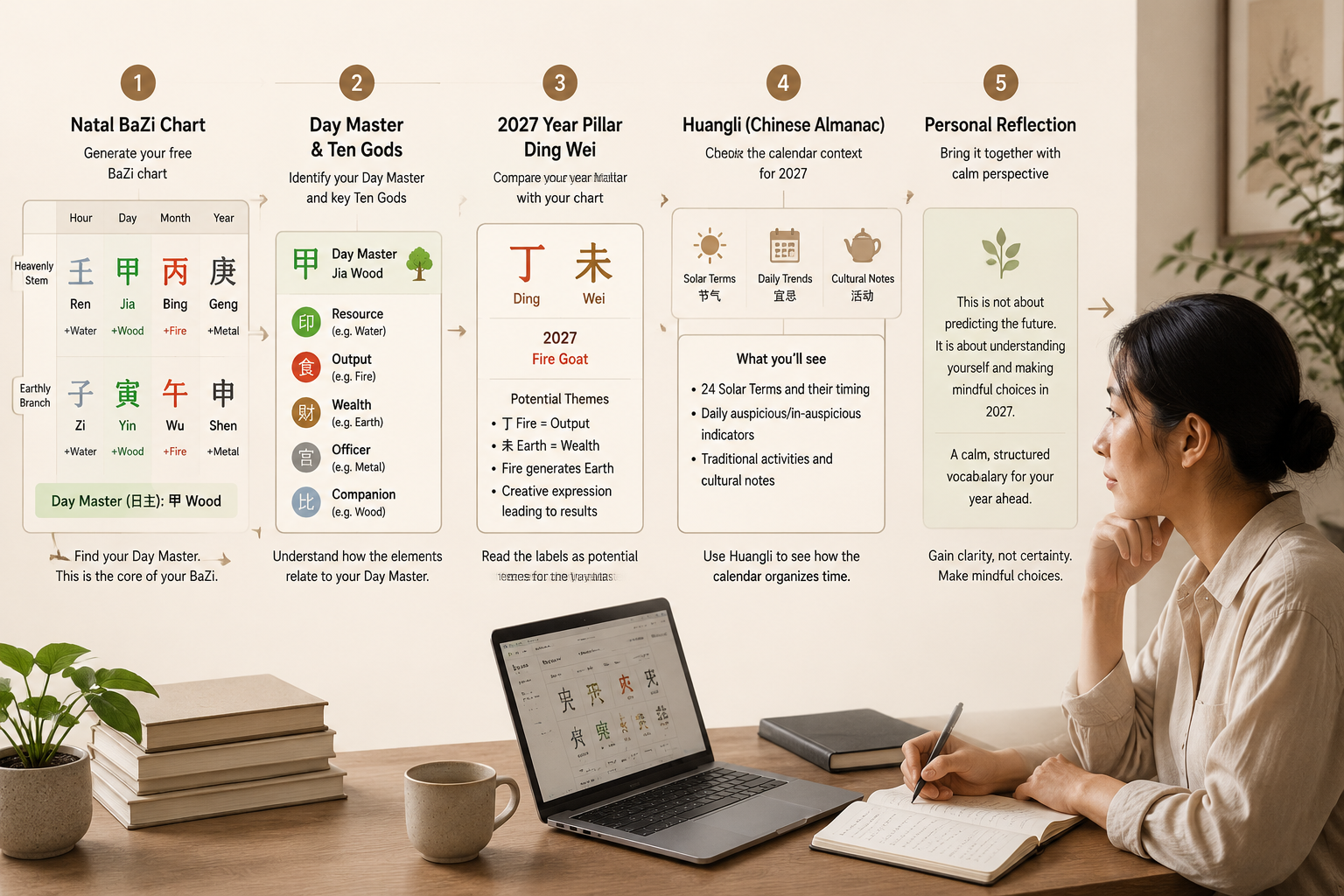
You can approach 2027 八字流年 through a simple series of comparisons. These steps are designed for anyone who already has a BaZi chart or can generate one easily.
Step 1: Confirm your natal chart and the 2027 year pillar
The first step is to have the right data. Use the Free BaZi chart, enter your birth information, and read the year, month, day, and hour pillars. The chart will normally show the Ten Gods and Five Elements relationships automatically. For 2027, you can mentally add the year pillar Ding Wei on top of your natal chart.
Step 2: Find your Day Master
The Day Master is the Heavenly Stem in the Day Pillar. In BaZi, it represents the person in the reading. Some charts label it clearly; on Free BaZi, it is the center of the structured output. Your Day Master might be a wood, fire, earth, metal, or water stem. Make a note of its element and yin or yang quality.
Step 3: Compare the year stem Ding with your Day Master
The Ten Gods system is one of the most practical reading paths in BaZi. It classifies the relationship between the Day Master and every other stem in the chart. For 2027, the year stem Ding Fire will produce one of the Ten Gods depending on your Day Master.
For example:
- If your Day Master is Geng Yang Metal, Ding Yin Fire is the Direct Officer (正官) in the classic Ten Gods framework. This is often associated with structure, responsibility, rules, and calm authority.
- If your Day Master is Ren Yang Water, Ding Yin Fire is the Direct Wealth (正财). This is often associated with resources, practical results, earned assets, and careful planning.
You do not need to memorize the whole Ten Gods table. The important point is that the same Ding stem is not "good" or "bad." It takes on a different role in each chart.
Step 4: Look at the year branch Wei and its interactions
The Earthly Branch Wei can form several interaction patterns with the branches in your natal chart. Traditional BaZi vocabulary includes combinations, clashes, harm, and punishment. For a 2027 八字流年 reading, you can simply ask whether Wei touches any of your natal branches. For instance, if your month or day branch is Chou, the Wei-Chou relationship is a direct opposition in the standard Earthly Branch pairings. That does not mean the year will be difficult in every area. It means that the themes represented by those branches may require more attention.
If you prefer a beginner-friendly approach, do not try to remember every interaction. Look for the branch labels and note any special relationships shown by your tool. Free BaZi does this for you in a structured way, so you can focus on reflection instead of memorization.
Step 5: Place the year inside your current Luck Pillar
A natal chart also has ten-year Luck Pillars. These describe longer cycles of resource, output, authority, and other themes. The 2027 Liu Nian does not replace a Luck Pillar; it is read inside it. The same Ding Wei year may appear intense in one Luck Pillar and supportive in another. This is why the same calendar year can be useful for one person and less relevant to someone else.
The Limits of Any 2027 八字流年 Reading
It is easy to expect a year pillar to behave like a list of events. But BaZi is not built that way. A chart does not contain a script for marriage, money, or travel. It contains a set of inherited and situational themes that interact with personal choices, local conditions, health, and chance.
Therefore, a mature 2027 八字流年 reading should include space for uncertainty. Saying that Ding Fire is the Direct Officer for a Geng Metal Day Master is a structural observation. Saying that person will definitely be promoted is a different kind of claim, and it is not supportable from the method alone. Responsible BaZi writers and tools present the structure and leave the outcome open.
How to Use Free BaZi Tools to Explore 2027
You can explore 2027 八字流年 without being a professional BaZi reader. Start by generating your natal chart with the Free BaZi chart. Once you see your Day Master and Ten Gods, compare them with the Ding Wei year pillar and read the labels as potential themes. If you want to connect the reading to the wider Chinese calendar, open the Huangli and check the solar terms, daily trends, and cultural activity notes. The Huangli is not a magic schedule; it is an almanac that helps you see how the calendar organizes time.
When you use these tools together, the purpose is not to make the future certain. It is to give you a calm, structured vocabulary for thinking about the year ahead. That is the value of reading Bazi as a cultural reference.
Frequently Asked Questions About 2027 八字流年
Is 2027 Ding Wei the same for everyone?
No. The year pillar is the same for everyone, but its meaning depends on the rest of the natal chart. A person with a Fire-heavy chart will relate to Ding Fire differently than a person with a Metal Day Master. Even the Wei branch can interact with different natal branches in different ways.
Can 八字流年 tell me whether I will get a job, marry, or move?
No. BaZi does not generate precise event predictions based on the year pillar alone. It can point to themes such as responsibility, resources, transition, or structure, but actual decisions and circumstances matter. A job offer, a relationship change, or a move is never guaranteed by a chart.
When does 2027 begin in BaZi?
In BaZi, the new year starts at Li Chun, the first solar term, which is usually around February 4. This is different from the lunar Chinese New Year date in some years. If you are comparing your BaZi year with the zodiac animal year, you may already be familiar with this distinction.
What if my natal branch clashes with Wei?
A clash is an interaction category, not a verdict. In practical reading, you look at the element strengths, the Ten Gods, and the broader Luck Pillar context before drawing any conclusion. A clash can highlight tension or movement, but it does not define the entire year.
How should I use 2027 八字流年 in my personal planning?
The most useful way is to treat it as a reflective lens. Ask what role Ding Fire plays in your chart, what themes Wei Earth touches, and how you might respond with more patience or care. Use the Free BaZi chart, check the Huangli when timing matters, and let the reading support your judgment rather than replace it.
2027 八字流年 is a useful map, not a fate. With the right method, it can help you see the year more clearly while respecting the uncertainty of real life.